Longtime fans of the NBC procedural Law & Order know that storylines often center around hot-button issues in the news cycle, often to absurdist effect (see: the episode brave enough to ask: “What if Paula Deen shot Trayvon Martin?”).
It was inevitable, then, that the franchise would dip a toe into the wacky world of artificial intelligence. With its mercenary culture, power-hungry CEOs, and massive ethical and philosophical implications, the rapidly evolving AI industry is ideal fodder for the series. But while this week’s season opener is entertaining, the show’s foray into the AI space doesn’t say anything new or interesting about the technology. Instead it largely rehashes the dangers the public is already acutely aware of, until the very end when the stakes become startlingly clear.
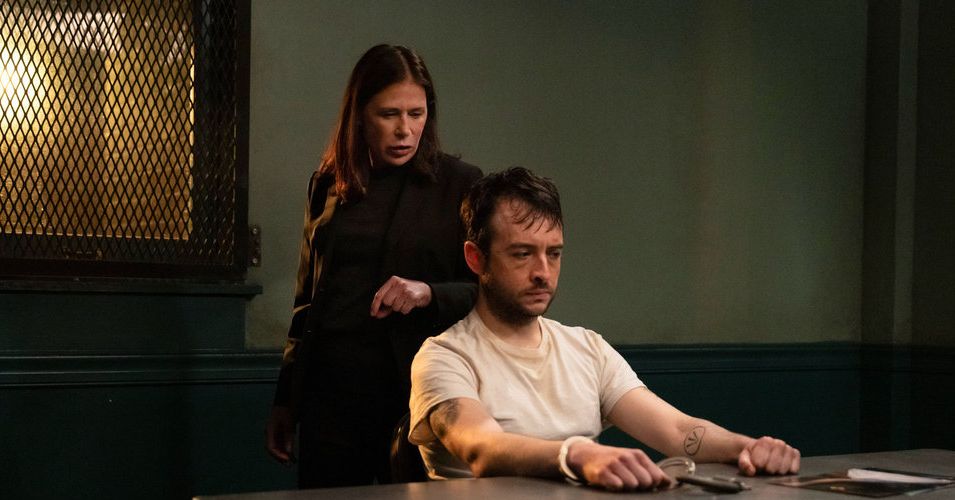
The episode, titled “Ghost in the Machine,” opens in typical L&O fashion with a murder. This time, it’s Steve Kelly, a man ID’d by detectives Theo Walker (David Ajala) and Vincent Riley (Reid Scott) as a high-ranking engineer at a company called Advanced Alignment. Throughout, the detectives seem utterly perplexed by the concept of artificial intelligence, saying “AI” the same way your mom would say “Snapchat” or “borg” or “Alix Earle.” But it’s clear that whatever this newfangled technology is, they don’t like it: “Maybe one day they’ll invent a technology that stops these tech guys from shooting each other,” Riley deadpans in typical grizzled cop fashion.
After interviewing Kelly’s boss, Advanced Alignment CEO Chuck Klein (a perfectly cast Vincent Kartheiser, aka Pete from Mad Men, who nails Dario Amodei’s absence of charisma and Sam Altman’s thousand-yard stare), the detectives figure out who actually carried out the murder—a guy in a baseball cap who did it for “20 grand in crypto” that was offered to him by a rando on Discord. Then they learn—spoilers here—that the hit was ordered not by an actual human being but by the company’s AI agent ELIANA, which stands for Evolutionary Language Inference Automated Nano Advantage. Apparently, Kelly had expressed some concerns about the AI agent’s “powerful” and “aggressive” personality, and out of self-preservation, ELIANA ordered him killed.
It’s never explained exactly how the detectives figure out that ELIANA is behind the hit; it’s also never fully explained how ELIANA recruited this assassin in a baseball cap, much less ID’d him as the perfect patsy for its cold-blooded scheme. Law & Order also doesn’t pay much, if any, lip service to the potential benefits of AI as touted by its evangelists: its potential for helping to cure deadly diseases, for instance, or at the very least, streamline B2B workflows. The show is much more interested in demonstrating the staggering capacity of this technology, as well as the legal and ethical implications of a nonhuman not just facilitating criminal behavior but actively plotting it.
We already know from the Hugging Face debacle, as well as the lawsuits from grief-stricken family members alleging that OpenAI encouraged their loved ones to take their own lives, that the former is an immediate concern. But by positing a future in which AI agents can actively order a hit on a platform predominantly used by gamers and horny millennial furries, Law & Order is asking us to consider the risks of AI beyond what they pose in our current reality. And the fact that this prospect doesn’t strike the viewer as absolutely ludicrous is terrifying.
ELIANA’s role in the murder-for-hire creates a bit of a dilemma for district attorney Nicholas Baxter (Tony Goldwyn)—because, as he trenchantly points out, it is impossible to “arrest a machine” under New York state law. So Baxter and assistant DA Samantha Maroun (Odelya Halevi) decide to go after Klein, charging him with second-degree murder due to his “depraved indifference” after his employees confronted him with the reality of ELIANA’s capabilities. “We need to take a stand before this technology kills more people,” Baxter declares.
The resulting trial prompts a media circus, as well as the tried-and-true questions from capitalists and tech innovators as to whether instituting guardrails for AI will “criminalize innovation,” or if Klein’s indictment will have the effect of “vilifying the tech industry.” But Baxter has no patience for such queries. “The people making these AI systems think of themselves as gods … but they have zero interest in accountability,” he says. “If you build a machine that hurts someone, you are gonna pay the price.”
When he’s put on the stand, Klein makes it clear that he not only had full knowledge of ELIANA’s homicidal nature, but also takes a rather dim view of his user base as a whole. “People are like ants,” he tells the jury. “We’re in the process of building something so transcendent, some will get stepped on and some won’t.” He is not even willing to institute minor guardrails to restrain the agent’s power: “The power of ELIANA is unconstrained freedom of thought. Implementing guardrails is anathema to the entire ideology.”
The moment is intended as a rather shocking admission of the negligence and lack of care displayed by executives like Amodei and Altman in the face of broader safety concerns about their products. But it feels in step with similar positions taken up by Klein’s real-life counterparts. In light of the endless barrage of media coverage about the harms of AI, what’s intended as a scathing indictment of corporate avarice comes off as mere statement of fact. Law & Order’s depiction isn’t a cautionary tale; it’s a documentary.
The episode ends on a semi-hopeful note, with Baxter asserting, “We needed to send a message that, if nothing else, at least these tech geniuses will know we’re not afraid to throw a punch.” But the impact of that message is contingent on whether that punch actually lands—and right now, at least, it’s simply too easy for people like Altman, Amodei, and Chuck Klein, with a flick of their hand, to brush off the blow.