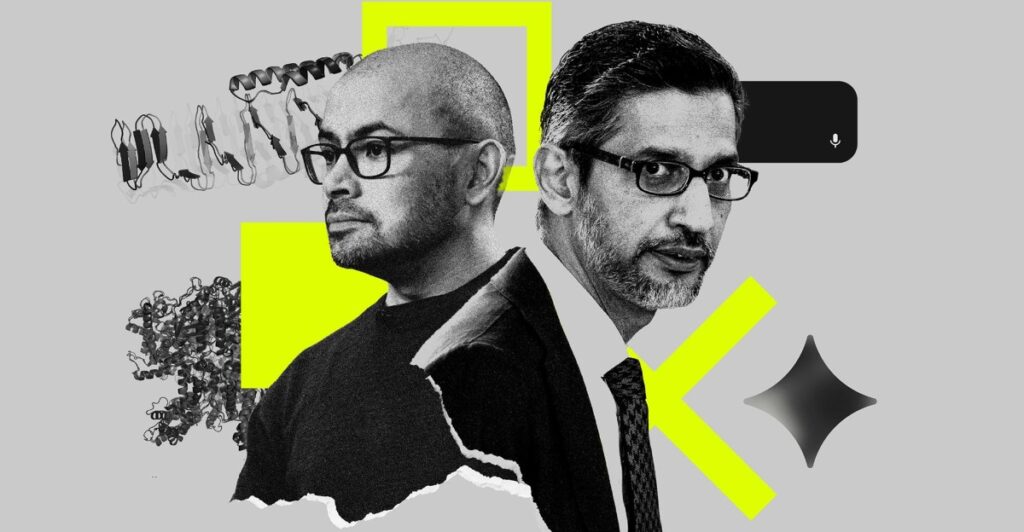
Google announced last week that Jeff Dean, its chief scientist, is leaving to launch a new startup, while Demis Hassabis, the co-founder of DeepMind, is stepping down as CEO to become chairman.
These moves follow a period where the tech industry has been asking whether Google is losing its grip on artificial intelligence. The company, once viewed as the natural winner due to its search dominance and resources, now faces a narrative of falling behind in frontier research.
Why the panic?
Google remains the best-positioned company to win the AI race. It controls the tools, the data, and the distribution channels to put AI in front of billions of users. Yet, observers note that Google is not currently competitive at the frontier of model development.
Hayden Field, The Verge’s senior AI reporter, suggests that while the situation is bad, Google’s position is not hopeless. The company has a massive safety net built on its existing products. Even if it makes mistakes or falls behind temporarily, its integration capabilities and data ownership provide a huge cushion that prevents a total exit from the market.
However, the focus has shifted. While consumer AI has not yet generated significant revenue, it is seen as the ultimate prize. Meanwhile, enterprise AI is where the immediate action lies. Competitors like Anthropic have gained a significant lead by focusing on enterprise use cases, particularly in coding.
A shift in strategy?
Questions remain about whether Google made the wrong bet on multimodal world models, an area Demis Hassabis has championed, instead of prioritising core enterprise applications. There is also speculation that Google may not want to lead the frontier research but instead wants to sell cloud services to companies like Anthropic.
Sundar Pichai, Google’s CEO, addressed this three months ago. He stated that the company had pivoted to be AI-first and needed a central infrastructure team to power everything. He described the challenge of merging world-class research teams from Google Brain and DeepMind as difficult, comparing it to merging Stanford and MIT.
Despite these assurances, the executive shakeup continues. The head of Google Brain is leaving, and the head of DeepMind is moving to a role focused on longer-term research rather than daily operations. DeepMind no longer has a CEO; it now has an SVP.
Field notes that Hassabis has never been interested in productisation, preferring to focus on world models and scientific breakthroughs like curing disease. This makes the departure of Jeff Dean and the restructuring logical from a personnel perspective. However, the uncertainty creates friction. Executive changes often lead to nervousness among staff, causing people to leave or work less effectively.
The state of the models
The controversy extends to Gemini 4, which was announced at Google I/O. The company emphasised models in the 3.5 class, which are currently not at the top of the leaderboards and have fallen behind competitors. This raises the question of whether the departures signal a lack of commitment to the frontier or simply a logistical reset.
Field points to analysis from SemiAnalysis, an investment research firm, which argued that the recent actions were not those of people excited about Gemini 4 Pro. The firm stated that for all intents and purposes, DeepMind is no longer a frontier lab. They noted that Google’s odds of reaching the state of the art again have dropped to zero.
While Field believes DeepMind still holds that designation, she acknowledges the situation could change quickly. There is a risk Google could follow the path of Meta or Apple, where they promise future delivery but take too long to execute, eventually falling significantly behind.
What it means
For the people making things, the implication is a period of instability. The departure of key figures like Jeff Dean and the shift in leadership at DeepMind suggests that the era of rapid, unified direction at Google may be ending. Teams that relied on these leaders for momentum now face uncertainty about their projects and future roles. The company’s ability to innovate at the cutting edge depends on whether it can stabilise its research teams before further talent drains away.