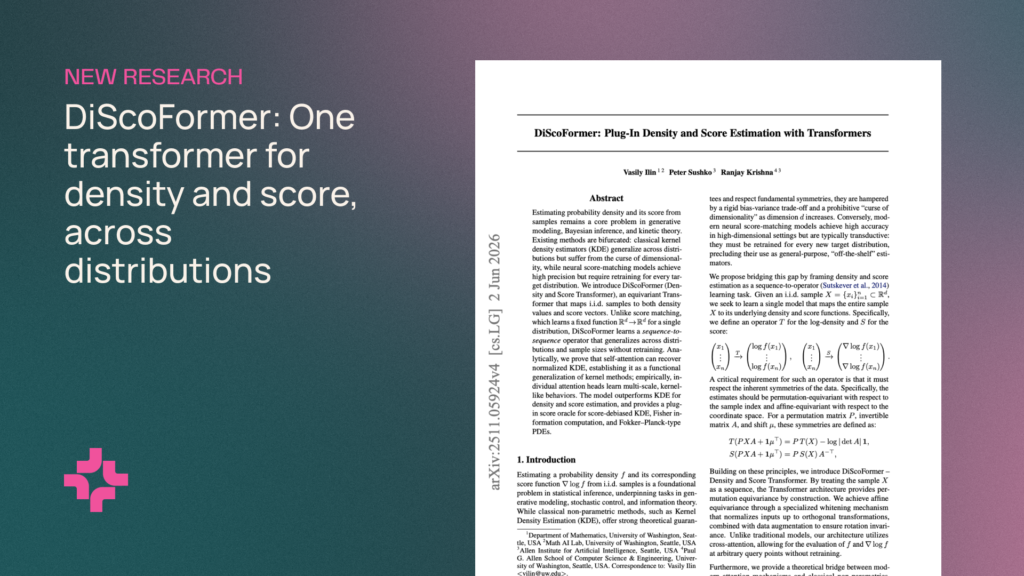
Researchers from Allen Institute for AI have released DiScoFormer, a single transformer model that estimates both density and score for data distributions without requiring retraining.
The core problem
Many tasks in machine learning and science involve recovering the distribution from which a set of data points originated. This means identifying which values appear frequently and which are rare. Estimating this distribution relies on two metrics: density and score.
Density acts as a smooth version of a histogram, showing high values where points cluster and low values where they are scarce. Score represents the gradient of the log-density, pointing in the direction where density rises most quickly. Moving a point along the score vector directs it toward a more probable region.
Diffusion-based generative models, such as Stable Diffusion and DALL-E, start with random noise and repeatedly follow the score to generate realistic images. The same score drives Bayesian sampling and particle simulations used to model systems like plasma.
Extracting density and score from a finite sample is difficult. Current tools force a trade-off between generalisability and accuracy. Kernel density estimation (KDE) calculates density at any location based on nearby data points. It requires no training and applies to any distribution, but accuracy drops sharply as dimensionality increases. Neural score-matching models predict the score accurately even in high dimensions, yet each requires retraining from scratch for a new distribution.
A unified approach
DiScoFormer takes a different path. Given a set of data points, it estimates both density and score in a single forward pass without retraining.
The model maps an entire sample to the underlying distribution using stacked layers of transformer blocks. It uses cross-attention to evaluate density and score at any point, not just where data exists. Score and density share a mathematical relationship: score is the gradient of the logarithm of density. The architecture uses a shared backbone with two output heads, one for density and one for score.
This coupling reduces parameters and improves adaptability. The score head must match the gradient of the log-density head at every query. Any gap between them creates a label-free consistency loss. The system uses this at inference by holding the context fixed and taking gradient steps on the loss. DiScoFormer adapts itself to out-of-distribution inputs on the spot without needing ground-truth density or score.
A mathematical reason supports the choice of transformer architecture. KDE uses a single bandwidth, a fixed distance that determines how far each point’s influence reaches. Attention is a generalisation of this concept. The authors show analytically that a single attention head’s weights act nearly like a Gaussian kernel over the data. One cross-attention block can reproduce KDE’s density and score. The model goes further by learning several scales at once and adapting them to the data. DiScoFormer includes KDE as a special case and improves on it.
Training data
The team trained DiScoFormer using Gaussian Mixture Models (GMMs). GMMs serve as universal density approximators; with enough components, they match essentially any smooth distribution to arbitrarily small error. They also have closed-form densities and scores, providing an exact target for supervision.
For every batch, the researchers draw a new GMM. This gives the model virtually unlimited examples of target distributions, supervising each against a given GMM’s exact density and score.
Performance results
DiScoFormer outperforms KDE at both density and score estimation across the board. The gap widens where KDE struggles. In 100 dimensions, the new model cuts score error by about 6.5x against the best hand-tuned KDE. Density error drops by more than 37x. Accuracy improves as samples are added, whereas KDE runs out of memory. The model also performs well outside its training data, remaining accurate on mixtures with more modes than seen during training and on non-Gaussian shapes like the Laplace and Student-t distributions. KDE retains a speed advantage, especially with small datasets.
The authors note that score estimation is a shared dependency across generative modeling, Bayesian inference, and scientific computing. A pretrained, plug-in estimator that stays accurate in high dimensions could remove the need to retrain for every problem. One model reused everywhere score and density appear would cut costs across all these fields.
What it means
Users of generative models or scientific simulations no longer need to train a separate neural network for every new dataset. The same architecture handles density and score estimation for diverse distributions, from standard Gaussians to complex, high-dimensional mixtures. This removes the recurring cost of model retraining while maintaining accuracy where traditional methods fail.