Destro, a startup that emerged from stealth on Tuesday with an $8 million seed round, argues that the most effective way to deploy a robot is not to build one.
While many robotics firms focus on form factors or AI models to control metal hands, Destro has constructed an intelligence layer designed for logistics. This system directs both robots and human workers to perform tasks efficiently.
Manthan Pawar, the founder and a veteran of the industry, told TechCrunch that many competitors start by asking engineers what cool things they can build. “One of the biggest reasons we are winning against robotics companies is because we are not a robotics company,” he said.
Pawar holds a master’s degree in robotics from NYU Tandon and spent roughly eight years in the US supply chain sector. He explained that the team understands customer problems deeply and is on course to be cash flow positive by the end of this year.
Richard Brunelle, director of automation for the American logistics group at Yusen Logistics, helped steer the startup. Yusen, a South Korean shipping giant, operates about 30 facilities in the US using fixed automation like conveyors and sorters, while piloting trailer-unloading robots and autonomous floor scrubbers.
Brunelle’s priority is finding ways to apply such technology. The company’s UK subsidiary has built a fully autonomous facility, and a similar plan is underway in the US. When Brunelle met Pawar, Destro was focused on picking and packing, the process of sorting goods into single packages.
Brunelle realised his primary challenge was fundamentally the same problem. His job involves cross-docking: unloading goods from one truck and sorting them into mixed loads for other trucks heading to customers.
“I asked whether Destro would be willing to adapt their solution to fit that cross-dock environment, because I don’t think anyone was doing that,” Brunelle told TechCrunch. “They went away, thought it through, and came back excited. They agreed nobody was addressing that space and that they could modify their tool to support it. Since then, they’ve gone all in.”
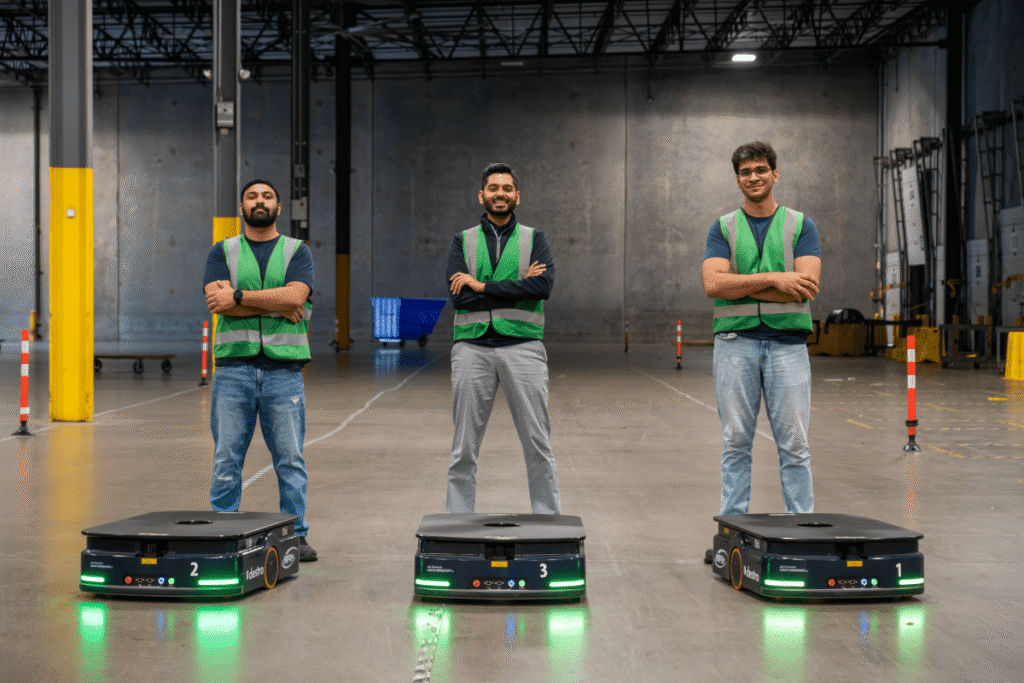
The initial pilot took place at one Yusen facility in the Pacific northwest. It used three cart-moving robots built by Miva Robotics and operated by Destro’s Vision operating system. This system relies on open-weight vision-language-action models, which interpret camera images and instructions to control robot movements.
As human workers unload goods from one truck into different carts, the robots identify full loads and transport them to their destinations. Brunelle and Pawar estimate the efficiency comes from the fact that the human, the cart, and the trucks are all directed by Destro’s Mothership operating system.
“We make that operation less labor intensive, and we get away from the paper,” Brunelle said. “Everything is now systematic.”
Yusen also consulted with two other major robot startups in this space, but neither could fit into their workflow. One offered a robot that could move carts point-to-point but could not manage loading or unloading. The other provided fleet management tools but required a person to handle all the orchestration. Destro won because of its ability to apply autonomous direction to the whole process.
Destro is now expanding its initial pilot to a full deployment of 26 robots and launching another pilot with 17 robots at Yusen’s facility in Southern California. Pawar plans to take this cross-dock loading workflow and replicate it across thousands of other warehouses handling similar labour.
That plan convinced Base10 Partners and Bonfire Ventures to lead the seed round, with additional investment from CoFound Partners.
Destro may face challenges with workflows requiring more dexterity and manipulation. Generic robot bodies and open-source models have not yet proven capable of these tasks, and it is unclear if companies building foundation models, ultra-dexterous hands, or general-purpose humanoids will make those tools available to a company like Destro rather than capturing the business themselves.
Pawar remains confident he has found the part of the stack where value will accrue and that his company can take advantage of research dollars pouring into new AI models and robot components.
“Robots are a platform. Every layer model is a platform. But we build a harness around it,” Pawar told TechCrunch. “That harness is just so complex and value-added that without that harness, these workflows are completely impossible, right?”
For now, competing with futuristic robot-builders is probably not an issue. Brunelle says he has yet to find a good use case for a bipedal humanoid robot, though he is evaluating a potential pilot with a wheeled humanoid.
“At the end of the day, we’re not putting automation into a building just because the technology is interesting,” Brunelle said. “It must solve a real operational problem. If it can make the operation more efficient, consistent, and flexible, that’s ultimately going to benefit our customers.”
What it means
Workers on the floor will see fewer instructions on paper and more systematic direction from the system. The robots handle the heavy lifting of moving full carts, while humans manage the finer details of sorting. The goal is to make the operation consistent and flexible without replacing the people who know the workflow best.