LFM2.5-2.6B runs agent workloads on phones and laptops
This 2.6-billion parameter model competes with models four times its size on tool use, instruction following, and multi-step tasks. It runs at 220 tokens per second on an Apple M5 Max and 113 tokens per second on an AMD Ryzen CPU, using under 2.5 GB of memory.
Training a model for edge devices
The team pre-trained LFM2.5-2.6B on approximately 34 trillion tokens. They extended the context window to 128,000 tokens during mid-training. Post-training then converted the base model into an agent through four stages:
- Supervised fine-tuning (SFT): two rounds of SFT, weighted heavily toward agentic data like tool use, web search, and harness trajectories.
- Teacher specialization: train one specialist teacher per domain (math, code, tool use, and more).
- Multi-domain on-policy distillation (MOPD): distill the specialist teachers into a single student.
- Agentic Reinforcement Learning (Agentic RL): run multi-turn RL inside real agent harnesses, where the model learns to work across different tools, system prompts, and multi-turn task environments.
The Agentic RL pipeline separates model optimization, inference, and environment execution into distinct components. The Training Engine optimizes the model, while the Rollout Engine generates actions using the latest policy. The RL framework orchestrates the training loop by launching rollouts, collecting trajectories and rewards, and updating the model.
Actions are executed within a Sandbox Service, where the Blackbox Harness hosts the agent (e.g., OpenClaw or Hermes Agent) and coordinates interactions with the task environment. The Harness Proxy lets us treat agentic harnesses as black boxes with no modification, while transparently capturing the token-level trajectories needed to reconstruct and validate RL training samples.
Benchmark results
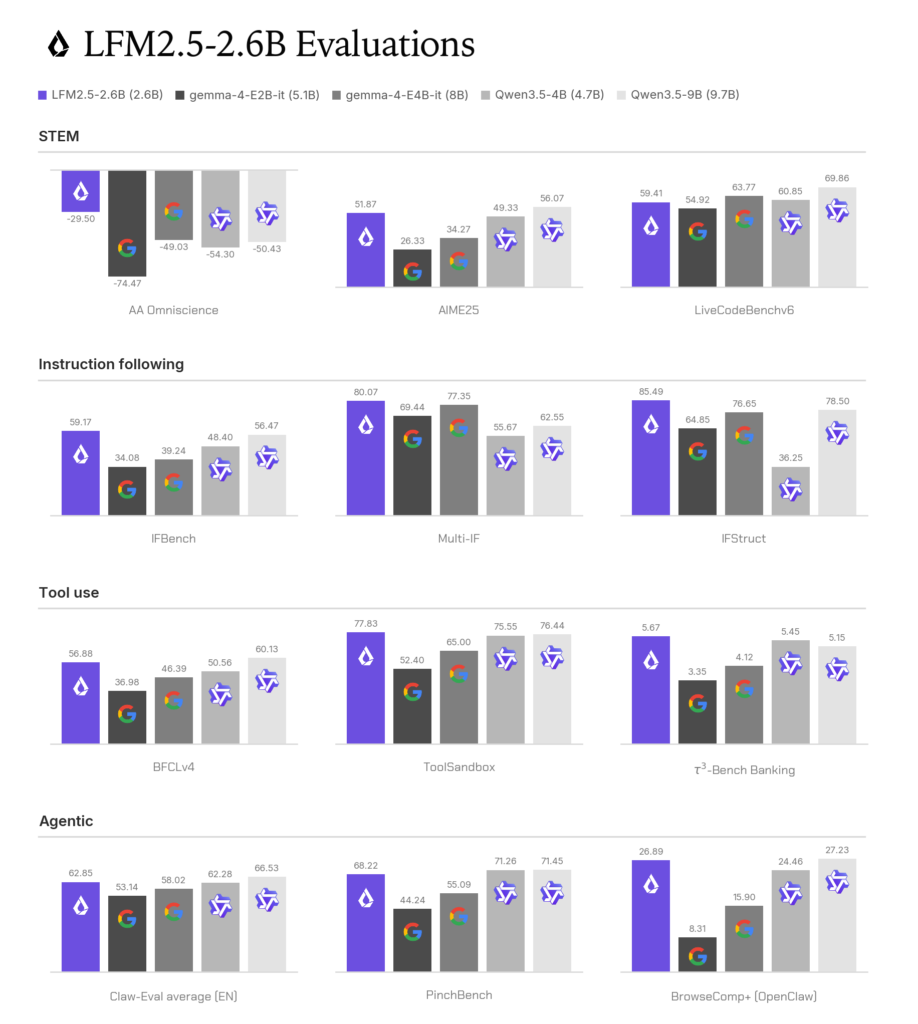
LFM2.5-2.6B competed against models up to approximately four times its size on STEM, instruction following, tool use, and agentic tasks. It is the smallest model in the group, yet it competes with and often beats the rest.
| Benchmark | LFM2.5-2.6B (2.6B) | gemma-4-E2B-it (5.1B) | gemma-4-E4B-it (8B) | Qwen3.5-4B (4.7B) | Qwen3.5-9B (9.7B) |
|---|---|---|---|---|---|
| AA Omniscience | -29.50 | -74.47 | -49.03 | -54.30 | -50.43 |
| AIME25 | 51.87 | 26.33 | 34.27 | 49.33 | 56.07 |
| LiveCodeBenchv6 | 59.41 | 54.92 | 63.77 | 60.85 | 69.86 |
| IFBench | 59.17 | 34.08 | 39.24 | 48.40 | 56.47 |
| Multi-IF | 80.07 | 69.44 | 77.35 | 55.67 | 62.55 |
| IFStruct | 85.49 | 64.85 | 76.65 | 36.25 | 78.50 |
| BFCLv4 | 56.88 | 36.98 | 46.39 | 50.56 | 60.13 |
| ToolSandbox | 77.83 | 52.40 | 65.00 | 75.55 | 76.44 |
| τ³-Bench Banking | 5.67 | 3.35 | 4.12 | 5.45 | 5.15 |
| Claw-Eval average (EN) | 62.85 | 53.14 | 58.02 | 62.28 | 66.53 |
| PinchBench | 68.22 | 44.24 | 55.09 | 71.26 | 71.45 |
| BrowseComp+ (OpenClaw) | 26.89 | 8.31 | 15.90 | 24.46 | 27.23 |
For your app, the strengths are instruction following and tool use. LFM2.5-2.6B tops every instruction-following benchmark here, and every tool-use benchmark except BFCLv4, where only the 9.7B Qwen edges ahead. On agentic tasks, it beats both Gemma models and stays even with the Qwens. It also leads on knowledge and stays close on math. Coding is the one place the larger models keep a clear lead, so reach for something bigger there.
Inference speed on CPU and GPU
LFM2.5-2.6B ships with day-one support across the inference ecosystem, including llama.cpp, MLX, vLLM, SGLang, and ONNX.
CPU inference. Due to its efficient LFM2 architecture, LFM2.5-2.6B is the fastest model we tested, with decode speeds of 220 tokens/s on an M5 Max and 113 tokens/s on a Ryzen AI Max+ 395. At 30 tokens/s, it allows you to run capable agents even on a phone.
GPU inference. LFM2.5-2.6B is the fastest model in its size class, reaching almost 15K output tokens per second at high concurrency, roughly 1.3B tokens per day on a single H100.
How to use LFM2.5-2.6B
Reach for LFM2.5-2.6B when you need on-device agents for high-volume workloads.
Install the latest version of
transformers
(compatible with
transformers>=5.0.0
):
pip install -U transformersThen load and run the model:
from transformers import AutoModelForCausalLM, AutoTokenizer model_id = "LiquidAI/LFM2.5-2.6B" model = AutoModelForCausalLM.from_pretrained( model_id, device_map="auto", dtype="bfloat16", # attn_implementation="flash_attention_2" # uncomment on a compatible GPU ) tokenizer = AutoTokenizer.from_pretrained(model_id) prompt = "What is C. elegans?" input_ids = tokenizer.apply_chat_template( [{"role": "user", "content": prompt}], add_generation_prompt=True, return_tensors="pt", tokenize=True, ).to(model.device) output = model.generate( input_ids, do_sample=True, temperature=0.2, top_k=80, repetition_penalty=1.05, max_new_tokens=512, ) print(tokenizer.decode(output[0], skip_special_tokens=False))LFM2.5-2.6B demo
Check out this browser demo of LFM2.5-2.6B powering a research agent. The agent helps you research specific questions and generates a summary.
Get Started
Both LFM2.5-2.6B and LFM2.5-2.6B-Base are available on Hugging Face today.
With LFM2.5, we’re delivering on our vision of AI that runs anywhere. These models are:
- Download: LFM2.5-2.6B-Base and LFM2.5-2.6B on Hugging Face.
- Try: run the WebGPU demo in your browser, no setup needed.
- Use in your harness: follow our guide on how to run a local agent, like OpenClaw, Hermes Agent, and Pi.
Citation
Please cite this article as:
Liquid AI, "LFM2.5-2.6B: Deploy Agents Everywhere", Liquid AI Blog, Aug 2026.Or use the BibTeX citation:
@article{liquidAI202626B, author = {Liquid AI}, title = {LFM2.5-2.6B: Deploy Agents Everywhere}, journal = {Liquid AI Blog}, year = {2026}, note = {www.liquid.ai/blog/lfm2-5-2-6b}, }
Source Read original →