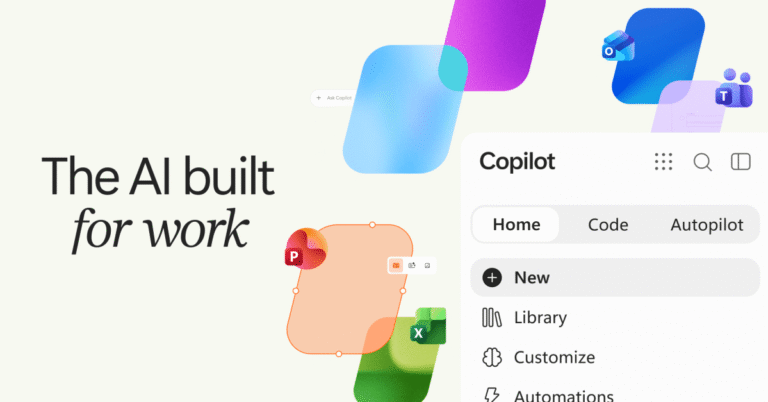
Microsoft is replacing AI models from OpenAI and Anthropic with its own in-house versions across several Copilot products, including Excel and Outlook.
These internal MAI models are already handling tens of thousands of requests per week in those apps, according to Bloomberg. Both applications previously relied more heavily on external systems.
The in-house models currently process only a small fraction of total traffic. Microsoft wants to keep reducing spending on third-party AI over time. The MAI models are also available in GitHub Copilot, and a proprietary transcription model is expected to ship in Teams soon.
At the Build conference, Microsoft unveiled seven new AI models, including MAI-Thinking 1, its first reasoning model. Microsoft claimed it could match Sonnet 4.6 and Opus 4.6 in coding based on human evaluations. But the benchmarks released at the time told a different story, with Thinking-1 trailing the competition from OpenAI and Anthropic by a wide margin and landing roughly on par with Deepseek V3.2.
Customers may get less capable AI for the same price
For Copilot and Office customers, this could mean paying the same amount for weaker AI so that Microsoft can lower its own costs. Microsoft’s head of AI, Mustafa Suleyman, openly acknowledged this plan in June: “We pay a lot of money to Anthropic—so our goal is to reduce and ultimately eliminate that cost.” This is the same Microsoft that just argued vendor lock-in with OpenAI and Anthropic is a bad thing and that it wants to be a platform-neutral alternative.
Microsoft CEO Satya Nadella also hinted that AI billing could shift further toward usage-based pricing instead of flat-rate subscriptions. One possible setup would make cheaper MAI models the default, with third-party models from OpenAI or Anthropic available as premium add-ons at extra cost. That way, Microsoft would pass its OpenAI and Anthropic expenses on to customers with a surcharge.
Microsoft also claimed that the MAI models are trained on clean, commercially licensed data, making them safe for businesses. But according to the technical paper, Microsoft used the Common Crawl dataset, a collection of freely accessible web data whose use for AI training is not legally settled. Every other AI company does the same thing, but Microsoft portrays its own training data as particularly clean.
What it means
Users of Microsoft tools face a potential drop in capability without a change to their monthly bill. The company plans to route more work to its internal systems to save money, effectively passing the cost of external models back to the customer if they choose to use them. Meanwhile, the performance gap between Microsoft’s new models and top competitors remains significant, despite internal claims of parity.