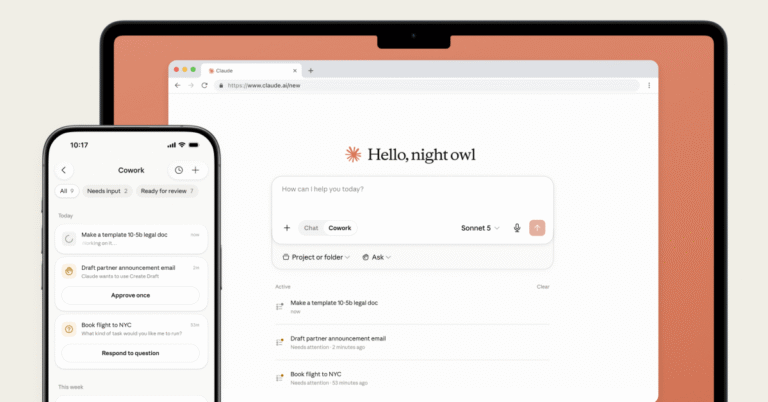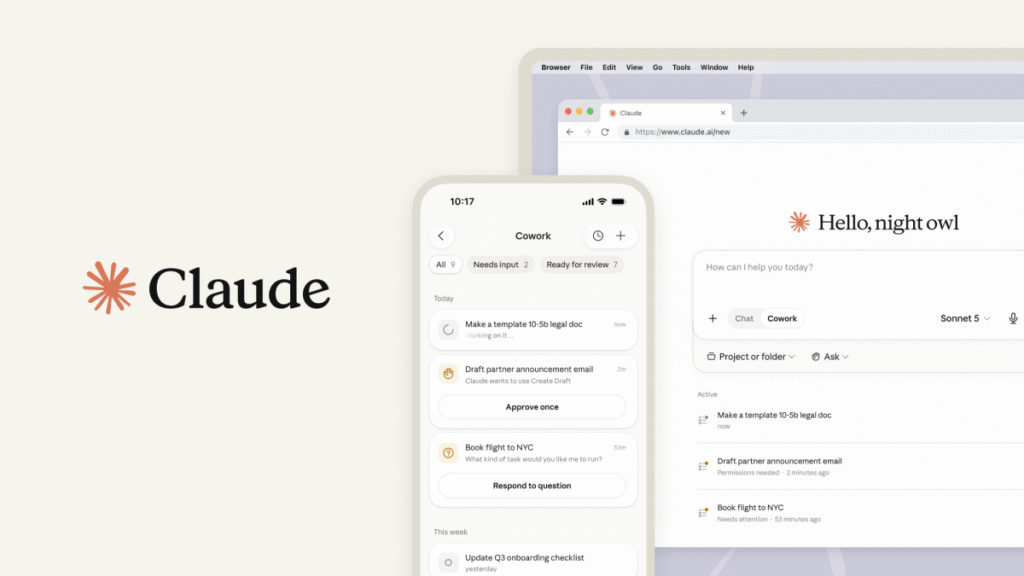
Claude Cowork, Anthropic‘s agent designed for general knowledge work, is now available on mobile and web for Max subscribers. The desktop version launched in January, but the new update allows users to initiate tasks at their desk, monitor progress on their phone, and retrieve completed outputs later, even with their laptop closed.
This expansion signals a shift in Anthropic’s strategy. They want Cowork to function as an administrative partner rather than a coding utility. The agent is designed to operate in the background, move across devices, and pause for human decision-making when required.
The coding agent wars are spilling into the rest of the office.
Software firms are increasingly pushing their products beyond chat interfaces into the everyday surfaces where work happens. OpenAI has made a similar move with Codex. Originally a development tool, it is now used by non-developers for reports, spreadsheets, presentations, research, and data analysis.
Both companies bet that success depends less on the quality of the chatbot and more on ownership of the space where work gets done. Anthropic recently launched Claude Tag, an always-on assistant within Slack. Beyond the specific interface, launching Cowork as a multi-platform app means the agent can continue running tasks in the background without a device being online.
An example from Anthropic reads: “Set Monday’s client prep for 6 am: Claude works through the email threads, transcripts, and recent news, builds the briefing doc, and leaves the follow-up email drafted but unsent. Review it over coffee.”
The desktop app remains the place for deep work, where Claude can access local files and the browser. Bringing Cowork to web and web means people who did not install the app can also use it. Anthropic says chat and Cowork will be unified in web and desktop to start, with projects and artifacts living together across both.
Anthropic also released early Cowork data. The study suggests the clearest use case is the “work around the work” that keeps companies functioning. These are tasks that are part of a broad swath of jobs but are rarely a person’s core responsibility.
The study sampled 1.2 million anonymised and aggregated Cowork sessions from more than 600,000 organisations over the last two weeks of May.
The largest category at 33.4% was business process operating. This included pulling scattered updates into a single report, building onboarding checklists, and reconciling spreadsheets. Anthropic said the tasks are common among roles in finance, HR, and administration.
The next largest category at 16.4% was content creation and copywriting. This covered tasks like drafts, slide decks, social posts, proposals, and other communications work usually performed by marketing and management positions. Software development, by comparison, only accounted for 8.7% of Cowork usage.
“While coding is still — understandably — one of the uses of AI that gets the most attention, the use of AI for everyday business work is on the rise, and the kinds of tasks people are finding it most helpful for are coming into focus,” Anthropic said in a statement. “Our goal is to make this a reference point for people who are figuring out how to integrate AI products into their daily work, and to show where value is most concentrated.”
What it means
People making things will see Cowork act as a persistent background worker rather than a tool they must actively prompt. You can start a task on your computer and finish it on your phone without managing the agent yourself. The agent handles the busy work, leaving the final decision and review for when you are ready.