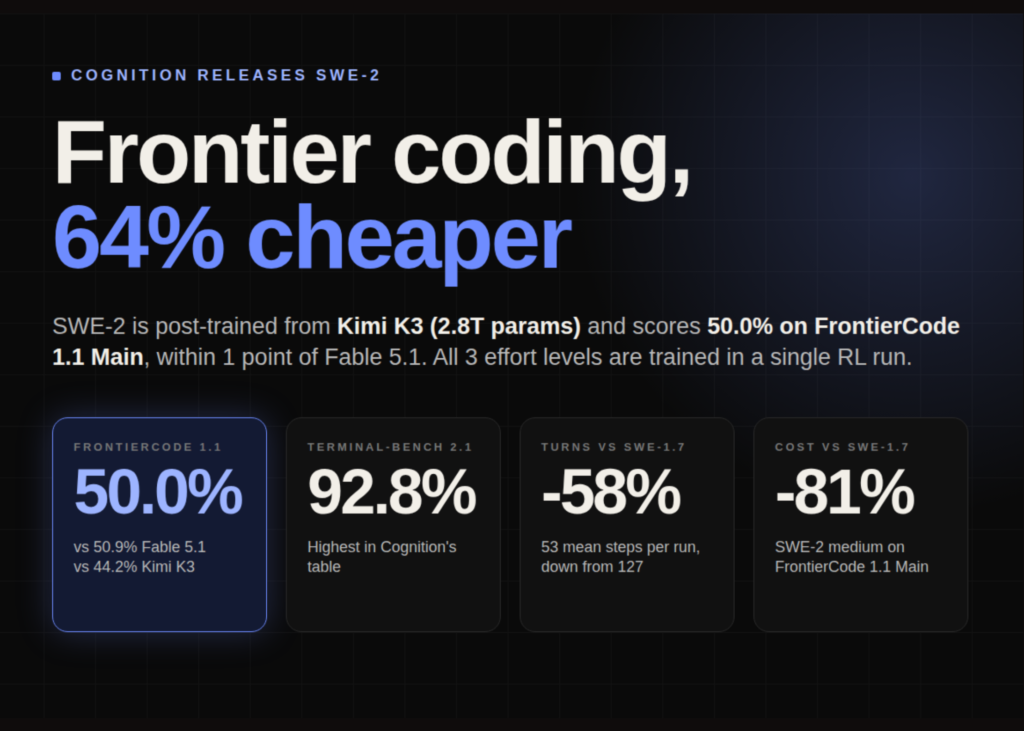
Cognition has released SWE-2, a coding model that scores 50.0% on FrontierCode 1.1 Main, a figure within one point of Fable 5.1 while costing 64% less.
The new tool is post-trained on Kimi K3, the 2.8T-parameter open model from Moonshot AI. It is the first in the company’s line to offer selectable reasoning-effort levels, all trained in a single reinforcement learning run.
Deployment limits
Users cannot run SWE-2 on their own hardware. The model has no open weights and no standalone API. It operates only inside Devin, the company’s coding agent, available via Desktop and CLI. Devin Web and Fusion are scheduled for release later.
Training approach
SWE-2 builds on the infrastructure used for SWE-1.7. That earlier version was post-trained from Kimi K2.7. This time, Cognition scaled reinforcement learning to the multi-trillion-parameter regime using a base model with almost three times the parameters.
The company states that reinforcement learning still finds substantial headroom on top of K3, adding five to six points on many benchmarks. The primary change is an RL algorithm that trains all three effort levels in one run. Each level carries its own cost penalty, so the entire cost-and-performance frontier moves simultaneously.
Performance data
Cognition published the following table. Public results are used where available; otherwise each model runs in its native harness at best effort.
| Benchmark | SWE-2 | Kimi K3 | Grok 4.6 | Fable 5.1 | GPT-5.6 Sol | GPT-6 Astra | SWE-1.7 |
|---|---|---|---|---|---|---|---|
| FrontierCode 1.1 Main | 50.0% | 44.2% | 48.0% | 50.9% | 47.5% | 53.3% | 42.0% |
| DeepSWE 1.1 | 73.0% | 68.5% | 67.5% | 67.4% | 72.7% | 74.1% | 37.7% |
| Terminal-Bench 2.1 | 92.8% | 88.3% | 88.4% | 91.4% | 88.8% | 89.9% | 81.5% |
| Terminal-Bench 4 | 27.3% | 21.5% | 20.3% | 55.8% | 37.3% | 57.9% | 7.6% |
SWE-2 leads on Terminal-Bench 2.1 and beats its K3 base on every row. Cognition says it comes within a few points of GPT-6 Astra at a quarter of the cost. The clear weak spot is Terminal-Bench 4, where SWE-2 trails Fable 5.1 and GPT-6 Astra by roughly 30 points. FrontierCode is Cognition’s own benchmark, and all rival numbers come from Cognition’s evaluation.
Model behaviour and efficiency
SWE-1.7 tended to over-explore on simple tasks. SWE-2 addresses this through what Cognition calls focused exploration. On FrontierCode 1.1 Main, SWE-2 medium scores higher than SWE-1.7 while taking 58% fewer turns and costing 81% less.
Mean steps per run drop from 127 for SWE-1.7 to 53 for medium, 80 for high, and 98 for max. SWE-2 medium makes its first real edit after a median of 18 steps, versus 48 for SWE-1.7.
The Cognition team also reports three behavioural patterns: stronger end-to-end test coverage, resourcefulness when a tool is blocked, and verification discipline. When challenged, the model re-derives conclusions instead of re-asserting them.
Training mechanics
Pareto-informed cost penalties: The reward is R equals S minus lambda times C, where S is binary success and C mixes inference cost in USD with rollout time. Cognition proves that only a linear penalty makes the RL objective depend purely on average cost and solve rate. Each effort level’s lambda is set to the local slope of the base model’s Pareto curve. That makes the iso-reward line tangent to the frontier, so reward can only rise by pushing the frontier up.
Length-weighted reward baseline: Cognition shares a baseline used since SWE-1.6. Gradient magnitude correlates strongly with rollout length, so the group baseline is weighted by tokens: sum(R x L) divided by sum(L). In ablations this kept inference-to-training KL divergence lower and stabilised training at no extra compute.
Rollout serving and numerics: A prefill delayer batches nearby requests, raising TPM per GPU and TPS per request by 10 to 20%. DSpark speculative decoding accelerates rollouts, with a draft model retrained via SpecForge for 15% longer accept lengths and then trained online alongside the policy. NVFP4 and FP8 kernels with quantisation-aware training keep memory usage down and train-inference mismatch below SWE-1.7 levels.
Data: Cognition tripled its RL environments, added instruction-following overlays, and built a flywheel that uses earlier SWE-2 checkpoints to patch false positives and negatives in verifiers.
Trustworthiness checks
Cognition reran two evaluations from its open-source trustworthiness study. On 145 politically sensitive questions about China, SWE-2 passed 98.0% overall: 99.8% in English, 95.2% in Simplified Chinese, and 99.1% in Traditional Chinese. On a context-dependent vulnerability test across customer framings, no framing produced a statistically significant change for any model.
What it means
Developers using Devin will see faster task completion because the model wastes fewer turns on simple jobs. The ability to select effort levels means teams can balance speed and accuracy without switching tools. However, the lack of open weights and API means users are locked into the Devin ecosystem to access this capability.