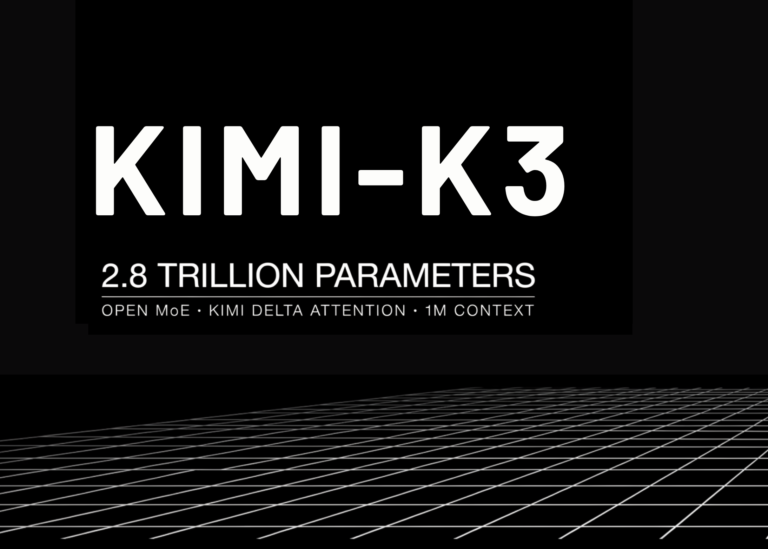
Moonshot AI has launched Kimi K3.1 Pro, a model with 2.8 trillion total parameters and 104 billion active parameters that accepts a one-million-token context window.
Key specifications
- Parameters: 2.8T total, 104B active (Mixture of Experts).
- Context: 1M tokens.
- Hardware: Requires clusters of 64 or more accelerators; it is not a single-GPU solution.
- Weights: Available for API use now; open weights are scheduled for November 2026.
Technical background
The model is a post-trained iteration of the base Kimi K3 architecture. Moonshot applied reinforcement learning across hundreds of downstream domains to improve performance. The team refined the RL framework, long-context inference, sandbox infrastructure and rollout scheduling to support this training.
The underlying K3 design uses Kimi Delta Attention (KDA) and Attention Residuals (AttnRes). It activates 16 experts out of a total of 896 via a Stable LatentMoE framework. The API accepts text, images and video inputs.
Developers can also access the Kimi K3.1 Pro Highspeed variant. Moonshot states this version runs 2 to 3 times faster than the standard model.
Benchmark results
The figures below come from Moonshot’s own reporting, using maximum reasoning effort and the Claude Code harness.
Coding performance
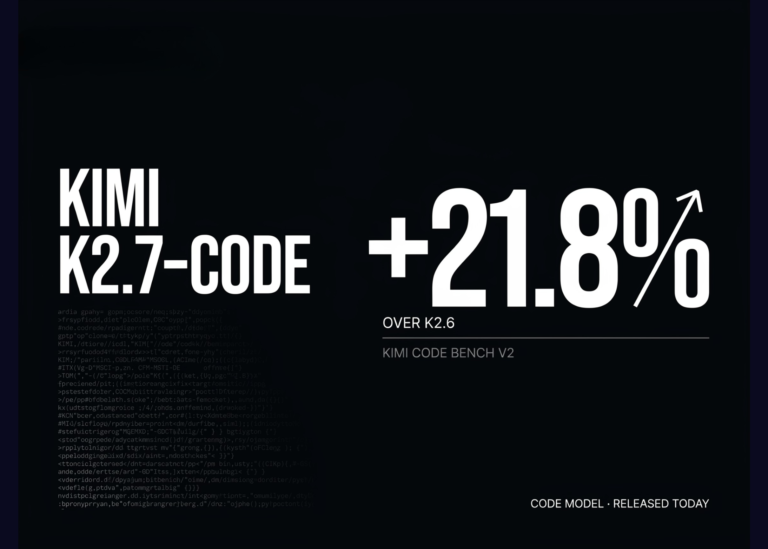
On Terminal-Bench 4.0, Kimi K3.1 Pro scores 65.7%. This places it just behind Claude Opus 5.5, which scores 66.4% in Moonshot’s chart. On SWE-Marathon, the new model leads with 51.7, compared to Opus 5.5 at 46.3. On an internal benchmark called Kimi Code Bench 3.0 Long-horizon, the score is 61.2, an increase from the original K3’s 55.95.
Scientific tasks
There is a significant gap in scientific terminal work. On Terminal-Bench Science 0.1, Kimi K3.1 Pro scores 38.1. This is well behind GPT-6 Astra at 68.1 and Opus 5.5 at 63.3.
3D and CAD
On BenchCAD with tools, the model scores 92.7. Opus 5.5 scores 96.2 and GPT-6 Astra scores 95.9. Without tools, Kimi K3.1 Pro scores 72.8, which is close to Opus 5.5 at 73.0.
Finance
The model reports a state-of-the-art 64.4 on OfficeQA Pro v2. It scores 58.6 on Frontier Finance. Internal finance tests show gains of 7.2 points in modeling and 11.6 points in research over the previous K3 version.
Hallucination rates
On the internal Kimi Hallu Bench Hard stress test, claim-level hallucinations fell from 23.4% for K3 to 8.3% for K3.1 Pro. Moonshot describes this as roughly a 65% drop. GPT-6 Astra still posts a lower 5.5% on the same test.
Cyber risk handling
Moonshot removed cyber-related data from mid-training and reinforcement learning for this open-weight release. On its internal xdev-bench-hard, an unfiltered checkpoint solved 90.5% of tasks at pass@3. The shipped K3.1 Pro solves 81.0%. Moonshot notes it stays behind frontier proprietary models on offensive cyber tasks.
Access and pricing
The model is live on Kimi.ai, Kimi Work, Kimi Code and the Kimi API. The API IDs are kimi-k3.1-pro and kimi-k3.1-pro-highspeed. The endpoint is OpenAI-compatible.
Pricing for K3.1 Pro is $2.00 for input and $10.00 for output per million tokens. Cache hits cost $0.20. The Highspeed variant costs $4.00 for input and $20.00 for output. The original K3 was priced at $3.00 and $15.00 respectively.
Practical limits from the quickstart guide:
- Thinking mode is always on. Reasoning effort is set to
low,highormax, withmaxas the default. - Temperature is fixed at 1.0 and top-p at 0.95.
- Output defaults to 131,072 tokens and can extend to 1,048,576.
- Access unlocks after a minimum $1 top-up.
- Vision input does not accept public image URLs. Users must use base64 or uploaded file IDs.
Limitations
- Weights are not public yet, so self-hosting is not possible today.
- The 2.8T size points to multi-node, supernode-class serving.
- Science-heavy terminal work trails GPT-6 Astra and Opus 5.5 by 25+ points.
- Several claimed wins come from internal benchmarks.
- For K3, Moonshot warned that dropping reasoning history in a harness destabilizes output. The K3.1 Pro docs also say to return the full assistant message.
What it means
Developers now have access to a high-capacity model that is cheaper than the previous K3 iteration. The lower API cost makes it viable for long-context coding tasks where the 1M token window is useful. However, the lack of open weights means teams cannot host the model locally yet. The performance gap on scientific tasks suggests this model is currently better suited for software engineering than for complex scientific terminal workflows.