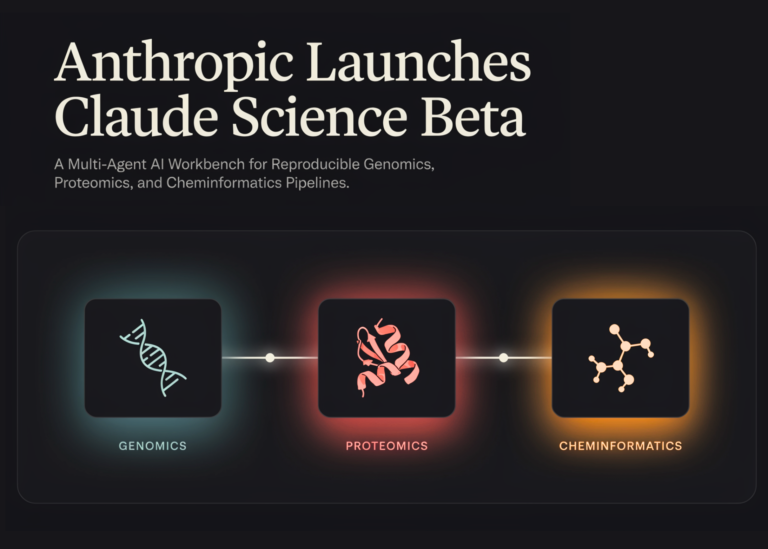
Anthropic announced Claude Science at a Tuesday event for pharmaceutical executives and biotech founders. This new product is designed to support scientific research in the same way Claude Code supports software engineering.
What it means
The tool allows scientists to carry out meaningful work autonomously when given concise, high-level instructions. It includes access to specific tools useful for computational biology and drug development. Alongside the launch, Anthropic made Claude Science available to all paid subscribers. The company also revealed it will use the product to pursue its own research into drugs for rare, neglected diseases.
This is not Anthropic’s first attempt at AI for science. In October, the company released plugins under the heading “Claude for Life Sciences” that help Claude make use of scientific software and databases. Unlike that earlier release, Claude Science is a full-featured, standalone product. The decision to elevate it to the same rank as Claude Code and Claude Cowork indicates the company is taking AI’s scientific applications very seriously.
“It represents how important this is to our mission that this is right up there with Claude Code and Claude Cowork as the next really significant product that we’re releasing,” says Eric Kauderer-Abrams, Anthropic’s head of life sciences. “Our mission is to develop AI that serves humanity’s long-term well-being, and we believe that by far the greatest opportunity to do that is in the life sciences.”
For the past decade, Google DeepMind has been at the vanguard of AI for science. CEO Demis Hassabis and researcher John Jumper won the Nobel Prize in chemistry for their work on AlphaFold. DeepMind has also made major contributions to meteorology, materials science, and a variety of other disciplines. But in the past several months, the fast-advancing frontier of AI progress seems to have left DeepMind in the dust. When it comes to coding, which has become the most lucrative use case for LLMs, DeepMind is stuck playing catch-up.
Anthropic is well positioned to take up DeepMind’s scientific mantle. Like Hassabis, Anthropic CEO Dario Amodei is a PhD scientist. Many scientists are already avid users of tools such as Claude Code. These days, a lot of scientific research involves some amount of coding, but not all scientists are expert software engineers. Tools like Claude Code can make a huge difference for their productivity. The company has recently earned a major scientific vote of confidence: Earlier this month, Jumper announced that he is leaving DeepMind for Anthropic.
Since agents powered by LLMs, including Anthropic’s Opus model series, became capable of useful, independent work in late 2025, scientists have been seeing just how much they can do. In a blog post published on Anthropic’s website, the Harvard physicist Matthew Schwartz estimated, on the basis of his work with Claude Code and other Anthropic tools, that the company’s Opus 4.5 model is about as capable of executing scientific projects as a second-year graduate student.
According to Kauderer-Abrams, Claude Science isn’t intended to displace Claude Code and Claude Cowork in scientists’ workflows. Instead, it’s designed to build on what scientists already find useful about Anthropic’s products. For instance, it not only writes code but also helps scientists run their code on powerful computer clusters. Many scientists need this for their work but find it difficult to manage. And it prioritizes reproducibility, so that scientists can trace back the source of any figure or result and check it for accuracy and validity.
Though Claude Science could in principle assist with any area of scientific research, it seems designed and marketed as a tool for molecular and cellular biology, and for drug development in particular. It can interface with various tools used in genetics, chemistry, and protein biology. All of these could come in handy for researchers on the hunt for new drugs. During the Tuesday event, Alexander Tarashansky, who led the development of Claude Science, demonstrated how the system could autonomously identify new drug candidates for phenylketonuria, a rare genetic disease.
And Anthropic isn’t leaving all that work to the pharma companies and university labs that were represented at the event. Armed with Claude Science, it will be pursuing its own research into drug candidates for neglected diseases. This is both to help move science forward and to gain a clearer sense of how Claude Science works in the real world.
There are obvious humanitarian reasons to prioritize drug development when creating a general-purpose scientific research tool, and AI industry leaders often cite curing disease as a major potential upside of the technology. But it’s also notable that pharmaceutical companies have far deeper pockets than academic researchers. Anthropic says it’s set to see its first profitable quarter. If major new contracts with pharmaceutical companies are forthcoming, they could help ensure it stays profitable as the tokenmaxxing craze dies down. This is something that’s ever more important as an IPO approaches later this year.