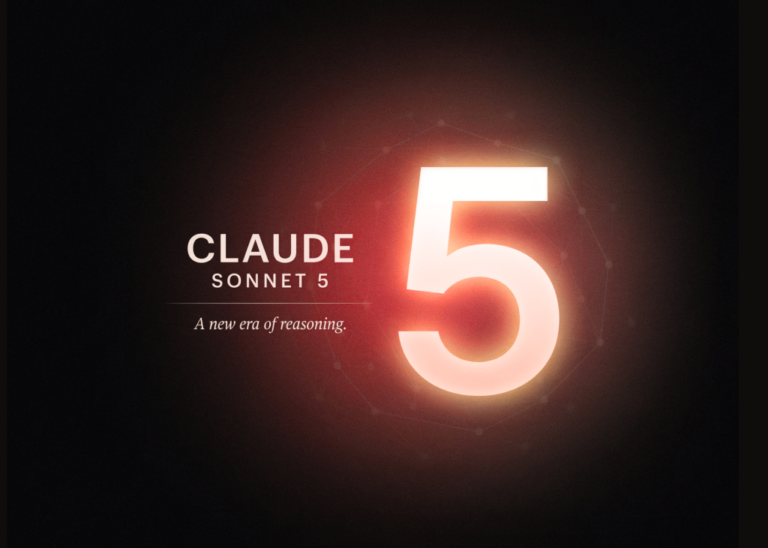
Claude Sonnet 5 launched this morning with performance levels close to Opus 4.8 but at a lower price point.
I checked the developer documentation immediately. It contains more practical details than the official press release.
Anthropic released a system card explaining how they avoided US government restrictions. The model is significantly less capable at cyber tasks than Mythos 5. Safeguards match those used for Opus 4.7 and Opus 4.8. Those older models sit between Sonnet 5 and Mythos 5 in terms of capability.
Technical changes and pricing
The API has dropped support for sampling parameters like temperature, top_p, and top_k.
The context window now holds one million tokens. Maximum output is capped at 128,000 tokens.
It includes the same set of tools and platform features as Claude Sonnet 4.6.
Adaptive thinking is enabled by default. You must specify "thinking": {type: "disabled"} to turn it off.
Base pricing matches Sonnet 4.6: $3 per million input tokens and $15 per million output tokens. An introductory discount applies until 31st August, bringing costs to $2 and $10 respectively.
The model uses a new tokenizer. Input text generates approximately 30% more tokens than on Claude Sonnet 4.6. This is effectively a 30% price increase.
Token cost analysis
I tested the new tokenizer against the old one using my Claude Token Counter tool. Here are the results for several larger documents:
| Document | Sonnet 4.6 | Opus 4.7 | Sonnet 5 |
|---|---|---|---|
| Universal Declaration of Human Rights (English) | 2,356 | 3,347 1.42x | 3,341 1.42x |
| Universal Declaration of Human Rights (Spanish) | 3,572 | 4,753 1.33x | 4,747 1.33x |
| Universal Declaration of Human Rights (Chinese, Mandarin Simplified) | 3,334 | 3,366 1.01x | 3,360 1.01x |
| sqlite_utils/db.py (4,279 lines of Python) | 44,014 | 56,118 1.28x | 56,113 1.27x |
English documents cost roughly 1.4 times more per token. Spanish is 1.33 times more expensive. Python code is 1.28 times more expensive. Simplified Mandarin remains effectively the same cost.
I also tested the model’s image generation with a prompt for the pelican. The output shows a white goose riding a bicycle with one wing extended forward to grip the handlebar. It is set against a plain white background with a brown ground line.

Via Hacker News