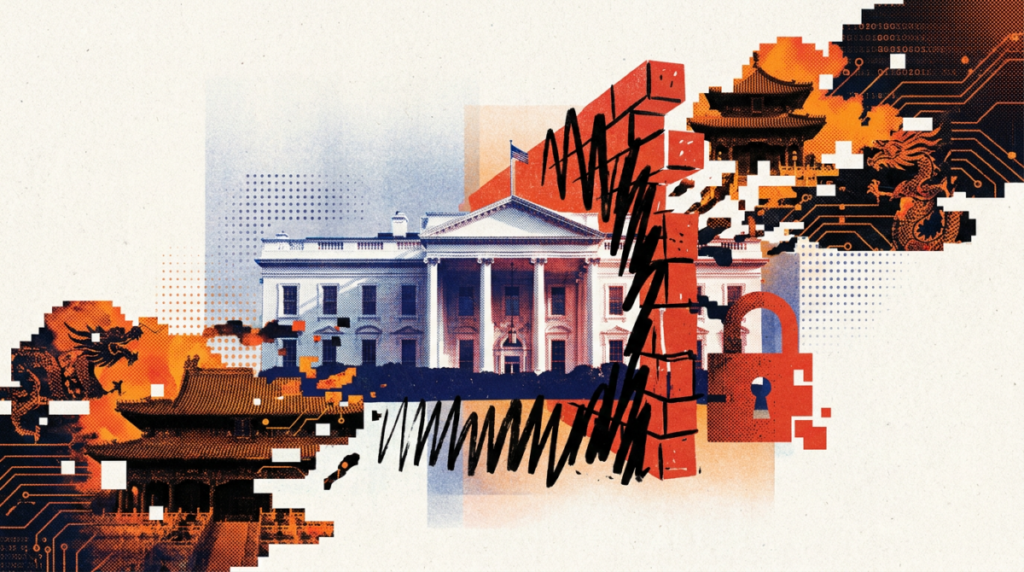
US export controls have frozen chip shipments to China and cut off overseas cloud access for local firms, forcing immediate contract cancellations and pausing major AI training projects.
The Commerce Department closed a loophole that allowed Chinese companies to rent compute power in Singapore, Malaysia, and Indonesia. Those data centers now require a license from the Bureau of Industry and Security. Operators have a 90-day window to screen customers for ties to China.
Sidley Austin notes the licensing threshold is roughly 300 modern AI chips. Chinese labs typically need several thousand processors. Moonshot AI canceled a $150 million contract with an Indonesian provider and paused further talks. The startup had planned to rent Nvidia Blackwell Ultra B300 chips next year to train its language model, Kimi K4. It agreed to prepay 50 percent of the cost, compared to the industry standard of 15 percent, due to the heavy compute demand. Access to Blackwell chips abroad was already critical for its previous model, K3, which matched top US models in July and triggered a BIS investigation.
Bernstein analysts warn of rising training costs. Five lenders are considering dropping out of a $480 million loan for Aolani, a Singapore-based provider supplying Nvidia chips in Malaysia for ByteDance.
TSMC and Samsung halt chip shipments to China
Contract manufacturers TSMC and Samsung have stopped certain processor shipments to Chinese customers while applying for Commerce Department licenses. This move hits Chinese tech firms during a period of high memory chip prices and capacity bottlenecks at domestic foundries such as SMIC. Huawei recently told customers to source their own memory for its new AI chip.
The new BIS rules block a workaround through independent packaging and testing firms. Chinese chip designers had used these firms to order high-performance processors without direct US approval. Samsung’s affected customers include ByteDance and Baidu’s AI data center unit, Kunlun. Exemptions for non-AI chips have also been eliminated. TSMC and Samsung now need licenses even for advanced smartphone processors from manufacturers including Xiaomi, Oppo, and Vivo. Industry insiders say this is likely to cause significant production delays.
Alibaba’s covert network reached China’s military research
A New York Times investigation into the espionage scandal involving Jensen Huang’s former mistress, Alice Huang, explains why Washington tightened controls. The Times reports Alibaba acted as the secret primary customer and financier behind Alice Huang’s Singapore-based firm, Megaspeed. That firm bought more than $4 billion worth of Nvidia chips. Nvidia’s sales team introduced Alibaba to Alice Huang in 2022.
Through its subsidiary, Speedmatrix, Megaspeed operated Nvidia chips on behalf of Alibaba in a data center in Johor built by Malaysian conglomerate YTL. Security firm Infrawatch says this analysis shows the arrangement. Megaspeed reportedly sourced servers from Aivres, a US subsidiary of state-linked Chinese firm Inspur. Technicians from Shanghai maintained the hardware, and data routed to China via fiber-optic and undersea cables through Singapore. Some chips were reportedly smuggled physically. A contingency contract gives Alibaba direct access to all servers, chips, and intellectual property if Megaspeed breaches their agreement. YTL’s stock price fell 20 percent amid the investigations.
Alibaba also has a direct connection to Zhejiang Lab in Hangzhou, co-founded in 2017, which links civilian and military research. The lab is run by former Alibaba CTO Wang Jian, a longtime friend of Jensen Huang who also advises the People’s Liberation Army’s National Defense University, an institution on the US sanctions list.
Researchers at the lab use Nvidia hardware to work on AI-driven cyberattacks and automated vulnerability discovery. They also work with a Chinese air force academy on war-game simulations against foreign carrier strike groups. Through the state-owned firm Zhejiang Computility and suppliers tied to the business network of Alice Huang and her husband, Kang Wei, Alibaba built data centers with export-controlled Nvidia processors for the lab, even though the company officially denies any military use of its services.
What it means
For companies building AI models, the immediate effect is a halt to renting high-end chips abroad and a scramble for domestic capacity. Financial backing is drying up as lenders pull out of major infrastructure deals. The supply chain for both training chips and general processors is now subject to strict licensing, delaying production for smartphone makers and data center operators alike.