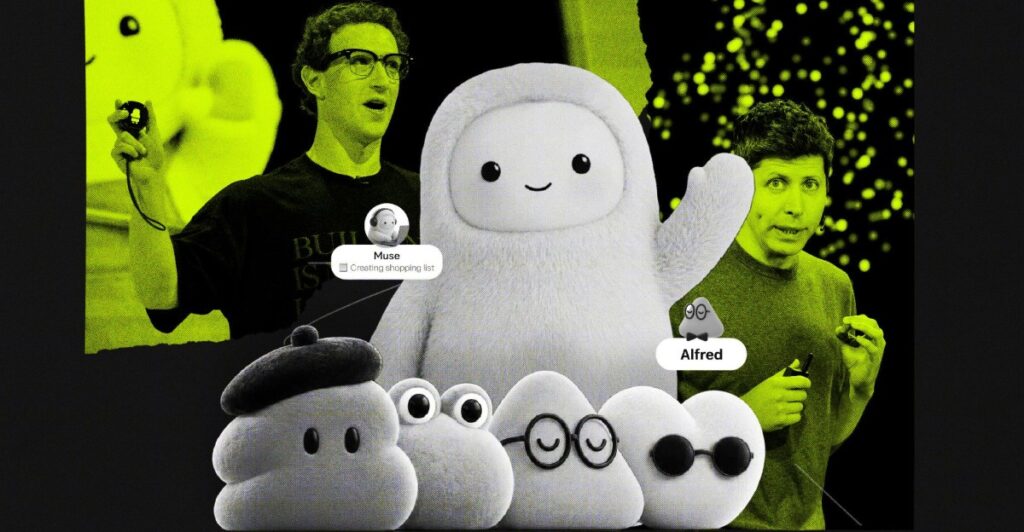
Meta’s Muse and OpenAI’s Dots have launched as the latest AI agents designed to run household tasks, business workflows, and personal errands without constant human intervention.
These tools, which feature animated mascots, represent the newest wave of consumer-facing software. They follow the OpenClaw project, a homebrew setup by Peter Steinberger that previously drove demand for Mac Minis but suffered from significant privacy flaws. Unlike that earlier iteration, Muse and Dots are distributed by major tech firms with established infrastructure.
The product landscape
Both companies are pitching these agents to mainstream users and businesses. The interface for each relies on a cute, animated character. OpenAI has introduced “specialist” Dots for specific fields like marketing, legal work, and accounting. Muse, by contrast, is currently free to use, whereas Dots require payment.
Meta does not currently possess its own frontier AI model. Instead, it relies on its existing large language models wrapped in a specific harness. This approach allows the software to control a computer or browser to perform multi-step tasks. The idea is that the agent can reason through a process, such as booking a flight, without asking the user for every single detail.
OpenAI hired Steinberger, the creator of the original OpenClaw, to lead development on Dots. Meta claims it built its version from scratch, though industry observers note strong similarities to the earlier project. Both systems operate on the premise that a model needs a web browser and a harness to execute actions on a user’s behalf.
Consumer utility versus engineering complexity
The distinction between the two products lies largely in their target audience and distribution strategy. Meta has a long history of building consumer products that people enjoy using immediately. OpenAI’s approach appears more geared toward software engineers and enterprise users, despite the presence of a mascot.
OpenAI faces a different financial pressure than Meta. The company needs revenue to sustain its operations. Consequently, Dots are positioned as a paid service. Muse is free, which could make it more accessible to casual users who want to test the capabilities of an always-on autonomous agent.
The underlying technology remains similar. Both agents function by accessing a user’s digital environment to complete complex requests. This means they can handle tasks ranging from inbox triage and restaurant reservations to managing loyalty programs and purchasing gifts.
Privacy and trust
Handing over credit card information, email inboxes, and other sensitive data to an AI that operates autonomously raises significant security questions. The original OpenClaw project highlighted these risks, as it ran on a user’s own network with a wide-open browser. Muse and Dots attempt to mitigate these issues by running on cloud infrastructure or more controlled environments.
It is not yet clear whether most people are willing to provide this level of access to make the technology work. The industry is currently testing the limits of what users will accept in exchange for convenience.
What it means
For people making things or managing daily life, the change is a shift from asking questions to delegating actions. You no longer need to manually input every detail of a complex task. Instead, you describe the goal, and the agent uses its access to your digital life to execute the steps. The trade-off is the requirement to trust that software with your private data and financial credentials.