Space is becoming the next frontier in longevity research.
A British startup has launched self-run chemical experiments into orbit, hoping zero-gravity data might shed light on disease-causing proteins that are too difficult to study on Earth. Before tackling those proteins, the team must first prove their autonomous laboratory functions in space.
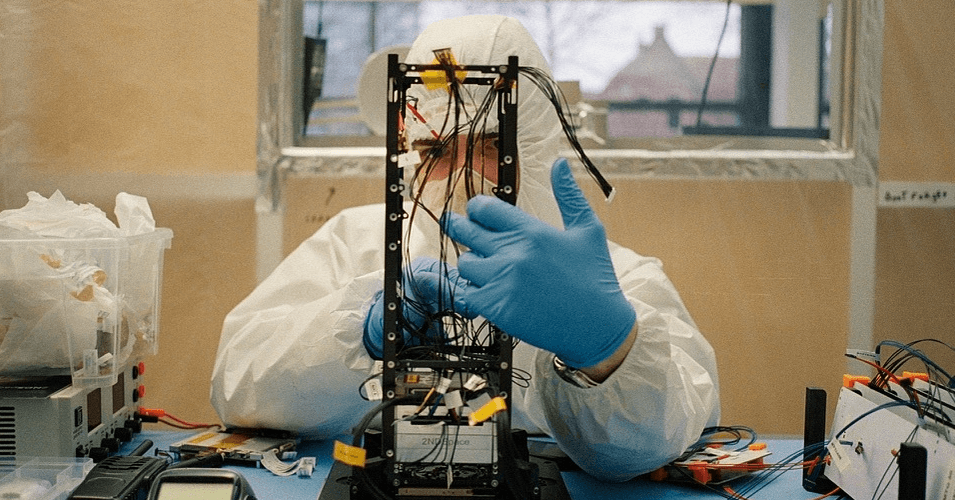
Mass Balance’s grapefruit-sized apparatus, packed with chemicals, sensors, and control elements, lifted off on a SpaceX transporter on Tuesday morning. The experiment sits inside a 10 centimetre pod built by Austrian firm Tumbleweed. It will orbit the Earth for a couple of months, automatically measuring and beaming back data on how live cells grow, react, and function under weak gravity.
This is the first test of a system designed to yield high-quality data unobtainable on Earth. Stronger gravity on our planet introduces effects like convection, through which heat flows, and sedimentation, where heavier compounds sink. Both processes muddy data collection.
“When you take away gravity, a lot of weird and wonderful things happen, some of which will be very valuable for life sciences and pharma,” says Toby Call, co-founder and chief executive officer of Mass Balance. “It sounds wild today, but the goal is really to make space boring, reliable, and just another research environment.”
Call says this research environment could be crucial for imaging disordered proteins. These proteins are responsible for age-related diseases including Alzheimer’s, Parkinson’s, and certain cancers.
On Earth, these proteins constantly change shape, making them difficult to image. That creates a gap in training data for life sciences models like Google’s AlphaFold. Consequently, these models remain unable to predict how disordered proteins will behave, or how they will respond to medicines.
In space, scientists believe some disease-driving disordered proteins may be easier to study and analyse. Call plans to generate data by running tests on disordered proteins under micro-gravity. He intends to use this data to train an AI model adapter which fills in the gaps. Revenue for his firm will come from the model, data licensing, and data access.
For now, the company is simply testing its operating system and data capture. Tuesday’s mission will take an industrial biocatalyst into space. This unit will break another chemical compound down. The platform will monitor the process using light to confirm that the chemical reaction takes place as planned.
Several other biotech startups are attempting to develop orbiting laboratories. In May, British firm BioOrbit launched a test unit growing ultra-pure, stable crystals which can be turned into injectable cancer medications. American-owned Varda Space Industries is similarly working on processing pharmaceuticals under microgravity. Unlike these two firms, Mass Balance is not trying to bring its system back to Earth intact. This decision spares the company some of the larger engineering challenges of ensuring it can withstand the extreme heat and stress satellites experience when returning through the Earth’s atmosphere.
“Microgravity is a new tool that is under-exploited,” Call says.
What it means
For scientists and drug developers, this mission represents a practical test of using space to solve problems that Earth’s gravity makes impossible. It moves beyond the idea of space as a luxury or a distant dream, treating it instead as a standard, reliable laboratory where specific biological variables can be controlled. The immediate impact is limited to validating the hardware, but the long-term implication is a new data source for training AI models, potentially accelerating the discovery of treatments for conditions like Alzheimer’s and Parkinson’s.