Audio Damage has released ShinRonin, a free modular filter and delay plugin that replicates the chaotic design philosophy of its 2003 predecessor.
The tool allows users to patch filter and delay combinations in any configuration, including setups that intentionally damage hearing. This release marks a return to an era when software developers permitted users to operate without restrictions.
ShinRonin serves as one of the company’s earliest plugins. It functions similarly to Wilkin’s Coffee, offering numerous methods to generate feedback loops and self-oscillating sounds. While some results are aesthetically pleasing, others are destructive. The intended outcome is user choice.
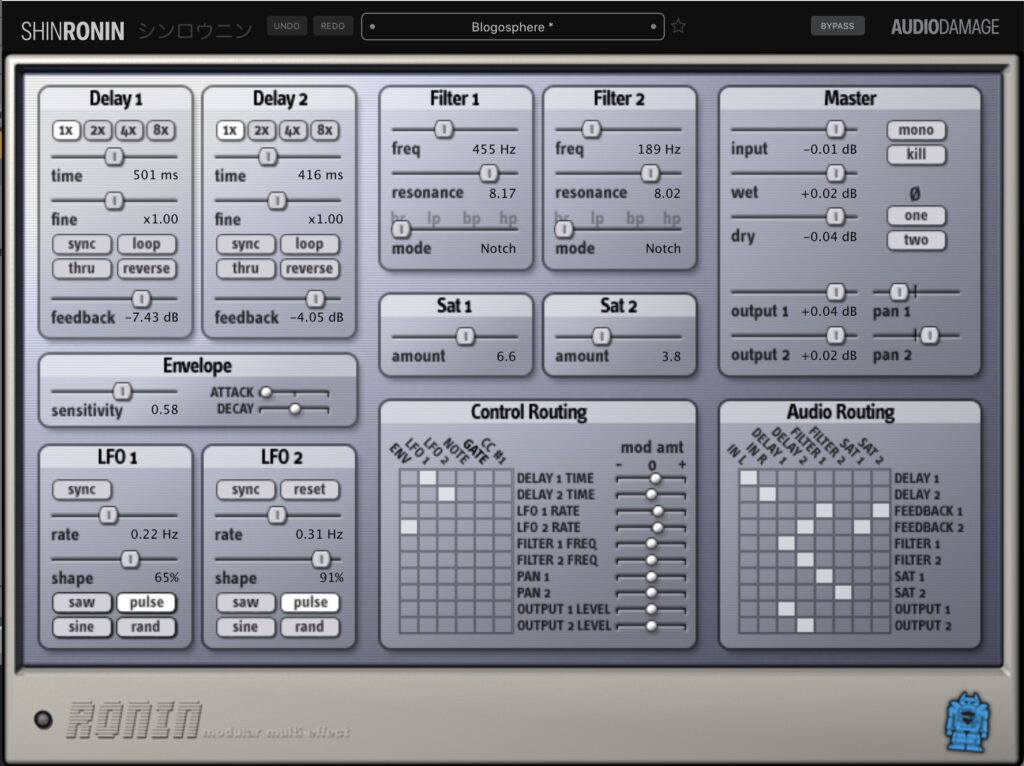
The plugin provides direct digital implementations for filters and delay lines. There are no analog models intended to mask the raw signal, nor are there fine-tuned controls designed to keep the user within a safe, predictable environment.
Users can create nuanced, subtle, and clean delay and filter effects. These can evolve into rich, modulated, and spatial sounds. Pushing the controls further yields unique timbres.
Accessibility is high, driven by two delay lines, two filters with multiple modes, envelope controls, and dual LFOs. Two saturation amounts allow for stomp-pedal-like effects. A control matrix offers positive and negative modulation for each parameter, alongside separate audio routing with inputs for the filter circuit.
Many other effect plugins lack this level of freedom. Developers often worry that users will create feedback loops or unwanted effects too quickly.
Audio Damage continues to produce excellent software. The company has released many tools in 2026, and there are valid reasons to use their current offerings.
Seeing Ronin reborn as ShinRonin is notable. The digital signal processing and user interface remain the same, but the software is now modernized for current systems. It runs on Windows, MacOS, and Linux via CLAP, VST3, AAX, AU, and LV2 formats.
The author would welcome a new SuperRonin effect based on this concept, perhaps featuring comb filtering rather than just band-rejection. Until then, the 2003 aesthetic fits well within the 2026 software suite.
The free price point makes it an attractive option.
Audio Damage ShinRonin
Free modular filter/delay
To illustrate the spontaneous sound worlds possible with the tool, the author tested ShinRonin alongside Chromaphone and Multiphonics CV-3 from AAS.
The accompanying audio clip demonstrates these capabilities.