A proposal in Alaska to turn a public library into a children’s library was withdrawn after local officials faced heavy criticism for trying to restrict adult access to media deemed harmful to minors.
Assembly member Michael Bowles introduced a resolution that would have barred the Matanuska-Susitna Borough Public Library System from lending materials if the borough manager classified them as unsuitable for young people. Public records show constituents rejected the move, calling it an audacious and idiotic attempt at destruction. One person described the plan as a bureaucratic nightmare, while another warned that adopting it would lead to the removal of countless books containing passing references to sex or adult themes that are not sexual in nature.
Bowles withdrew the request a week later to recalibrate. In May, the Mat-Su Sentinel reported that the assembly member introduced and again withdrew a resolution forcing the system to remove the book Let’s Talk About It: The Teen’s Guide to Sex, Relationships, and Being a Human from shelves. This title has resided in the adult section of Mat-Su’s borough-run libraries since 2023, after being relocated from the teen section following a challenge.
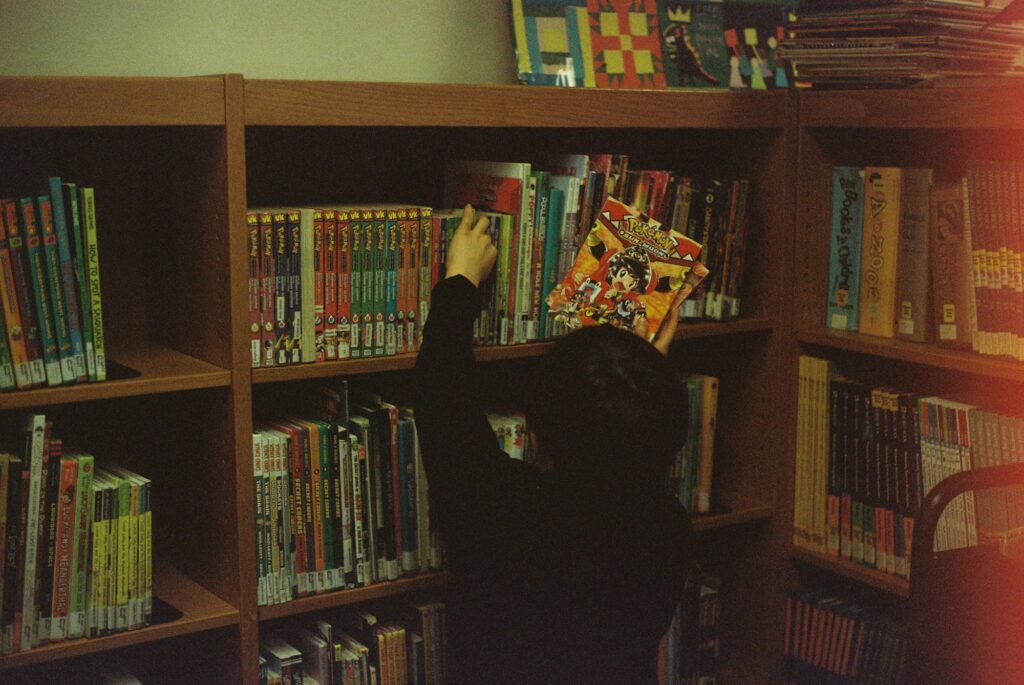
Records obtained from dozens of public libraries reveal a chaotic trend. These files include Requests for Reconsideration of Materials forms, official decision letters, and draft collection development policies. While much has been written about efforts to suppress books with challenging ideas or those deviating from cis white heterodoxy, the impact on the rest of the public is less discussed. Reports confirm that more books intended for children and young adults now sit in adult sections because challengers believe people of color and queer, trans individuals should not be read by youth. A large-scale reorganization of collections is underway, though application varies by state and locality.
South Carolina relocation data
Records from one South Carolina public library system show that between June 2024 and August 2025, more than two dozen young adult books were moved to the library’s adult section. Prior to this, the system had already resectioned more than two dozen other YA titles. The ACLU sued the Greenville County Public Library System in 2025 regarding board-adopted policies from 2024.
Most letters from the library’s executive director did not include reasons for the relocation. More recent correspondence references the library’s updated collection development policy.
“That becomes manifest by removing opportunities for demonstrating honesty for students,” William Rodick told 404 Media.
One frequently challenged title caught up in this mix was The Hate U Give, a 2017 YA book about a teenager who witnesses her friend, an unarmed Black man, being murdered by a police officer during a traffic stop. In 2024, the Greenville County Public Library System challenged the book and retained it. In 2025, the book was challenged again and moved to the adult section. Between these events, the library’s board adopted policies making this and other books easier to remove.
State funding conditions
Most anti-library laws introduced in the United States from 2022 to now have focused on school libraries. Only a few states have laws affecting municipal and county public libraries, and most of these efforts have failed to pass or were struck down by governors. State governments have found other ways to enforce censorship, however. At least two states have mechanisms tying public library funding to content restrictions.
South Carolina has a legislative requirement that threatens to strike the system from its budget unless the system certifies with the State Librarian that they do not keep books in the children, youth or teen sections that could be of prurient interest to a 17 year old. Alabama presents a more aggressive version of state library-agency rulemaking.
In 2024, the Alabama Public Library Service amended its administrative code to withhold funding to public libraries that do not restrict minors’ access to sexually explicit or otherwise inappropriate material. The agency has since broadened its scope. It expanded the criteria for what is sexually explicit before adding a provision to treat content dealing with the concept of more than two biological genders as inappropriate for youth sections.
Tuscaloosa Public Library released records to 404 Media in response to a public records request. These included tracked edits to the library’s 2025 collection development policy, initially based on a 2022 version, to meet APLS funding requirements. These changes appear to have been accepted. A line about the library welcoming community feedback on collection development, which an editor appeared to question, was also retained.
Intellectual condescension
The motives behind changes to collection policies and funding incentives raise serious questions about who public libraries are for in America. William Rodick, who researches representation and culturally responsive teaching in Pre-K and primary education for the nonprofit EdTrust, says the mass relocation of diverse books from developmentally appropriate sections into adult sections is a form of intellectual condescension. This is the idea that young people are not capable of dealing with hard topics through literature.
Rodick notes that students already have disproportionate access to spaces outside of classrooms where they can access reading materials. Regardless of where they are getting their books, students of color and students who are LGBTQ+ are not presented in the majority of the books they have access to. This situation is worse now than just a few years ago. When they are presented, quite often those representations are stereotypes through really negative portrayals that are certainly not going to use the kind of motivation students need to engage with reading. Rodick fears that at some point, we will see even greater disparity in outcomes than we already do for literary rates because of perpetual inaccess to quality materials.
Declining literacy
Literacy rates have been trending downward for young people for a while. When the National Center for Education Statistics released its Nation’s Report Card assessment in early 2025, it caused a stir. One major takeaway was that more than 60 percent of fourth graders do not read proficiently. Another was that the gap between the country’s strongest and weakest readers is widening because the lows are getting lower. Meanwhile, in 2020, about half of Americans between the ages of 16 and 74 were found to have low literacy skills.
Nadja Young is chief brand officer with MetaMetrics, the company that developed the widely-adopted Lexile Reading Framework. The framework measures both reader ability and text complexity to match readers with books that are appropriately challenging. Young says the focus for upper grades in high school is really about vocabulary in contexts that are authentic. Reading whole books absolutely helps to build that stamina.
Yet shrinking attention spans and fast-moving curricula are pushing schools toward teaching excerpts over whole books. College instructors observe that students are finding an expectation to finish a whole book for a college course novel. For The New Yorker this month, Becca Rothfeld literally wrote an essay about the immaturity of modern American books, likening them to the literary equivalents of the social-media profiles that teen-agers and adults who have never quite outgrown teen-age tics compulsively check and update.
There are, of course, other factors to weigh when making widesweeping generalizations about literacy rates in adults. Young notes that adults with dyslexia, neurodivergence, and English language learners have historically and continue to have difficulty finding books they can parse that also honor their maturity and intellect. Lexile only measures a text’s complexity, not the content or themes a book contains. And yet, books are being relocated based on content or theme. Whether text complexity is an afterthought or conflated with content or theme is only something the most prolific censors can know.