Apple has announced a radical transformation of Siri at WWDC 2026, aiming to evolve the smartphone voice assistant into a tool that is genuinely helpful, deeply aware of personal data, and focused on taking action. A central pillar of this overhaul is a strategic partnership with Google Gemini, designed to power the underlying model for the new Apple Intelligence suite.
Following a period of significant delays, Apple is finally shifting its strategy to reposition Siri. This involves a visual and functional redesign on the iPhone interface, alongside the introduction of a dedicated, stand-alone Siri application. This new app will offer a distinct entry point for the assistant, moving beyond simple voice commands.
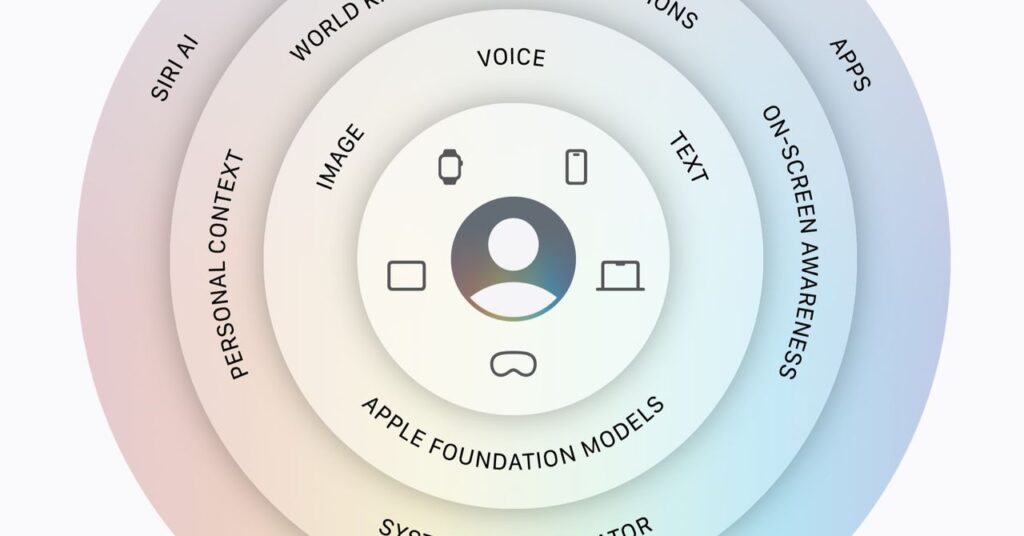
Expected to launch for consumers later this year, the update will introduce chatbot-style interactions, allowing users to review past conversations much like they would on ChatGPT. Crucially, the revamped Siri will be permitted to utilise personal information stored locally on the device, including the content currently displayed on the screen, to formulate answers.
Until this announcement, Siri had remained largely static while the broader generative AI revolution accelerated around it. Competitors such as Google’s Gemini, Anthropic‘s Claude, and OpenAI’s ChatGPT quickly surpassed Apple’s capabilities in terms of sophistication and utility.
“Over the last few years, with the growth of large language models, some of these assistants have gotten tremendously capable-while Siri has remained relatively programmatic and limited in what it can do,” says Avi Greengart, a lead analyst and president of Techsponential, a market advisory firm.
The new iteration of Siri is designed to be significantly more versatile. For instance, if you require assistance drafting an email, the updated assistant can synthesise contextual details from your Apple ecosystem, such as notes tucked away in your Notes app, to generate a complete response. It can even compose draft messages for group chats. This approach mirrors the strategy adopted by other leading assistants in 2026: granting the AI access to more personal information to enhance its utility as a helper.
Oral History
In 2011, Apple’s decision to integrate Siri into the iPhone 4s marked a watershed moment for smartphone voice assistants. This early version could check the weather, schedule appointments, and set timers. The launch video featuring Zooey Deschanel lounging in her pajamas and asking if it was raining outside remains a defining memory of that era. Rather than requiring a separate download, the voice assistant was now native to the device itself.
As the years progressed, rival voice assistants began to catch up with Apple, sparking articles in outlets like this one that questioned whether the iPhone maker was losing its competitive edge.
This tension came to a head at the WWDC stage in 2024, when Apple unveiled a suite of new Siri features promised to iPhone owners. The company positioned these highly personalised updates as a primary reason to upgrade to a newer smartphone. When these AI capabilities failed to materialise fully and on time, consumers took Apple to court for false advertising, resulting in a $250 million settlement.
Despite these early hurdles, is Apple too late to succeed alongside the next generation of AI assistants? Based on the company’s track record, that does not appear to be the case.
“Apple has really done a very good job at standing on the shoulders of the giants that came before them and taking things forward,” says Ramon Llamas, a research director on the devices and displays team for International Data Corporation. “They did that with smartphones. They did that with smartwatches.” Success now hinges on how Apple executes this new Siri and whether device owners perceive the updates as genuinely useful.
What’s Happening
During the same WWDC 2024 event, Apple had previously announced an integration with ChatGPT, allowing users to route voice questions to OpenAI’s chatbot for answers if they preferred.
The introduction of a stand-alone app is a strategic move by Apple to ensure the user experience meets the standards expected of an AI tool in 2026. This allows users to revisit previous chat threads and continue conversations. Consequently, the Siri experience is becoming more robust, supporting text-based requests and file uploads in addition to voice commands.
Siri is also expanding into the camera app, offering a feature similar to Google Lens where users can ask questions about objects or scenes they are viewing.
Apple is renowned for prioritising user privacy. However, some experts remain concerned about how personal data will be accessed under this new model.
“It could have good benefits, make you super efficient, and be really helpful, but it does make the privacy issue a little bit more murky,” says Marshini Chetty, a computer scientist at the University of Chicago who specialises in privacy and human-computer interaction.
When Apple first launched its ChatGPT integration for Siri, it obscured user IP addresses and ensured OpenAI did not store user requests. The company appears to be adopting a similar, privacy-preserving approach with this latest launch, emphasising on-device processing in its recent presentation.
Siri Knows You
As Apple leans into a more powerful, AI-boosted Siri, the cultural backlash against generative AI continues to resonate with users. While some are eager to adopt AI-powered tools, others actively avoid them or lament the inevitable encroachment of generative AI into their daily apps.
“In many cases, they don’t want these AI features,” says Serge Egelman, an online privacy and security expert at UC Berkeley. “At the same time, all of these companies are invested in this. That’s why it’s getting shoved down everyone’s throats, regardless of whether they actually want it.”
I look forward to testing Apple’s revamped AI assistant later this year to see the extent of the changes. When I recently granted Google’s Gemini access to all my personal data in hopes of better automation and more attuned outputs, I was surprised by how well the tool performed, yet also unsettled by the deep insights it gleaned from my unfiltered information. Will Siri feel the same? Let’s chat and find out.
Key takeaways
- Apple is partnering with Google Gemini to power a significantly more capable Siri that can utilise on-device data, including screen content, to provide context-aware answers.
- A new stand-alone Siri app will launch later this year, introducing chat history, text-based commands, and file uploads to rival the functionality of other generative AI tools.
- While the new features promise greater efficiency, experts warn that granting assistants access to personal data raises complex privacy concerns that Apple must navigate carefully.
- Apple’s history suggests it can successfully integrate advanced AI, but the company must execute this launch well to avoid the false advertising controversies of the past.