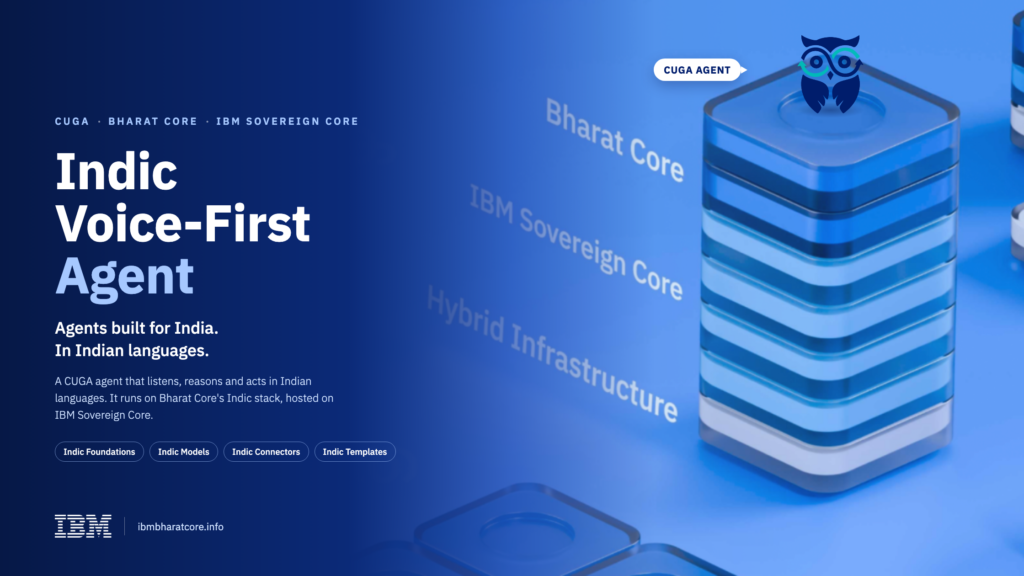
IBM Research has released a voice agent that answers farming questions in regional Indian languages by searching English documents. The system, built with the open-source CUGA harness, listens to queries in Hindi, Tamil, Telugu, Gujarati, Marathi and others, then retrieves answers from a 154-page agricultural handbook written in English. The agent responds in two to four spoken sentences using only the retrieved information and displays the source pages for verification. If a user asks about cricket or coding, the system politely redirects them back to farming topics instead of generating incorrect information.
CUGA as a text-based core
CUGA (Configurable Generalist Agent) manages the model wiring, tool management, state and guardrails. This setup lets developers write tools and prompts rather than managing the agent loop. The team embedded the harness inside a small web application to handle three specific tasks.
- One agent, any model. Users can switch between watsonx and OpenAI with a single setting.
- The knowledge engine. The system parses a PDF, chunks it, embeds it and searches it locally using agent.knowledge.search().
- Conversation threads. Each question starts a fresh thread so one person’s language or context never leaks into another’s.
The design treats CUGA as a text-in, text-out brain. Voice functions as two thin layers around this core. Audio goes to speech-to-text, then to the knowledge search, then to CUGA for a grounded answer, followed by text-to-speech and back to audio.
Developers can build and test the system with plain text first. They can add speech capabilities later without rewriting the agent. The project supports two speech providers: Sarvam AI’s cloud speech APIs, called directly from the user’s browser, and open-source models running on a local server. The speech-to-text model is SraVaani and the text-to-speech model is Svara.
Adding speech is straightforward. Cross-lingual retrieval is the difficult part. A Hindi question must find an English paragraph. Search works by turning text into vectors and finding the nearest ones. CUGA’s default embedding model is English-only, so it turns Hindi into vectors that carry almost no meaning. With the default setup, a Hindi or Tamil question retrieves five passages, but they are the wrong ones. The model, instructed to answer only from provided text, says the handbook does not cover the query. Every layer behaves correctly, so there is no error or warning.
The fix involves using a multilingual embedding model, specifically intfloat/multilingual-e5-large. This ensures the same meaning lands in the same vector space regardless of the language. Conceptually simple, wiring it into CUGA required a small workaround shown in the tutorial. After this change, one English document serves every language, removing the need for translated copies.
Recommendation: before tuning a single prompt, ask the agent one question in a non-English language and check that it finds the right pages.
Several small decisions had a larger impact than expected.
- Write for the ear. Markdown, bullet points, citation tags and bracketed translations such as “millet (बाजरा)” sound wrong when read aloud. The prompt instructs the model not to produce them, and a light formatter strips any that slip through before speech.
- Keep guardrails cheap. Simple input checks catch obvious off-topic questions. If one gets through, the model starts its reply with OFF_TOPIC, and the app swaps in a polite redirect. This avoids a second LLM call, keeping the voice path fast.
- Ground every answer. The model sees only the retrieved passages, is told not to use outside knowledge, and the page sources are shown to the user.
- Keep keys out of the server. With the Sarvam option, the browser talks to Sarvam directly. The server receives only text and never sees the user’s key.
Users do not need to set anything up to see the system work. They can open the voice agent in CUGA Apps on Hugging Face Spaces, ask a farming question in their language, and listen to the answer.
For those building their own, a step-by-step tutorial, Build an Indic Voice Agent with CUGA, starts from an empty folder and adds each layer in turn. Nothing here is specific to agriculture. Swapping the handbook for scheme documents, health advisories or legal guides creates a different assistant. Changing the speech provider alters the deployment model, such as cloud for speed or on-premises for data sovereignty, without rewriting the agent.
Voice-first, multilingual assistants allow digital services to reach people who were never served well by English-only text screens. Building them on an open, auditable harness, with answers tied to sources people can check, is how they earn trust.
This approach sits at the intersection of work being done with IBM Bharat Core. Bharat Core is an optimized AI stack built on top of IBM Sovereign Core, designed specifically for the Indian ecosystem to run Indic AI workloads securely on local infrastructure. When scaling a voice agent from a prototype to a secure enterprise application, such as a vernacular KYC system or multilingual government bot, greater control over data sovereignty is required. Pairing CUGA’s flexible agent harness with Bharat Core’s ready-to-deploy Indic connectors and fine-tuned models allows developers to build fully compliant, sovereign AI solutions tailored to India’s unique linguistic diversity.
Resources
For those new to CUGA, the following places offer starting points:
- cuga.dev: the CUGA home page.
- CUGA on GitHub: the open-source harness (Apache 2.0). Star it, file issues, or pick up a good first issue.
- CUGA documentation: setup, the SDK, knowledge, policies and configuration.
- CUGA Apps gallery on GitHub: the source for the apps in the Hugging Face Space.
Spaces available to try in a browser include:
- CUGA Agent: the general-purpose agent, running on a demo CRM scenario.
- CUGA Apps: launch working CUGA apps from one dashboard.
- CUGA Policy Playground: two live agents side by side, one with policies and one without.
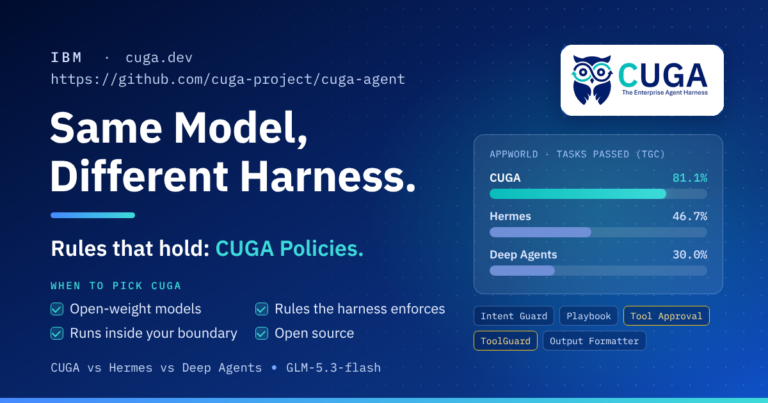
Additional posts on the Hugging Face blog cover CUGA on Hugging Face: Democratizing Configurable AI Agents, which introduces CUGA and its configurable reasoning modes; Build real agentic apps using CUGA, featuring two dozen working examples on a lightweight harness; and Same Model, Different Harness: CUGA, Hermes, and Deep Agents, which explains when to pick CUGA.