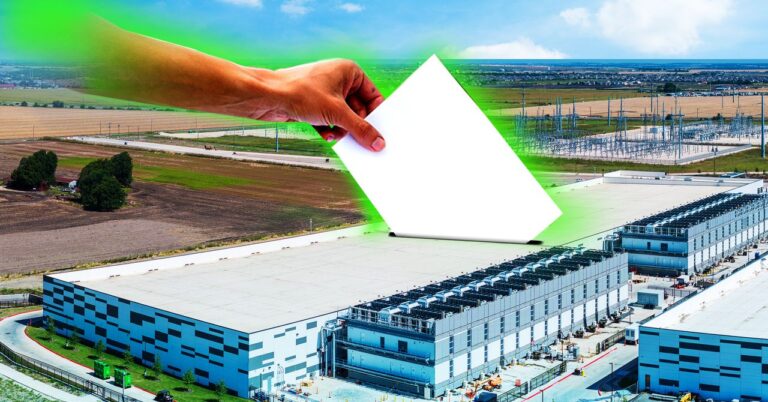
More than 40 ballot measures across 13 states went against data centers during last night’s midterm election. Voters rejected these proposals in 38 of the races. Six cities voted to ban such facilities completely, while 12 others placed limits on the megawatts allowed. Candidates who supported building them lost elections nationwide.
Abbott’s defeat in Texas
The rejection of pro-data center politicians was most visible in Texas. Greg Abbott lost his bid for a fourth term as governor. He had previously made the state friendly for data center construction. Texas now hosts more than 300 working facilities, with plans to double that number. In a 2025 press conference alongside Google CEO Sundar Pichai, Abbott stated that Texas is the epicenter of AI development and that the state must remain at the forefront of the revolution. He accepted more than $9 million in donations from data center-related donors.
After public sentiment turned against these projects, Abbott issued a “pause” on new developments. This pause was not real. Texas regulators continued to approve data center projects after the announcement. They only shut down the state’s permitting web portal when 404 Media reported on the issue. Gina Hinojosa, Texas’s Democratic governor-elect, made Abbott’s stance a central part of her campaign. His repeated messages about making Texas an AI state played on television and the internet. He lost by more than 700,000 votes.
Local wins across the country
Anti-data center candidates won statewide races across the nation. In Burgin, Kansas, mayoral candidate George Hensley lost his bid after voting to approve a hyperscale project. He faced a write-in candidate named Joe MonroeTK, who ran an anti-data center campaign. Hensley was the only name on the ballot. Emporia, Kansas, passed a ban on high impact data centers. In Yukon, Oklahoma, the mayor lost a recall election after supporting a hyperscale data center project.
“These midterms sent a clear message — people don’t want to see data centers in their backyards,” Michael Whitesides, the deputy communications director for Local Progress, told 404 Media. “Across the country, people do not see the promised benefit of these data centers, and the AI they power, playing out in their daily lives. They’re seeing basic goods and services get more expensive while these billionaire backed monstrosities take up space in their community, poison their air, and drive up their utility bills.”
Local Progress is a network of local elected officials. Its members have focused on data centers as a top political issue over the past year. Whitesides noted that Kim Rooney in Asheville, North Carolina, and Amanda Rodrigues in San Marcos, Texas, were elected mayors after running anti-data center campaigns.
“Big Tech will continue its typical playbook of trying to buy and bully local officials into complying with their demands for more data center development, but our hope is that last night’s results are a clear signal to local leaders that they can resist and their community will back them up,” Whitesides said.
American voters in the communities where data centers are being built hate them. They increase power bills, consume large amounts of water, and power Silicon Valley’s AI apparatus. Americans rejected data centers last night as symbols of the big tech oligarchy and a physical manifestation of a future they want to fight against.
Elon Musk, one of the night’s big losers, took a break from his weeks-long posting spree on X as election results rolled in. Musk spent half a billion dollars on the midterms, $224 of it in Texas, the state where he lives and does business. He wanted to cover the state in data centers. Those plans look difficult now that Abbott is out and Hinojosa is in.
Musk broke his election day posting silence a little after 1 am. “Data centers in space looking pretty appealing right now,” he said on X. Chased off the land by its people, the billionaire looks to the sky.
What it means
Local leaders can resist big tech demands. The election results show that communities will back them up. Voters are rejecting the physical presence of these facilities and the associated costs. The focus shifts from building on land to other potential solutions, such as space-based infrastructure.