Joe Allen is asking for the name of a delivery robot outside an Atlanta hotel while I try to get him to the airport. I have been trying to reach Allen, who became a national figure on Steve Bannon’s War Room podcast, to discuss the growing resistance against artificial intelligence. I came to Georgia, a hub for data center opposition, to hear him speak, but he had to leave the event immediately. Fortunately, his flight was delayed, allowing me to follow him to a nearby restaurant where he spoke about the “inverse singularity,” his theory that humanity’s intellect and creativity will collapse as we rely more on AI for information.
Allen’s friends at the restaurant knew very little about me. One called him for an estimated time of arrival, noting he was bringing a “frenemy,” and gave me a sharp look. Delivery robots are common in downtown Atlanta, one of few major cities rolling them out to serve food. Allen approached one with bright white lights shaped like eyes on the front and read the name “CJ” from the side. I thought of his book, Dark Aeon: Transhumanism and the War Against Humanity, and wondered about the human worker the machine replaced. The robot’s gaze seemed fixed on me without interest.
When asked why I am in Georgia, I say that people hate data centers, so I am checking if they also hate AI. That is true. The vitriol directed at data centers is unlike anything I have seen in my years reporting on energy and the environment. This anger has built up into a near-religious fury and is uniting people from opposite ends of the political spectrum.
As I write this, a friend sent me a post from a “white Christian nationalism” account on X. It showed a cartoon of Smokey Bear standing before a burning data center with the text “ONLY YOU CAN PREVENT DATA CENTERS.” My friend asked what was happening. I will try to explain.
Once upon a time, you might have lived next to a data center and never heard of it.
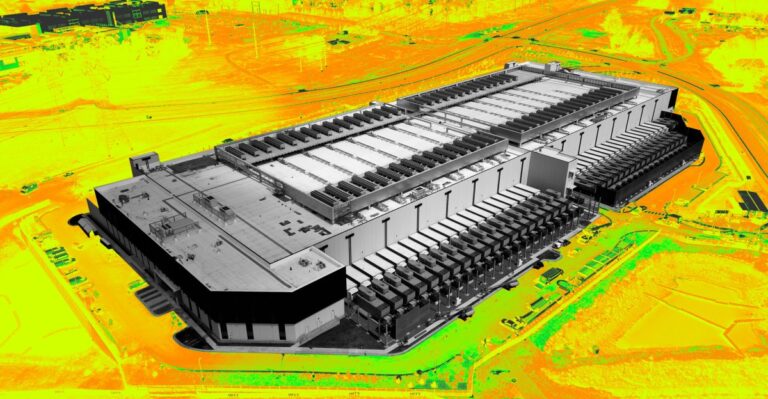
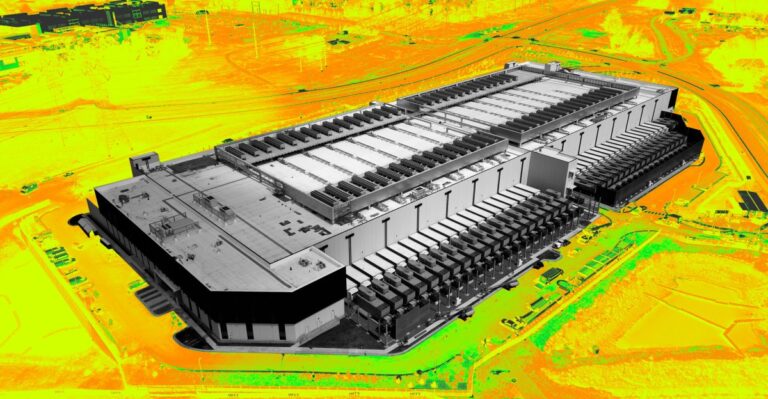
For decades, these facilities were built quietly across the US, mostly in areas with fiber connectivity and access to power. Silicon Valley and the Washington DC area were popular choices. They supported streaming Netflix, storing cloud data, and countless other online tasks.
Then came ChatGPT and the race for artificial intelligence. Tech leaders argued that building as many data centers as possible was necessary. They claimed that making the best AI required a massive expansion, especially of hyperscalers, which are larger versions of existing structures. The Trump administration supported this by rolling back environmental regulations to clear the way for development.
Data centers began appearing everywhere as companies searched for the cheapest land, power, and water. Headlines became more dramatic every day. Elon Musk reportedly transported unpermitted gas turbines to his Memphis xAI campus, located in a majority-Black neighborhood already facing high pollution levels. A Washington Post article, later disputed, estimated that a single ChatGPT search used the equivalent of a bottle of water. People watched their electric bills rise as utilities forecasted high demand. Economic outlets suggested data center construction now underpinned the entire US economy. Tech CEOs publicly discussed how AI would take jobs and replace human creativity.
People started asking questions.
Data center resistance has roots in classic NIMBYism. Many Americans do not trust powerful companies building mysterious structures in their backyards. The pace of outrage is shocking. A recent Gallup poll showed that 70 percent of Americans would somewhat or strongly oppose data center construction in their area. In recent months, there was an attack on a pro-data-center council member in Indianapolis, Ron Gibson. There was also an attack on OpenAI CEO Sam Altman. At least a dozen states, including Georgia, introduced data center moratoriums. New York passed one. Many cities and counties passed bans or moratoriums, including in deep-red Hill County, Texas. Protesters at public meetings in New Jersey, California, Wisconsin, and Indiana were arrested, detained, or escorted out.
When I started reporting on data centers last year, Washington seemed unprepared for the backlash. It was unprepared for anything AI-related, perhaps unsurprising for a Congress with members who struggle to use their phones. Two of the first national politicians to call out data center development were right-wing populists Marjorie Taylor Greene and Thomas Massie. They worried that a proposed 10-year ban on state-level AI regulations could be used to build data centers on private property. “Forcing eminent domain on people’s private properties to link the future Skynet is not very Republican,” Greene tweeted in June 2025.
Steve Bannon, Trump’s former adviser and a longtime technology critic, regularly addressed AI on War Room under Allen’s guidance. At the end of 2025, when the Trump administration tried to renew a ban on regulation, a MAGA coalition led by Bannon stopped it. Bannon told ABC News last fall that Allen was a key part of his plan. He said Allen would visit every conference and church that asked him, aiming to get the base involved at the ground floor.
Anger against data centers and public anxiety about AI are usually treated as separate topics in polling and policy. One is viewed as an expression of environmental and civic worries, the other as concerns about job loss and chatbots. Evidence suggests this is not clear-cut. Research published in June on a small sample of voters showed that very few people opposed to data centers actually live near them. Most of those against data centers are also skeptical of AI. Bannon seemed to understand how the American right might rebel against data centers. He aired a segment last year describing them as “weapons labs” being turned onto the population.
I felt the populist right knew something I did not about AI, American attitudes to technology, and the built environment. That is why I first reached out to Allen in January.
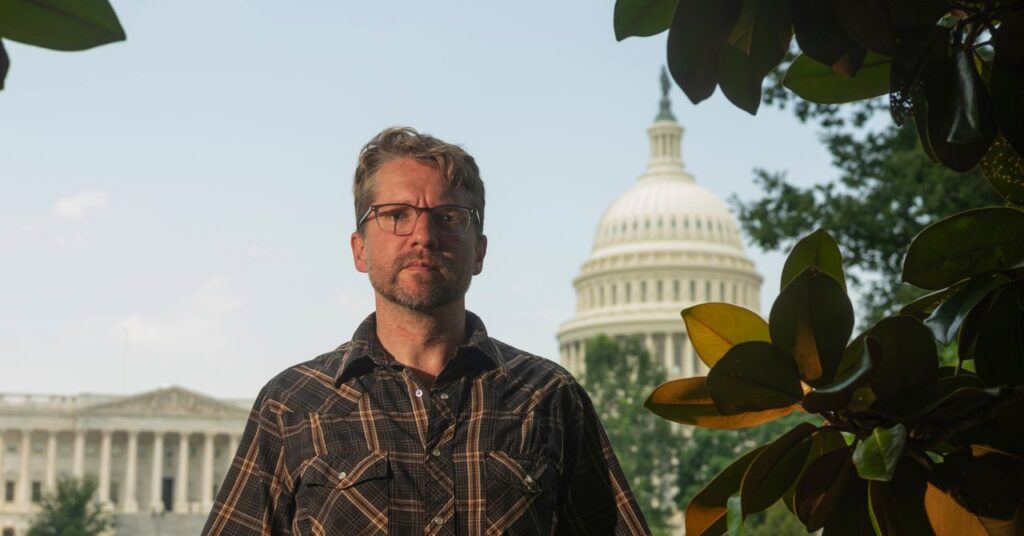
Joe Allen has startlingly blue eyes behind professorial glasses and a grin reminiscent of a high school student telling non-PC jokes. His origin story appeals to journalists like me. When I met him at an event in New York, he was accompanied by Suzy Weiss from the Free Press, who noted she was also profiling him. Allen toured internationally for years as a rigger for musical acts like the Black Eyed Peas and Calvin Harris. He paused to get a master’s in theology from Boston University. He watched the music industry collapse during Covid. He had written about the evils of technology for far-right and far-left outlets and was living in a van in 2021 when Steve Bannon’s producer invited him on War Room. Bannon offered him a job as a tech correspondent shortly after. At one point, Allen lived in the DC apartment where War Room is recorded.
The world of AI safety and ethics is incestuous and mostly inaccessible to normies. It is full of people living mostly in London or the Bay Area. Many high-profile AI safety researchers are headquartered in one office block in Berkeley. They argue with each other about whether an all-knowing superintelligence will annihilate us, requiring a slowdown, or lead us to Nirvana, requiring rapid development.
Allen arrived in this world as an outsider, able to speak its nerdy language with a mass-appeal, conspiracy-tinted flair. Since his book on transhumanism was published in 2023, Allen has interviewed AI critic Gary Marcus, debated futurist Max More and tech ethicist Nell Watson, and given a talk with a top official from the Golden Gate Institute for AI. The same day Max Tegmark, an AI safety scholar and leader of the Future of Life Institute, did an event with Bernie Sanders, he appeared on War Room with Allen and Bannon. AI safety people began posting about Allen “in all their group chats,” one AI advocacy organization staffer told me. “Now everybody’s like, Joe! Joe! Joe!”
In late 2025, the Center for AI Safety recruited Allen to advise a bipartisan group on AI safety, dubbing it “Humans First,” a term Allen had used as a rallying cry. The organization’s goal was to galvanize regular people around AI to demand that politicians in Washington put guardrails on a technology that threatens to upend the existence and purpose of humanity. The event that brought me to Georgia was the second leg of Humans First’s maiden voyage, fresh off stops in Florida.
A motley audience filled about half a lecture hall at Georgia Tech that evening. Some were students, including members of a nascent AI safety club that had invited Allen. Two told me they came only because of posters around campus. A camera guy from More Perfect Union, a leftist content channel that has become a central hub for anti-data-center videos, hung around filming. Also in attendance was a well-heeled group of Atlantans in their thirties: two women with glossy, long hair and, seemingly, their partners.
Up front, Jeremy Ornstein, a slight Humans First staffer with wild hair, started us off. Like a surprising number of Humans First staffers, Ornstein has a background in climate organizing. It showed: “A tiny group of people in control are racing ahead faster than ever with power and profit,” he warned, in a familiar, almost Obama-style cadence.
Then Allen, sporting a belt with a big American flag buckle, strode up with a “Howdy, Georgia.” He stood before a whiteboard on which, earlier that day, he had doodled a little Jetsons-style robot with a cheerful expression, aiming what looked like a ray gun at a blank space.
What it means
The resistance is no longer just about local noise complaints. It is a political force that cuts across the aisle, driven by a shared fear that these facilities represent a threat to the future of work and the environment. The technology sector’s rapid expansion has triggered a backlash that political leaders and tech companies are still learning how to manage.