Chad Steelberg built an artificial intelligence model to help him decide how to intervene in the war in Ukraine. That decision led to a defence business valued at more than $1 billion. Today, he holds proprietary munition designs, holds several government partnerships, and runs a defence-as-a-service company.
Steelberg and Andy Baynes, a fellow former Google employee and ex-Apple executive, aim to break the stalemate in Russia-Ukraine using Silicon Valley methods. They argue their experience in rapid technology iteration can align Western manufacturing with the speed of innovation on the battlefield. They seek to end the attritional cycle of technology that Baynes describes.
Steelberg, originally from Newport Beach, California, began wanting to change the outcome of the conflict after taking in hundreds of Ukrainian refugees in his French chateau in early 2022. He described feeling heartbroken by reports of husbands, fathers, and sons dying back home. He told WIRED he believes he could change the result of this war and every future conflict, noting that while the goal is to make a difference, the company will also make money.
This week, Tiberius Aerospace announced $85 million in Series A financing. The round was led by European firm Lakestar and Rochefort Asset Management, a national-security-focused investment firm licensed under the US Defense Department. Ukrainian venture capital firm UA1 is also an investor.
Tiberius began as Steelberg’s private research lab, incorporated in 2021, with staff across France, the UK, and the US. The team experimented with drones, electric vertical takeoff aircraft, and quantum computing. After the invasion, engineers pivoted to writing code and building spreadsheets to objectively analyse the war. An AI model ruled out building better defensive technology because that would only harden the stalemate.
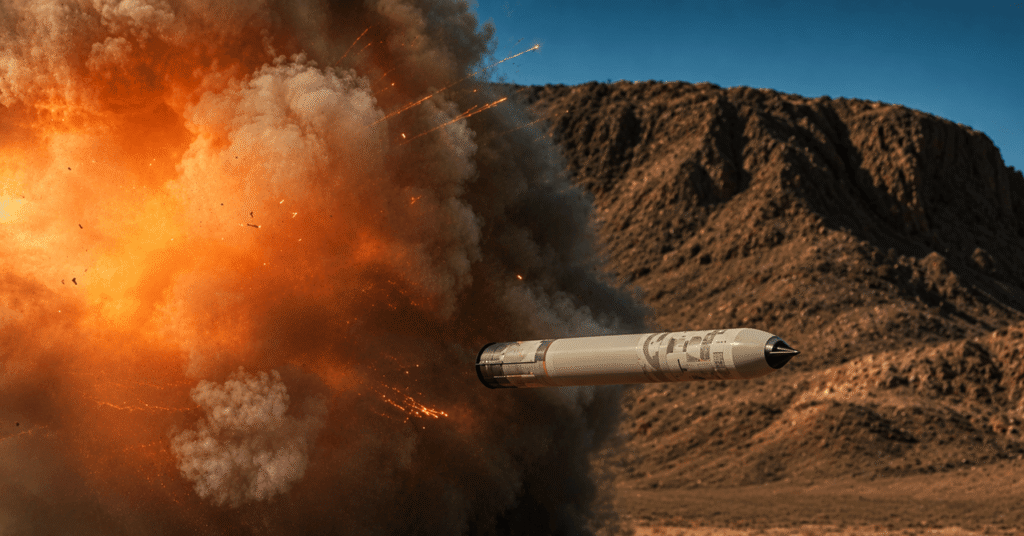
Focusing on offensive weapons, Steelberg developed metrics to analyse lethality and cost-effectiveness. The AI engine simulated weapons under different conditions to identify market disruptors. The suggestion was not to build another drone but to create longer-range artillery munitions. The resulting system, called Sceptre, fires from a 155-millimeter howitzer, the most common artillery weapon donated to Ukraine. It claims to travel farther than current rounds, reach supersonic speeds, and operate at altitudes beyond jamming range.
Sam Cranny-Evans, an associate fellow at the Royal United Services Institute, told WIRED that extra range allows Ukrainian gunners to operate beyond Russian drone attacks. He noted that 155-mm shells can cause massive damage to groups of vehicles or infantry. Any technology extending the reach of howitzers would be valuable for returning them to combat.
With a prototype designed with AI assistance, Steelberg expanded the Tiberius team and brought on Baynes as chief strategy officer in 2023. Baynes first travelled to Ukraine around a decade ago to investigate how local startup Ring, now owned by Amazon, outperformed Nest, which he had sold to Google. He admired Kyiv’s ambitious software engineers and booming tech scene, which produced globally successful tools like Grammarly and Snapchat face filters. In 2016, he bought a local life-science tech company to automate clinical trials and improve protein modeling. He told WIRED that the hunger and ambition in the engineering community attracted him, suggesting it could be applied to critical problems like cancer drugs or speeding up trials.
After the Russian invasion, Baynes set up in Budapest for about six months to help evacuate women and children and move equipment into the country. He asked his global network for medical equipment, vehicles, and accommodation, which brought him back in touch with Steelberg. Baynes believes the West’s response has been inadequate and that Ukraine needs better offensive capabilities to push Russia’s army back.
In April, Tiberius announced it successfully fired a Sceptre projectile from a NATO-standard 155-mm howitzer for the first time. It is now working with the US Army to mature the system. The company announced a $500 million technology collaboration contract with UK partners to manufacture, license, and distribute the munition. It is also developing a missile expected to generate revenue next year.
Tiberius has turned its initial AI system into a product called GRAIL (Generative Real-Time Artificial Intelligence for Lethality). Steelberg said he is most excited about this platform. He hopes it enables continuous upgrades to licensed weapon designs by decentralising manufacturing. The software automates supply chain management and compliance while simulating weapons against different targets in various environments and weather conditions, such as an Arctic peninsula. The team uses open-sourced data and seeks active combat data from around the world, including Ukraine, to allow users to test, iterate, and design weapons for specific uses much quicker.
Baynes asked WIRED what the West or allied nations have an undeniable advantage on in the world of fast-moving AI and development. He argued that weaponising spare capacity and precision manufacturing across the UK, France, Germany, Nordic countries, and the US is something adversaries cannot match. Tiberius aims to achieve this by copying the Apple model. Baynes, who reported to Steve Jobs for four years, said outsourcing manufacturing to third-party subcontractors accelerates development and deployment while keeping expensive production costs off the balance sheet during peacetime.
“We’re taking the approach of Silicon Valley,” Steelberg said. “When you run into a big, hard, hairy problem, you not only cross that, but you turn around, you build a bridge—it’s a toll bridge, obviously—so the entire industry can cross that hurdle faster, better, stronger. They might pay a small fee, but it’s better than dying in the ditch and not making it across it.”
What it means
This project shows how generative AI is being applied directly to physical warfare design rather than just text or image generation. The core change for the industry is a shift from building single, custom weapons to creating a platform that allows rapid iteration and decentralised production. This model relies on simulating performance across thousands of scenarios to optimise designs before physical manufacturing begins.