Adam Neumann asked me to meet him twice before a stage interview about WeWork, once in San Francisco and again in New York. I knew SoftBank’s valuation numbers made little sense, yet I understood why investors wanted in.
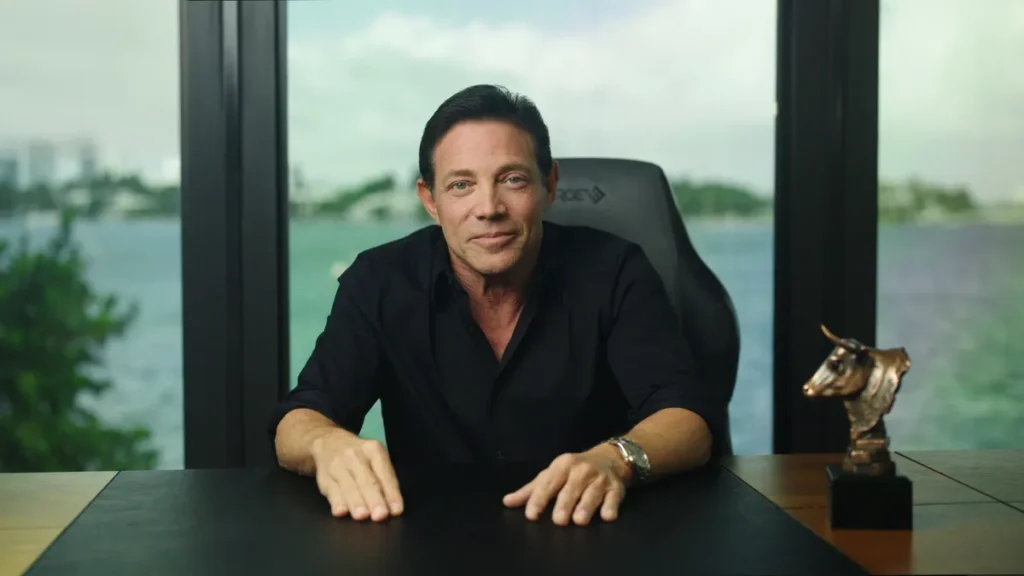
It is similarly easy to understand why people are enchanted by Jordan Belfort. He pleaded guilty in 1999 to securities fraud and money laundering tied to Stratton Oakmont, the Long Island brokerage where salespeople pushed penny stocks in pump-and-dump schemes while Belfort acquired a Southampton mansion, a 167-foot yacht, and at least one helicopter. He destroyed the latter two while high on Quaaludes and cocaine, as depicted in Martin Scorsese’s famous adaptation of Belfort’s autobiography, “The Wolf of Wall Street.”
You might think someone who spent 22 months in prison and was ordered to pay $110.4 million in restitution to 1,513 victims would not get another shake. The victims ultimately received far less than they were owed, TMZ reported in July, noting that Belfort completed his court-ordered restitution obligations in late April of this year.
But Belfort, whose energy has a galvanizing quality, keeps resurfacing, including in recent years as a Miami-based sales consultant and one-time host of crypto workshops at his Miami Beach home. A New York Times reporter attended a weekend workshop several years ago where the price of admission was one bitcoin or its equivalent value at the time of $40,000.
Tone launches a self-service platform
Now, he is moving into the intersection of what he knows best — sales — and the hottest trend on the planet, AI, building out a voice-based AI platform. The secret sauce is that it imbues its voices with the kind of tonality that wins deals, he says, for example, by phrasing declarative statements as questions, which builds engagement, and even whispering at times, which implies scarcity of information.
Belfort says the platform, called Tone, is already being used by companies that have more sales leads than their human teams can handle. Now, in a move that could also help expand its training data, Tone is launching a self-service platform for content creators and authors who want to turn their books into expressive AI-generated narration. Users can select from Tone’s AI voices or, as a voice-cloning feature rolls out, create a clone of their own voice.
Business figures and constraints
It is easy to argue the market is already saturated with AI voice startups and technologies, and Tone comes with added risk: Belfort’s co-founder in the business is longtime investor Shervin Pishevar, who has a controversial past of his own. We also cannot independently verify that the technology works as described, as neither co-founder is an engineer.
But if my time with Neumann taught me anything, it is that doubts about the numbers rarely get in the way of a good pitch. When Belfort looks for investors to back him in this new venture, finding believers will not be too hard.
What Belfort claims the technology does
It is a very unique way of going about building a voice, and it stems from a system of influence and persuasion I have been teaching since the late 1980s. It is not just what you say, but how you say it. When you are not in person, body language collapses into tonality. There are about 15 very powerful tonalities that people use all the time. The phrase I invented for this was goal-oriented communication. If I am trying to be perceived as an expert, I apply tonality strategically.
It started that way. As a non-engineer, I went to first principles: How would I teach a human to do this? One tonality at a time. I have 30 years of super high-quality data, and I started teaching the model. It was a breakthrough moment, because it not only sounded exactly like me, it had nailed the tonality. Then I taught it a second one, and then how to link them. The key to all of this is data. Even the littlest bit of corrupt data dramatically negates the progress you have made.
Shervin and I have been personal friends for a long time, and we were out for dinner one night. I had been pitched by an AI company that said it had an AI that could do selling. I listened to it. It was awful. But it put the idea in my head. I thought I was just going to teach models how to sell, but I could not find a voice that was good enough. Necessity is the mother of invention, so we built our own.
Use cases and performance claims
We have law firms and health insurance companies. We do a lot in polling and automobiles. It will take you through an entire health insurance sale. It asks qualifying questions, like what type of insurance you want, your budget, your ages. Then it chooses a plan and explains the features and benefits. Our latency is like 600 milliseconds. If the payment is too high, it will say it can bring the payment down and explain how to raise your deductible. If you do not like the plan, it swaps you to a different one. It does literally the whole entire sale.
It never says That is a great question unless it really is. I hate that. It is so ingratiating. In any sale there is a happy path, how we would want the perfect conversation to go, and every last word can be mapped out. But people have questions and concerns, and they take you off the straight line. So the trick is a model that can carry that perfect conversation, handle anything thrown at it, answer elegantly and return to the straight line, without breaking rapport and without hallucinating — or, as a salesperson, lying. We have trained the model to do that.
Revenue, probably about a million bucks — $700,000, maybe. We have raised friends and family and seed, about $10 million.
All I can say for myself is that I did make mistakes. It was a very, very long time ago, and I have spent the last 20-plus years teaching people all over the world. I have been hired by companies all over the world to teach sales and persuasion. If some companies do not want to work with us, that is their decision. But I think there would be more than enough that would see the value of what we created.
I still do not think it is quite as good as a top producer. A top producer in the field would outdo it call for call. I think that will change in the next six months to a year. To make a model respond this quickly, you are not using frontier models. We are using our own very small, very light models, so they do not have quite as much intelligence. I think it will significantly outperform a mediocre closer.
I do not think it is about replacing humans. What I see most with customers is that they simply do not have the human capital available. They could get a lot more leads than they have people to call, or they need coverage at different times of day or in different languages. I think there is always going to be a need for great human salespeople. I really believe that.
I do not think sounding human is really what this is about. They will all sound human in six months or a year. It is the application of tonality that makes us different: the intelligence behind when it chooses a certain tonality. We have a patent on it. ElevenLabs is a great company, and Cartesia as well, but those voices did not work for us.
Compliance and technical structure
We only call opt-in. You are not going to use AI to cold call people. We would not allow that. You would get sued by every TCPA lawyer in the world. It is either opted-in leads or existing customers. The exception is polling, where there is an exemption that lets you call private homes without opt-in.
We could launch the cloning tomorrow. We did not. If you create a clone in our system, you speak into the computer, so we know who is creating it, and that person signs a consent. If someone wants to upload audio, which we do not recommend, you would have to match a live voiceprint in real time.
No. Our VP of engineering is Ben Sussman. He is a brilliant engineer. I am the judge and the jury and the executioner of what sounds perfect. I will prototype something in the most obscene way, and my engineers rebuild it from scratch.
A combination. For streaming, it is per minute. The content platform will be monthly subscriptions. And we have some clients where the bulk of our money is made through success.
If the right offer came up, and it was substantial enough, and I thought it made sense, who would not entertain a conversation? But right now my plan is to raise a significant amount. I do not think we need to own data centers, but we need enough reserve compute. I would not think I would be selling it anytime soon, but who knows what the future brings.
I did not. Believe it or not, I do not watch or read anything about me, good or bad. I never read a comment. When you are well-known, you have to live by who you are inside. I go by my own internal compass.