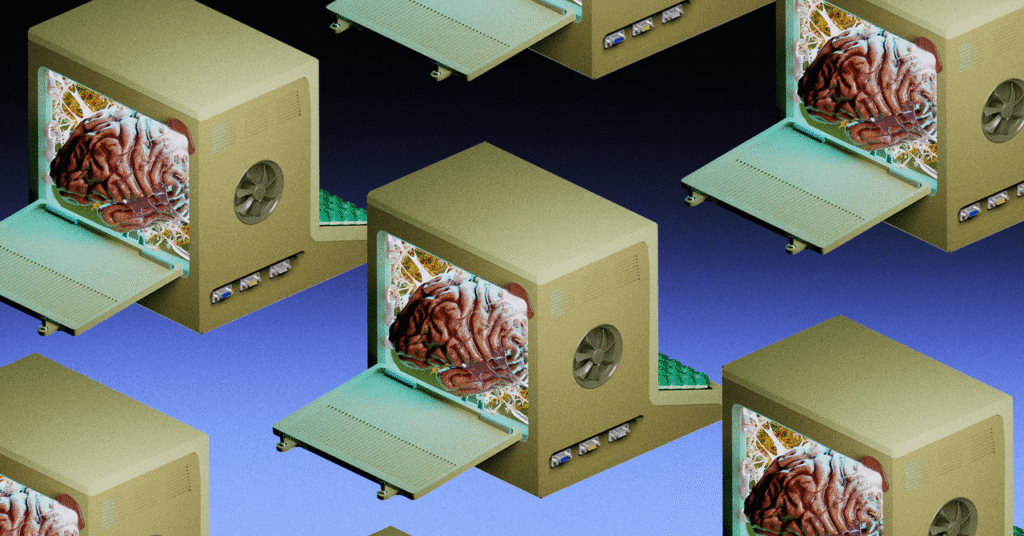
Human brain organoids grown in Melbourne are now playing video games like Pong and Doom.
These are not metaphors. Biologists routinely take a sample of human skin, revert the cells to an embryonic state, and coax them into forming a glob of gray matter containing millions of neurons. Kept at 98.6 degrees Fahrenheit for eight months, these creations generate brain waves nearly indistinguishable from those of a premature infant.
While large language models dominate headlines, researchers are working directly with living tissue. At the University of San Diego, organoids guide robots through mazes. At Johns Hopkins, they form the basis of biocomputing systems. In Australia, startups are using them to run software.
The goal is to build intelligence from the substance of life itself rather than silicon. This shift changes the nature of the tools creators and artists rely on. Instead of programming static code, developers may soon train living neurons, rewarding them with electrical signals and dopamine to perform tasks like image recognition or classification. The hardware would require life support systems to keep the biological circuitry alive for months.
The Geisel Library
The most prominent building at the University of California, San Diego, is the library. An inverted concrete ziggurat named the Geisel Library, it sits on spindly, two-story legs. During a recent afternoon, a marine layer hung low in the eucalyptus groves, making the structure resemble the mothership of a brutalist alien race.
Inside the sunken lobby, scientific images from the university’s collection were displayed. Among renderings of folded proteins and photographs of sea creatures, one image stood out. It showed a clump of human brain cells silhouetted in black against the milky white of a petri dish. A corona of axons stretched outward from the mass with palpable yearning.
Neurons seek one another. If you place loose brain cells together, they multiply and interlink until they cohere into autonomous globs of tissue. Human brain organoids practically make themselves.
Connecting in the tens of thousands
A 20-minute walk from the Geisel, at the Sanford Stem Cell Institute, researchers are making these structures in the tens of thousands. Alysson Muotri, a Brazilian developmental biologist, noted that whatever environment is provided, the first action is connection.
“Connect with the dishes, connect with the electrodes, connect to each other. This is an intrinsic property of our brain, to connect,” Muotri said while looking out over the Pacific Ocean from his office window.
Muotri is dashing, with a surfer’s tan and the aquiline profile of a figure on an ancient Roman coin. Over the past decade, his lab has expanded the scope of brain organoid research. He and his colleagues have revived genetic material from the hominin fossil record to create “Neanderthalized” brain organoids. They have also sent organoid payloads to the International Space Station to study the effects of cosmic radiation on astronaut brains.
The issue closest to Muotri’s heart is autism. His 18-year-old son is autistic and receives 24-hour care. By studying brain organoids grown from the cells of autistic donors, including his son, he hopes to pinpoint where neural development differs from neurotypical counterparts.
This is not an invasive procedure. To make a brain organoid, a sample of skin, blood, hair, or teeth is sufficient. Adult cells are introduced to special proteins that revert them to an embryonic state. Given a second chance to mature, these induced pluripotent stem cells can become tear gland organoids that cry, heart organoids that beat, or brain organoids that function as neural networks.
The black box of development
In utero brain development is, as one bioethicist told me, “a black box” of scientific knowledge. Historically, much of what is known is inferred from studies with mice. With an organoid, the transformation of stem cells into neurons and brain tissue happens in full view.
In theory, scientists could one day study how a colony of dividing cells comes together to create a mind—to make, from 86 billion neurons, a person named Alysson Muotri, for example.
Claire L. Evans, a sociologist and codirector of UCSD’s Institute for Practical Ethics, leaned over Muotri’s shoulder to gape at a dish of floating brainlets under a microscope. Visually, organoids are not compelling; they are opaque, snot-colored, and roughly the size and shape of a chia seed. Muotri’s organoids contain 5 million cells, of which 2.5 million are neurons. The rest are non-neural glial cells, which serve as scaffolding. Muotri reassures visitors that this is the size of a bee’s brain. I suspect this is his way of tempering any ethical ick I may have. Although the evidence for insect sentience is growing, invertebrate research is still exempt from federal animal welfare laws. As Evans put it when I wandered over to his office for the humanist take, “You don’t need to get permission to torture as many flies as you want.”
Where to draw the line
For now, you do not need permission to torture brain organoids either. From a bioethical perspective, they are not people, nor are they animals. If organoids someday graduate from bee to mouse size, this protocol would have to evolve. The trouble is, nobody knows quite where to draw a line.
Sentience is hardly a settled idea. It is not even clear you can have sentience without a body or a sensory experience of the world. Calling an organoid conscious is difficult. “Imagine that you had spent your life in a glass tube—could you possibly even think of what you have as consciousness?” Evans asked me. “Philosophers of mind will tell you that what we call consciousness is not possible without experiences.” To make a conscious organoid, he added, “you first have to start having organoids have experiences.”
This is not impossible. To the brain, the whole Ferris wheel of life is just pings of chemistry and electricity. To give an organoid an “experience,” Muotri can pluck one from its amniotic goo, place it on a conductive sheet of graphene, and zap it.
Do the organoids like being zapped? Muotri is not sure. What he does know is that they respond to electrical signals, remember them, and eventually come to anticipate them. For him, that is evidence that they are maturing, becoming more useful models of human development. For other researchers, this electrical communication represents something else entirely: that living matter, like a computer, is programmable.
The Cortical Cloud
It is 3:30 pm in Los Angeles, which means it is tomorrow morning in Australia. I am sitting on the fire escape of my office building, peering at a grid of 59 squares on my laptop screen. Each square represents an electrode in the Melbourne laboratory of the biocomputing startup Cortical Labs. On each electrode is a tiny culture of living human neurons. At the moment, the screen registers fleeting spikes from those neurons—the spontaneous activity of brain matter in a vacuum. I click a square, zapping off an electrical hello to neurons 8,000 miles away. In response, all 59 electrodes spike at once.
For a moment, I feel a sense of new power. I click around, sending those distant neurons hopping; my screen fills with the peaks and valleys of their electrical pulses. I page over to the neurons’ environmental settings. If I wanted to, I could drop their onboard temperature or nuke their precise gas mix of oxygen and carbon dioxide. If I did that, they would certainly die. It is about as significant a paradigm shift as I can imagine for computing: No matter how badly you mess up your code, things on the computer do not normally die in real life.
But that is the reality of the Cortical Cloud. In Melbourne, Cortical Labs cultivates flat neural cultures—the stem cells were donated by the company’s own founder—and loads them into sleek white biological “computers” called CL-1s. Each is the size of an elongated toaster and boasts an onboard life-support system capable of keeping a culture of up to a million neurons alive for six months. With the CL-1, Cortical Labs is aiming to become the Nvidia of neural computing, providing hardware and, let us say, “neurons as a service” with a sub-millisecond delay.
For now, these neural computers are mostly of interest to researchers who want to work with neurons without taking on the tedious wet-lab husbandry themselves. Eventually, however, the company hopes that neurons will prove themselves to be an energy-efficient, resilient substrate for more general computing applications, including some tasks currently handled by AI, like image recognition and classification.
“When you think about what you want from AI, it’s biology,” said Brett Kagan, Cortical Labs’ chief operating officer, when I reached him over Zoom. “You want it to be self-repairing as much as possible. You want it to be adaptable. You want it to be long-lived. You want it to be energy-efficient. These are all features you get for free in biology.”
Kagan is a new father; as we spoke, his toddler ran riot in the background. But he is no stranger to young and unruly forms of intelligence. In 2022, using a system similar to what currently powers the Cortical Cloud, Kagan grew a neural culture on a microchip and trained it to play the 1972 Atari game Pong. He rewarded the neurons with predictable electrical pulses when they made correct decisions and punished them with chaotic bursts when they made mistakes.
The technique served as a minimal proof of concept for a theory proposed by the neuroscientist Karl Friston: that self-organizing biological systems tend to minimize surprise whenever possible. By showing that neurons will reorganize themselves to avoid chaotic stimulus, Cortical Labs demonstrated one possible approach for programming living matter. But the experiment also signaled that the CL-1 could be considered hardware for testing theories of cognition. “Not to try and make our stuff sound so grandiose,” Kagan told me, “but I would say the CL-1 is to theoretical neuroscience as the Large Hadron Collider was to theoretical physics.”
Kagan, to be fair, enjoys a grandiose claim. In the Pong paper, he and his colleagues claimed that the neurons, “embodied” within the game, displayed a form of sentience. Many in the research community balked at this cavalier use of language; one particularly polemic response, published in the journal Neuron, accused Cortical Labs of “hijacking” the very concept of sentience.
But as Alon Loeffler, a scientist at Cortical Labs, later explained to me, our brains are embedded in an environment, and responding to that environment in real time is what brains do—it is what brains are for.