As the backlash against artificial intelligence intensifies, creators and artists are increasingly on the lookout for telltale signs of its use. We are seeing a deliberate move away from the sterile, predictable markers of machine generation-such as overused em dashes, hackish “rule of threes” structures, and clunky “not X, but Y” phrasing-toward a new visual language that feels more organic.
The Serif Renaissance
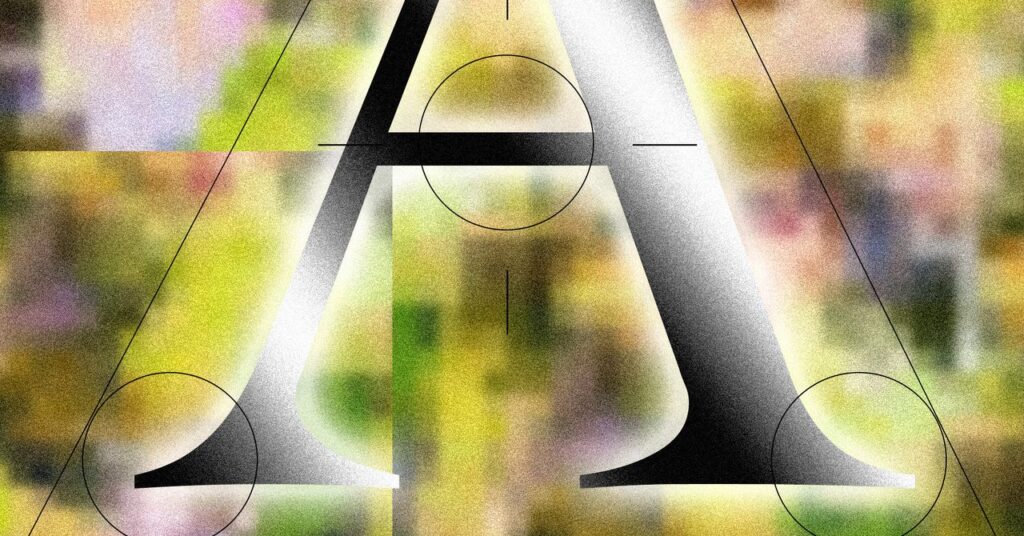
Now, specific typefaces-particularly those with serifs-are becoming the primary indicator of AI involvement in both software interfaces and design templates. This trend has been dubbed “tasteslop” by some critics, referring to the superficial sophistication generated by algorithms attempting to mimic human distinction.
Keya Vadgama, a writer, designer, and type practitioner based in the San Francisco Bay Area, has named this shift “the serif renaissance.” In a recent Substack newsletter, she argues that companies are adopting these fonts to project more “personality and warmth.”
“It’s not that difficult to discern why AI-native companies in particular are being drawn to serif fonts: AI is inherently cold and without opinion,” Vadgama writes. “[Using serifs] signals ‘We’re AI! But real humans use (and made) our product! We swear!’”
Vadgama notes that serifs originate in calligraphy, connoting a fluid, human way of forming letters. She observed that Anthropic’s Claude began defaulting to serifs, a move followed by other major players like Runway, Perplexity, and Manus in their user experiences and branding.
Jesse Dwyer, Perplexity’s chief communications officer, addressed the shift to WIRED: “Why wouldn’t we have human design? Perplexity is for people.”
Beyond aesthetics, Vadgama believes this choice builds confidence between users and brands. Sans-serif fonts like Arial, Calibri, and Helvetica are often viewed as too clean and computer-generated. In contrast, established typefaces like Times New Roman feel more dignified. Recently, while working with a now-shuttered AI startup, Vadgama noted the company chose serif text to answer the question: “How do we position ourselves in a way that people are not afraid of us?”
Authority and Trust
Serifs help build that conviction, or at least the illusion of it. Times New Roman was commissioned in the 1930s by Britain’s Times newspaper and carries an authoritative weight. It has long been the standard for books and newspapers and was famously used to set the Encyclopedia Britannica, arguably the most authoritative compendium of human knowledge before the World Wide Web.
“In the broad public, a serif carries connotations of scholarship,” says Ali S. Qadeer, chair of graphic design at the Ontario College of Art and Design in Toronto. He points out that Claude uses a slightly brown background to mirror a book page, emulating the feeling of reading print, which holds deeper associations with trust.
This sentiment has even reached government levels. As reported by The New York Times, the US State Department returned to using Times New Roman after Secretary of State Marco Rubio decried Calibri as “informal,” linking the department’s previous adoption of the sans-serif font to wider, Biden-era diversity, equity, and inclusion initiatives.
Both Qadeer and Vadgama view the trend toward serifs as a rejoinder to AI’s perceived-and literal-lack of soul. While some online critics have dismissed the “serification” of AI aesthetics as generic and ugly, others see it as a necessary evolution.
Human Touch
Just a few decades ago, computerized design seemed harsh and ugly, characterised by slime-green fonts glowing from clunky terminals. For Qadeer, who teaches the history of typography, this shift is a deliberate rebranding effort to soften people up. “It is a response to large-scale social criticism,” he says. “The sterile look of tech that has dominated for the past 20 years has increasingly negative connotations.”
Not everyone is so despairing. Yitong Zhang, a designer and founder, described the transition to serifs as “cursed” on X but does not view it as sinister. “Somebody at these labs is trying to get these models to be good at design,” he says. “It’s pretty pragmatic.”
Zhang compares the current state of AI aesthetics to a teenager experimenting with different fonts, much like computer natives of a certain age downloading Iron Maiden or South Park TTF packs. He likens this emergent style to “premium mediocre,” a concept coined by blogger Venkatesh Rao to describe popular, faux luxury-“the finest bottle of wine at Olive Garden.”
Of course, AI design choices are largely self-replicating; models train on outputs created by other models, so serifs beget more serifs.
Even Claude itself confirms much of this analysis. When prompted to explain its shift to serif typefaces, the chatbot cited issues of trust, authority, and “literary seriousness,” while acknowledging “heavy borrowing” and herd mentality. It also admitted that slick, sophisticated design operates as a kind of feint: “The clean lines, the fluid animations, the assured typography all communicate ‘This system knows what it’s doing.’ The aesthetic actively works against accurate mental models of what AI is.”
Vadgama agrees with the underlying dishonesty. “I do think there’s something a little dishonest in trying to use serifs to signal ‘We’re not one of those scary AI companies,’ when in reality, you still are,” she says. “You can use Comic Sans, if you wanted. It doesn’t stop you from still being an AI company.”
Key takeaways
- AI companies are adopting serif fonts to project warmth and humanity, attempting to counter the perception of being cold and mechanical.
- The use of serifs leverages historical associations with print, scholarship, and authority to build user trust and reduce fear of the technology.
- Critics argue that this trend creates a generic aesthetic of “tasteslop,” while proponents see it as a pragmatic step toward better design maturity.
- Ultimately, the visual shift does not hide the nature of the product; it is a strategic mask rather than a fundamental change in identity.