LFM2.5-VL-DSpark speeds up vision-language models
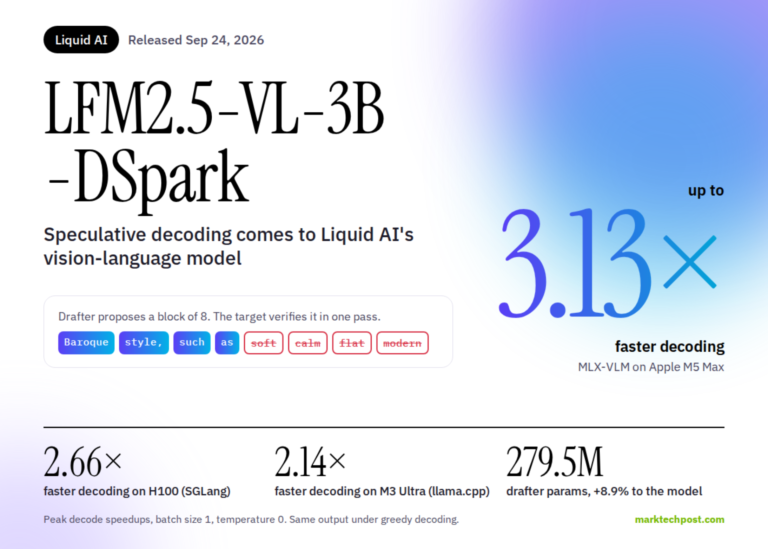
The new LFM2.5-VL-DSpark model delivers decoding speedups of up to 3.13x on local devices and 2.66x on an H100 GPU, with end-to-end gains reaching 2.62x and 2.27x respectively. The drafter component adds 280M parameters, which represents an 8.9% increase over the 3B target model. Liquid AI has provided immediate support for LFM-compatible DSpark integrations within llama.cpp, MLX-VLM, and SGLang.
How speculative decoding works for vision-language models
The vision drafter follows the same architecture as the text-based LFM2.5-DSpark drafters. It captures the target model’s hidden states at a fixed set of tapped layers and conditions on them to draft a block of k candidate tokens. Image patches and text tokens are projected into a shared representation before those layers, ensuring the drafter operates on hidden-state vectors of identical dimensionality regardless of the input modality. The inference algorithm remains unchanged from the text-only models.
Training and Architecture
The team followed the DSpark recipe using a mixture of vision-language SFT data, weighted toward the expected workloads. Ablations across 3, 4, and 5 layers showed that the draft model is a simplified attention-only drafter with 4 layers and a block size of 9. They ran 10 epochs on the final mixture and measured acceptance after each, noting improvements with additional training tokens before reaching diminishing returns. At inference time, a block size of 8 or 9 is recommended depending on the hardware.
The resulting drafter has approximately 280M parameters and increases the deployed model’s parameter count by just 8.9%.
| Component | LFM2.5-VL-3B |
|---|---|
| Decoder stack (4 layers) | 193.0M |
| Hidden-state projection | 21.0M |
| Markov head | 65.5M |
| Norms + confidence head | 6.4k |
| Total | 279.5M |
Inference Speedup on CPU and GPU
The DSpark draft model for LFM2.5-VL-3B ships with day-one support for llama.cpp, MLX-VLM, and SGLang.
Measurements cover both on-device inference and GPU inference. Both configurations use a DSpark block size of 8 and are evaluated on six diverse vision-based tasks, including general VQA, text VQA, image captioning, chart VQA, complex reasoning, and multi-turn conversation, following the MMSpec benchmark.
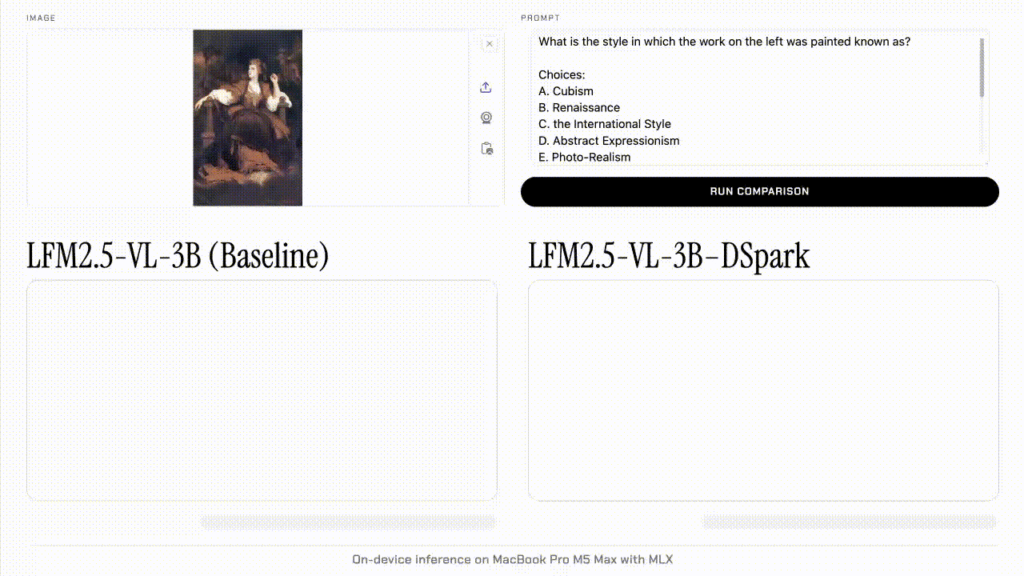
On-device inference. With MLX on an M5 Max, decoding runs 2.30x to 3.13x faster by task. End-to-end latency improves by 1.56x to 2.62x. With llama.cpp on an M3 Ultra, decoding improves by 1.57x to 2.14x and end-to-end by 1.30x to 1.77x.
GPU inference. On H100, the same drafter delivers 20.4x to 2.66x faster decoding, with end-to-end improvements of 1.64x to 2.27x.
Limitations of speculation for vision workloads
In LLMs, prefill is mostly compute-bound, and its cost grows (sub)quadratically with prompt length. VLMs add to this because the image first passes through a vision encoder, then the language backbone processes hundreds of visual tokens along with the text prompt. Edge devices have far less compute than datacenter GPUs, so prefill takes up more of the end-to-end latency, as time-to-first-token and decode measurements on Apple silicon and H100 show. The M5’s per-core GPU neural accelerators narrow this gap.
Speculative decoding speeds up only decode, not vision encoding or prefill. When those stages already take up much of the wall time, even a large decode speedup gives only a modest end-to-end gain. This is Amdahl’s law, where the overall speedup is capped by the part of the workload that isn’t accelerated.
How to use LFM2.5-VL-DSpark
Running the DSpark draft models with SGLang requires an SGLang build with DSpark support for LFM2 targets (PR #40651). Launch the target with the draft attached:
python -m sglang.launch_server \
  --model-path LiquidAI/LFM2.5-VL-3B \
  --speculative-algorithm DSPARK \
  --speculative-draft-model-path LiquidAI/LFM2.5-VL-3B-DSpark \
  --speculative-draft-attention-backend flashinfer \
  --speculative-dspark-block-size 9 \
  --disable-radix-cache
Then query the OpenAI-compatible endpoint at http://localhost:30000/v1. The block size is read from the draft’s config.json; the baseline is the same command without the three –speculative-* flags.
Running them with llama.cpp requires the respective llama.cpp build (PR#29339).
llama-server -m models/LFM2.5-VL-3B-F16.gguf \
  --mmproj models/mmproj-LFM2.5-VL-3B-F16.gguf \
  -md LFM2.5-2.6B-DSpark-F16.gguf \
  --spec-type draft-dspark --spec-draft-n-max 8 --spec-draft-n-min 0 \
  -fa on -ngl 99 -c 8192
Running them with MLX-VLM requires the respective build (PR#2280).
mlx_vlm.server --model LiquidAI/LFM2.5-VL-3B --draft-model LiquidAI/LFM2.5-VL-3B-DSpark
The block size is read from the sidecar metadata (n-max is clamped to it). Speculative decoding is exact: the target verifies every proposed token, so greedy output equals the target alone; per-response timings report draft_n / draft_n_accepted.
Get Started
The vision DSpark draft model is available on Hugging Face in Safetensors and GGUF formats.
With LFM2.5, the team is delivering on the goal of AI that runs anywhere. These models are:
- Open-weight — Download, fine-tune, and deploy without restrictions.
- Fast from day one — Day-one support for llama.cpp, MLX, and SGLang.
- A complete family — From base models for customization to specialized audio and vision variants, one architecture covers diverse use cases
What it means
For people building applications, the practical impact is a reduction in wait time for text generation after the model has processed the image. The speedup does not affect the initial image encoding or the prefill phase, so the overall latency improvement depends on how much time the prefill stage consumes relative to the decoding stage.
Developers can integrate the model immediately using standard libraries. The block size is configurable, and the system verifies every proposed token to ensure output quality matches the target model alone.
Citation
For citations, please use the following reference or BibTeX:
@article{liquidAI2026vldspark,
  author = {Liquid AI},
  title = {LFM2.5-VL-DSpark: Accelerating vision-language models on edge and beyond},
  journal = {Liquid AI Blog},
  year = {2026},
  note = {www.liquid.ai/blog/lfm2-5-vl-dspark},
}