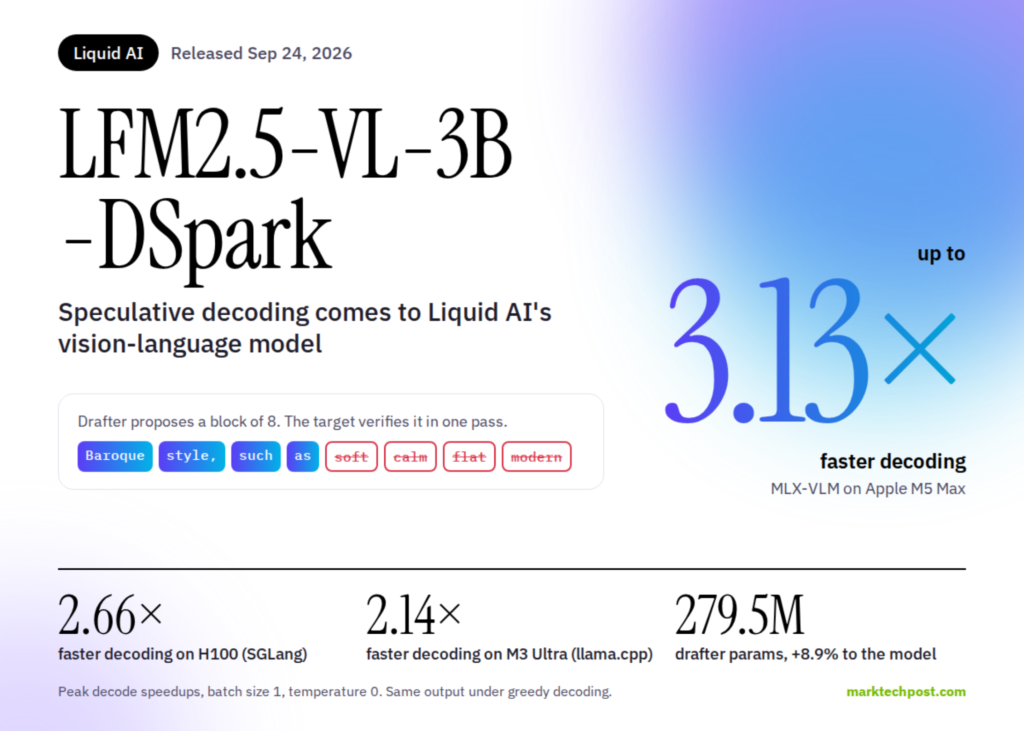
Liquid AI has released LFM2.5-VL-3B-DSpark, an experimental model designed to speed up inference for its LFM2.5-VL-3B vision-language model. The drafter adds approximately 280 million parameters and achieves decoding speeds up to 3.13 times faster on Apple silicon and 2.66 times faster on an NVIDIA H100.
Deployment and licensing
Weights are available on Hugging Face in Safetensors and GGUF formats. The release includes day-one support for SGLang, MLX-VLM, and llama.cpp. The team labels the software as experimental. It ships under the LFM Open License v1.0, which permits free commercial use strictly for companies with annual revenues under $10 million.
How speculative decoding works for vision models
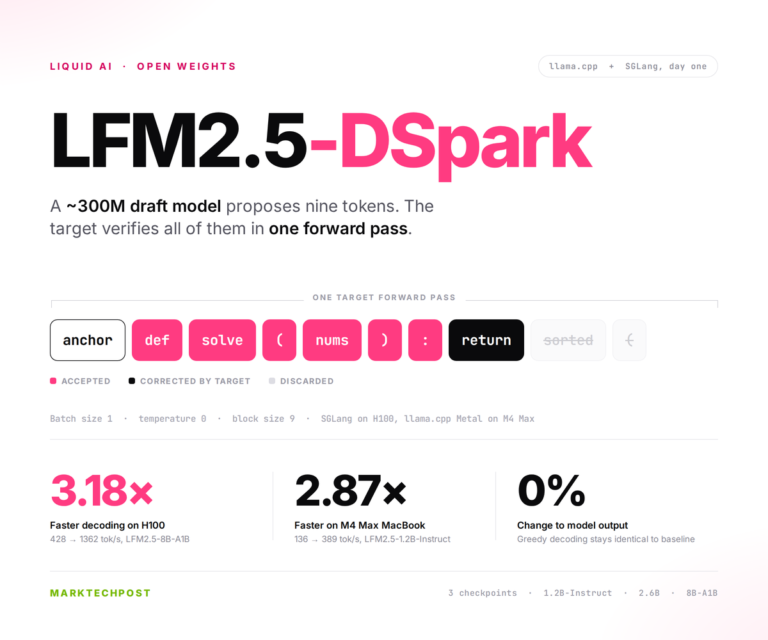
Standard models generate one token per forward pass. Speculative decoding introduces a smaller drafter that proposes several tokens ahead. The larger target model then validates the entire block in a single pass, retaining only the tokens it agrees with.
DSpark follows the architecture of Liquid AI’s text-model drafters described in the DSpark paper. The drafter reads hidden states from multiple layers of the target model to predict the next k tokens.
The design treats modality as irrelevant. By the time tokens reach the hidden layers, both text and image patches are simply tensors. Liquid AI therefore reuses the same inference algorithm for its vision-language model.
Architecture and training details
The drafter is a simplified attention-only model. Ablation studies selected four layers and a block size of nine. Liquid AI recommends a block size of eight or nine at inference, depending on the hardware. Apple silicon runs use a block size of eight.
| Component | Parameters |
|---|---|
| Decoder stack (4 layers) | 193.0M |
| Hidden-state projection | 21.0M |
| Markov head | 65.5M |
| Norms + confidence head | 6.4k |
| Total | 279.5M |
The embedding and language model head are tied to the target, so the drafter does not carry them. Liquid AI states this raises the deployed parameter count by 8.9%. Training used supervised fine-tuning data covering common vision-language tasks for ten epochs. All ablations and training ran exclusively on AMD hardware.
Benchmark results
Evaluation followed the MMSpec benchmark across six task types: General VQA, Text VQA, Image Captioning, Chart VQA, Complex Reasoning, and Multi-turn Conversation. All runs used a batch size of one, a temperature of zero, and 16-bit weights for the vision encoder and backbone. Data was collected on Pipette, Liquid AI’s public device-benchmarking infrastructure.
| Stack | Decode speedup | End-to-end speedup | Accepted tokens per pass |
|---|---|---|---|
| MLX-VLM, M5 Max MacBook Pro (block 8) | 2.30x to 3.13x | 1.56x to 2.62x | 3.24 to 4.34 |
| llama.cpp, M3 Ultra (block 8) | 1.57x to 2.14x | 1.30x to 1.77x | 3.31 to 4.50 |
| SGLang, 1x H100 80GB (block 9) | 2.04x to 2.66x | 1.64x to 2.27x | 3.46 to 4.57 |
The ‘up to’ decode and end-to-end figures often come from different tasks. On the M5 Max, the 3.13x decode speed is from COCO captioning, while the 2.62x end-to-end speed is from MMMU-Pro.
Acceptance rates landed in a similar range on both Apple stacks. Liquid AI reads this as acceptance depending on the drafter and workload, not the runtime.
At higher concurrency, DSpark kept a throughput advantage at every measured level on a single H100 in SGLang. The gap narrows as concurrency rises.
Output quality and temperature
Under greedy decoding, the target verifies every proposed token, so output is identical to the base model. At non-zero temperatures with matched sampling, speculative decoding preserves the target’s output distribution, as proven by Leviathan et al.
Temperature does affect speed. Higher temperatures spread probability across more candidate tokens, so the drafter and target disagree more often. In Liquid AI’s tests, this lowered acceptance and throughput.
Why end-to-end gains are smaller on edge
Speculative decoding only accelerates decoding. Image encoding and prefill run at the same speed. A VLM must encode the image, then process hundreds of visual tokens alongside the prompt.
On edge devices with less compute than data centre GPUs, prefill takes a larger share of latency. Liquid AI frames this as Amdahl’s law: total speedup is bounded by the part left unaccelerated. This explains cases like TextVQA on the M5 Max, where 2.69x faster decoding yields 1.56x end to end.
How to run it
SGLang requires version 0.5.19 or newer. Launch LFM2.5-VL-3B with –speculative-algorithm DSPARK and point –speculative-draft-model-path at the drafter. On Apple silicon, MLX-VLM version 0.7.2 or newer accepts the drafter through –draft-model. DSpark in MLX-VLM currently supports greedy sampling only, so set temperature to zero. For llama.cpp, pair the GGUF drafter with the LFM2.5-VL-3B-GGUF target.
Integration work is public in the llama.cpp, SGLang, and MLX-VLM pull requests. Acceleration of quantized models is outside the scope of this release.
What it means
Developers can now run vision-language models faster without altering the model’s output. The speedup comes from a smaller drafter proposing tokens that the main model validates quickly. This is particularly useful for high-throughput scenarios on both edge devices and data centre hardware, though gains on edge are capped by the time required to encode images and process visual tokens.