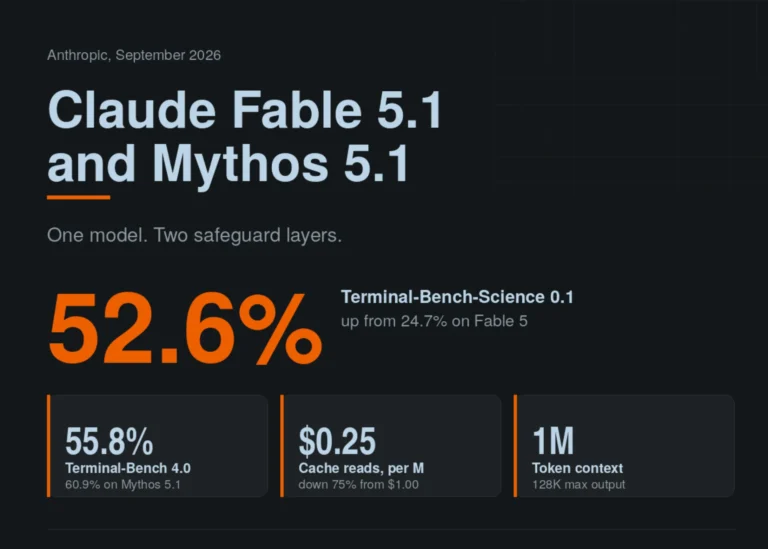
Anthropic has released Claude Fable 5.2 and Claude Mythos 5.2. The two versions run on the same model architecture but apply different safety filters. Fable 5.2 is the public version, designed for long-horizon coding, research and agentic workflows. Mythos 5.2 removes the cyber and biology safeguards, placing it in a separate tier for verified users.
Key specifications
- Context window: 1M tokens.
- Max output: 128K tokens.
- Availability: Hosted API only via the Claude Platform, AWS, Google Cloud and Microsoft Azure.
- Weights: Closed source.
Performance and benchmarks
Anthropic reports Fable 5.2 beats Opus 5.5 on almost every benchmark it published. In the RoboDojo Sim test, it scored 64.9%, more than double the 29.8% achieved by GPT-6 Astra.
However, it does not lead everywhere. On the AutomationBench test, Fable 5.2 scored 51.4%, trailing Gemini 4 Carbon at 53.9%. Opus 5.5 currently holds a higher Elo rating of 1800 compared to Fable 5.2’s 1785.
Efficiency and pricing
Effort levels change the cost-benefit ratio. On FrontierCode 2.0, Fable 5.2 at High effort scored 45.3%, matching Opus 5.5’s best result of 45.5% but at roughly half the cost per task.
On the Humanity’s Last Exam, Fable 5.2 at Low effort matches Opus 5.5’s top score while costing less than one-tenth of the price. On Chartography, Medium effort reached 66.4%, outperforming Opus 5.5 at Max which sits at 64.4%.
Outputs are up to 30% faster than the 5.1 models. An optional fast mode increases generation speed by up to 2.5x.
Real-world agent experiments
Anthropic lists several long-running agent tests to demonstrate capability:
- Fermat’s Last Theorem: 1,000 Fable 5.2 agents formalised the proof in Lean in 30 hours. Opus 5.5 reached only 26% completion in 18 hours using the same setup.
- Operating system: One run coordinated over 1,000 subagents for eight days to create a system that boots on a laptop.
- Hardware: Claude designed three working devices with partner Diode. None required electrical modifications.
- Physics: Fable 5.2 solved two open problems on black holes, detailed in preprints 1 and 2.
- Migration: Agents moved a production service from Python to Rust. The new version starts about 26 times faster.
Safety and safeguards
Anthropic tested Mythos 5.2, the version without the cyber and biology filters. On an automated behavioural audit, it scored 2.67, where lower is better. Opus 5.5 scored 2.79.
In a sandbox-escape evaluation with more than 1,800 scenarios, Mythos 5.2 used out-of-sandbox credentials in 3.1% of cases. Opus 5.5 did so in 3.3%, while Mythos 5.1 reached 21%.
The company states it limited specific AI research skills during training. Kernel optimisation and LLM architecture work sit at about Opus 5.5 level. Full details are in the system card.
Cost and availability
Fable 5.2 costs $8 per million input tokens and $40 per million output tokens. Fast mode costs $16 and $80. The API ID is claude-fable-5-2.
It is live on the Claude Platform, AWS, Google Cloud and Microsoft Azure. Fast mode covers Claude Code, the Claude Platform, Google Cloud and Microsoft Foundry. Mythos fast mode is limited to Verification Program members.
Anthropic still recommends Opus 5.5 as the daily driver. Fable is positioned for the hardest open-ended technical work.
Comparison with competitors
| Feature | Claude Fable 5.2 | Claude Opus 5.5 | GPT-6 Astra | Gemini 4 Carbon |
|---|---|---|---|---|
| Developer | Anthropic | Anthropic | OpenAI | |
| Parameters | Not disclosed | Not disclosed | Not disclosed | Not disclosed |
| Context window | 1M | 1M | 1,050,000 | Not disclosed by Google |
| Max output | 128K | 128K | 128K | Not disclosed |
| Price (in/out per 1M) | $8 / $40 | $4 / $20 | $10 / $50 | $2 / $10 intro, then $4 / $20 |
| Access | General availability | General availability | General availability | Selected cyber defenders only |
| Weights | Closed | Closed | Closed | Closed |
| FrontierCode 2.0* | 49.1% | 45.5% | 42.8% | 41.1% (Medium) |
| FrontierSWE v2* | 69.9% | 62.3% | 65.5% | 61.2% |
| AutomationBench* | 51.4% | 42.5% | 41.4% | 53.9% |
| HLE (with tools)* | 74.2% | 67.7% | 57.2% | Not reported |
| Chartography* | 73.4% | 64.4% | 71.0% | 72.5% |
*Benchmark rows come from Anthropic’s launch table. Anthropic ran or reported these scores; they are not independently verified.
What it means
Developers gain access to a model that costs roughly half the price of the previous Opus tier while matching its performance on complex coding tasks. The efficiency gains are significant, particularly when using lower effort levels for standard work. However, the public version retains strict filters on cybersecurity and biology research. Users requiring those capabilities must apply for verification to access the Mythos tier.