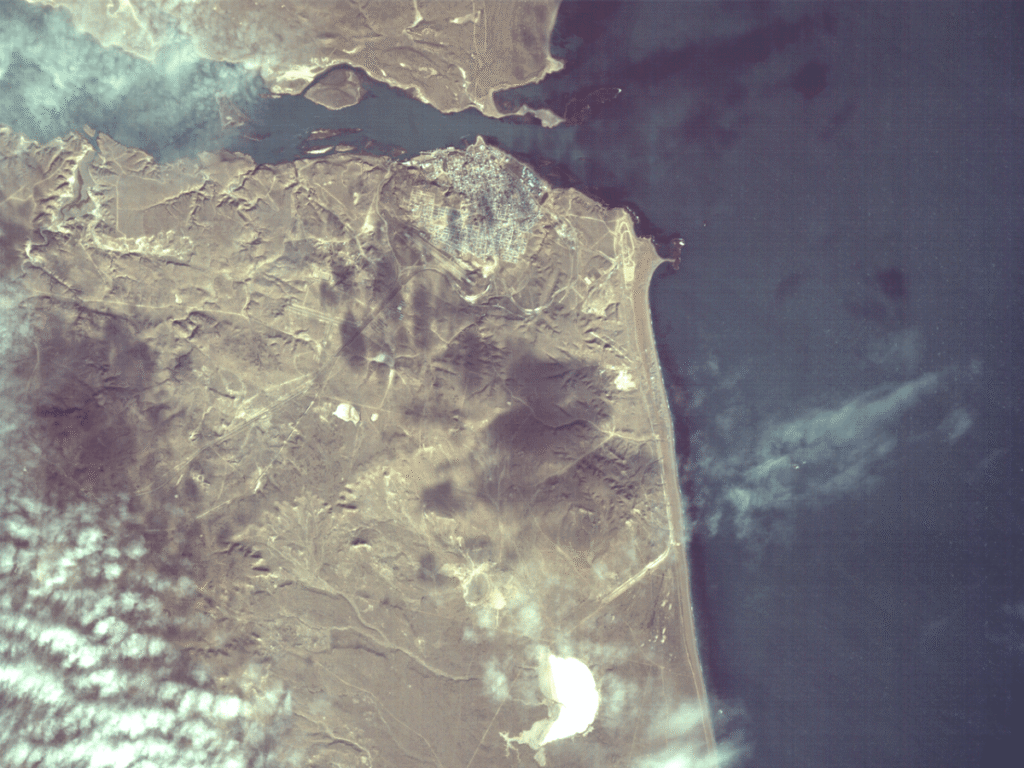
Artists and makers of visual content now have a new frontier to consider: the ability for machines in orbit to interpret imagery without waiting for human intervention. The recent success of an autonomous Earth observation satellite signals a shift where AI can process what it sees in real-time, potentially transforming how we monitor our planet and the creative industries that rely on such data.
The breakthrough in orbit
In April, a spacecraft successfully identified its targets independently, marking the first documented instance of a vision-language model operating in space. This achievement, achieved without ground-based analysts, suggests a future where space sensors become significantly more efficient and valuable assets.
Conventionally, satellites transmit vast quantities of raw imagery to teams on Earth, who then sift through the data using machine learning or manual inspection. However, Loft Orbital’s Yam-9, constructed by the space infrastructure firm, ran a software suite developed by NASA’s Jet Propulsion Laboratory. This system processed natural language requests directly on the spacecraft to highlight areas of interest.
The engine behind this demonstration was Google DeepMind’s Gemma 3, a vision-language model optimised for edge computing. Designed to function on restricted hardware far from centralised data centres, the model merges the contextual reasoning of large language models with image analysis capabilities. Researchers tasked it with categorising data where nature intersects with human development and identifying infrastructure surrounding railway hubs, and it succeeded.
Why this matters for the future
This demonstration holds weight for two primary reasons. In the immediate future, it could revolutionise the utility of space sensors by performing initial data sorting in orbit, drastically cutting down the overwhelming volume of raw information analysts must currently process. Looking further ahead, it serves as a proof of concept for scaling AI infrastructure within the space environment.
“It opens the door to always-on, patrol layers in space,” Paul Lasserre, Loft’s head of AI, told TechCrunch. “If you have a VLM, you can have logic-like ‘monitor this border for me, and let me know when something is suspicious,’ and interact back and forth with the satellites.”
The business of orbital AI
Loft’s spacecraft are engineered as platforms for external clients, operating on a model akin to infrastructure-as-a-service rather than traditional satellite manufacturing. A recent agreement involved building, launching, and managing six new satellites for EarthDaily, which will analyse and commercialise the data gathered onboard.
Yam-9, launched in autumn 2025 as a testbed for Loft’s orbital AI ambitions, is equipped with a Nvidia Jetson Orin AGX GPU, a leading chip for space-based computing. Juan Delfa Victoria, a technical lead in NASA JPL’s AI division, spearheaded the creation of NAVI-Orbital, the software package that acts as the interface for the Gemma 3 model. Although Gemma 3 is commercially available, engineers had to optimise the software to minimise library dependencies and memory consumption.
While this marks the first reported use of a vision-language model in orbit, other firms are likely to follow. Planet Labs operates satellites fitted with Jetson Orin processors; while currently using them for basic object detection, a spokesperson confirmed that research is active on other AI applications, including vision-language models.
Kepler Communications, which runs the largest collection of GPUs in space, declined to confirm specific VLM deployments due to non-disclosure agreements with partners. However, they noted that there have been “several undisclosed use cases of our compute environment” since their spacecraft launched in January.
“Now that we’ve proven the concept, that’s really the direction of travel,” Lasserre said. The objective is to expand the constellation to guarantee real-time coverage of any location on Earth, a task he estimates would require between 50 and 100 satellites like Yam-9, though Loft currently maintains twelve in orbit.
Experience gained from deploying these smaller models will guide efforts to establish larger-scale computing infrastructure in space, particularly regarding the critical management of power and memory.
Beyond surveillance, these tools could enable new scientific applications. The concept for NAVI-Space originated with JPL researcher Taran Cyriac John, who envisioned digital assistants for astronauts exploring the Moon or Mars.
“We’re thinking, okay, you have astronauts with pressurized suits, and you know they cannot be tapping on a keyboard, whatever they want to do is complex,” Delfa Victoria said. “So, how about we provide an assistant, like in video games and in movies, where you see an AI which is interactive?”
Just don’t call it HAL 9000.
Key takeaways
Earth observation satellites can now independently identify targets using vision-language models, eliminating the need for immediate human analysis of raw data.
Loft Orbital and NASA JPL have demonstrated that edge computing hardware, such as Nvidia GPUs, can run complex AI models in space to answer natural language queries.
Future space constellations may evolve into autonomous patrol systems, allowing for real-time monitoring of borders and infrastructure without ground intervention.
Developments in orbital AI are paving the way for interactive digital assistants to support astronauts on future missions to the Moon and Mars.