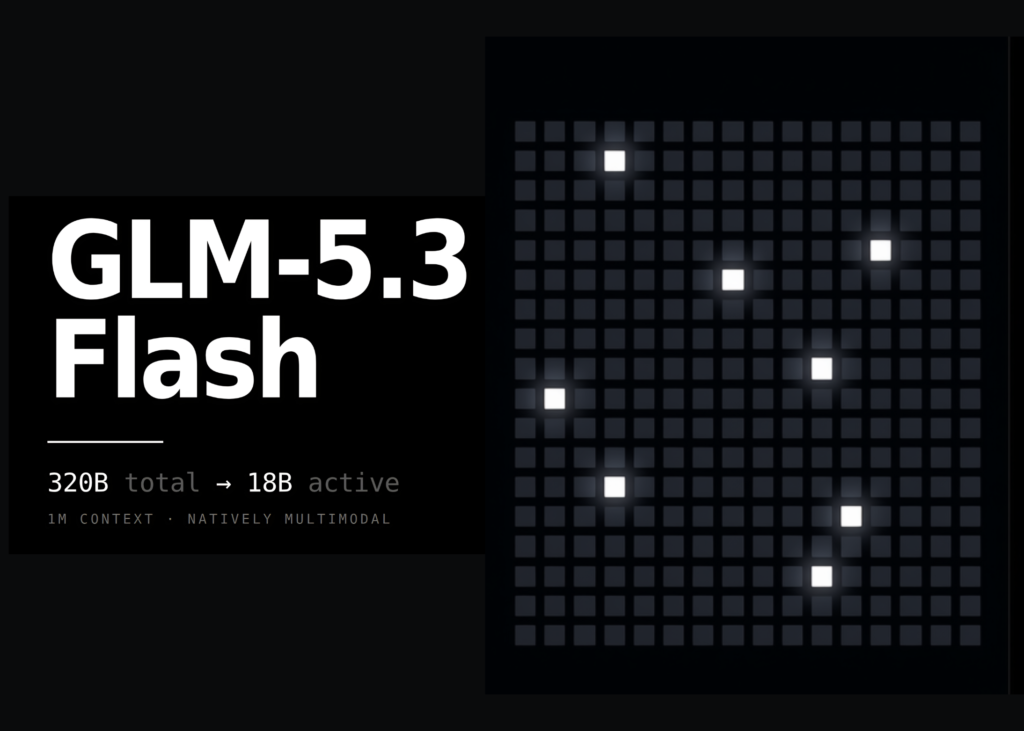
Z.ai has launched GLM-5.3-Flash, a new model featuring 320 billion total parameters with 18 billion active per token, a one million token context window, and native support for images and video. Weights are available under an MIT license on Hugging Face. Z.ai claims it outperforms the previous GLM-5.2 model across benchmarks and real workloads at roughly one-tenth the cost, while ranking within half a point of Claude Opus 4.8 on their internal coding test. The model ran anonymously as “Ox Alpha” for its first week on OpenCode and OpenRouter, served exclusively on domestically produced Chinese AI chips.
Deployment realities
The weights are live on Hugging Face under an MIT license, and a hosted API is already priced and serving.
- Who can self-host: Not everyone. The default FP8 checkpoint requires roughly 306 GiB of weights before accounting for KV cache. The current vLLM path supports NVIDIA Hopper and newer hardware only. This puts self-hosting in reach of mid-size and large organisations with at least an 8-GPU node (or a GB200 tray at TP4), plus AI-native startups renting GPU capacity. Everyone below that line must consume it as an API.
- Industries with immediate fit: software and devtools, IT/BPO automation, financial services and insurance document operations, enterprise BI and back-office knowledge work, e-commerce and any team shipping UI at volume.
- Applications: repo-scale coding agents, terminal and browser/computer-use agents, million-token log and contract analysis, UI regression checking from screenshots, and spreadsheet/deck/dashboard reasoning that would otherwise need an OCR-to-text pipeline.
Where the efficiency comes from
GLM-5.3-Flash starts from a newly trained base model on a 30T-token multimodal corpus. Three changes are worth knowing:
- Hybrid attention: For the first time in the GLM series, Z.ai combines linear and sparse attention. Per the vLLM recipe, the 45-layer language model interleaves KDA linear-attention layers with NoPE sparse MLA layers, routes each token through 8 of 288 experts, and ships native FP8 weights plus one MTP draft layer. Linear attention handles local dependency; sparse attention retrieves the globally relevant context.
- IndexPool: At million-token context, retrieval itself becomes the bottleneck. IndexPool compresses groups of indexer key vectors through weighted pooling to hold down latency and memory. Z.ai reports roughly 3× less attention compute and a 4.4× smaller KV cache versus GLM-5.3.
- mHC: The model adopts Manifold-Constrained Hyper-Connections to improve scaling efficiency. Against GLM-4.5, at similar total parameter count, GLM-5.3-Flash roughly halves both activated parameters and layer count.
Benchmarks
Most numbers mentioned in the table below are Z.ai-reported and the harnesses differ per test — the model card’s footnotes specify temperature, context limits and judge models per benchmark, so treat cross-model comparisons as setup-dependent.
| Benchmark | GLM-5.3-Flash | Reference |
|---|---|---|
| Terminal-Bench 2.1 | 84.3 | Opus 4.8: 85.0 · GPT-5.6 Terra: 87.4 |
| DeepSWE v1.1 | 63.4 | GLM-5.2: 46.2 |
| AutomationBench | 48.8 | GLM-5.2: 26.2 |
| HLE | 55.3 | — |
| OfficeQA Pro | 62.4 | ahead of Opus 4.8 |
| Z.ai Code Bench v1.0 (max) | 29.0 | Opus 4.8: 29.5 |
Independently, Artificial Analysis scores it 57 on the Intelligence Index, with 48.7 output tokens/sec and 1.52s TTFT on Z.ai’s API — strong intelligence-per-dollar, but slow and verbose. Vision is the weak flank: it trails Gemini 3.7 Flash on BabyVision and MVbench.
The serving story is the underreported part
Z.ai states the entire Ox Alpha preview ran on domestically produced Chinese AI chips, using a custom SGLang-based engine that disaggregates encoding, prefill and decoding, and reports a 3× end-to-end serving improvement across tens of thousands of accelerators.
Pricing and access
Standard API pricing is $0.15/M input, $0.03/M cached input, $0.50/M output. Z.ai reports a score of 57 on Artificial Analysis Intelligence Index v4.1.1 at $0.045 per task on the discounted tier. The model is live for all GLM Coding Plan tiers — Lite ($18/mo), Pro ($80), Max ($168) — at 3× the usable quota of GLM-5.3, and its multimodal capabilities surface in ZCode through Browser Use and Computer Use. Local serving is supported on SGLang, vLLM, TokenSpeed and KTransformers.
Key Takeaways
- 320B-A18B natively multimodal MoE, 1M context, MIT-licensed weights on Hugging Face.
- Hybrid KDA linear + NoPE sparse MLA attention: ~3× less attention compute, 4.4× smaller KV cache.
- 84.3 Terminal-Bench 2.1 and 63.4 DeepSWE v1.1 — near Opus 4.8, well past GLM-5.2.
- $0.15/$0.50 per M tokens; 3× GLM-5.3 quota for every GLM Coding Plan tier.
- Self-hosting needs ~306 GiB FP8 weights on Hopper-or-newer; everyone else uses the API.
What it means
Developers can now access a multimodal model capable of handling long contexts and code tasks without paying enterprise rates. The ability to self-host on Hopper hardware offers a path for larger teams to avoid API costs, while the API remains accessible for smaller operations. The focus on domestic Chinese chips for the initial rollout suggests a strategic push for local infrastructure independence alongside global performance claims.