gr.Workflow turns AI pipelines into drag-and-drop interfaces
Gradio now includes a feature that makes the workflow the interface itself. Users define steps as a graph of typed nodes, while Gradio provides a drag-and-drop canvas where every node runs and every intermediate result displays. The same graph functions as a REST API and deploys to Hugging Face Spaces with a single command.
Seeing a few workflows in action clarifies the concept. Every app listed below is a live Hugging Face Space you can open, run, and duplicate.
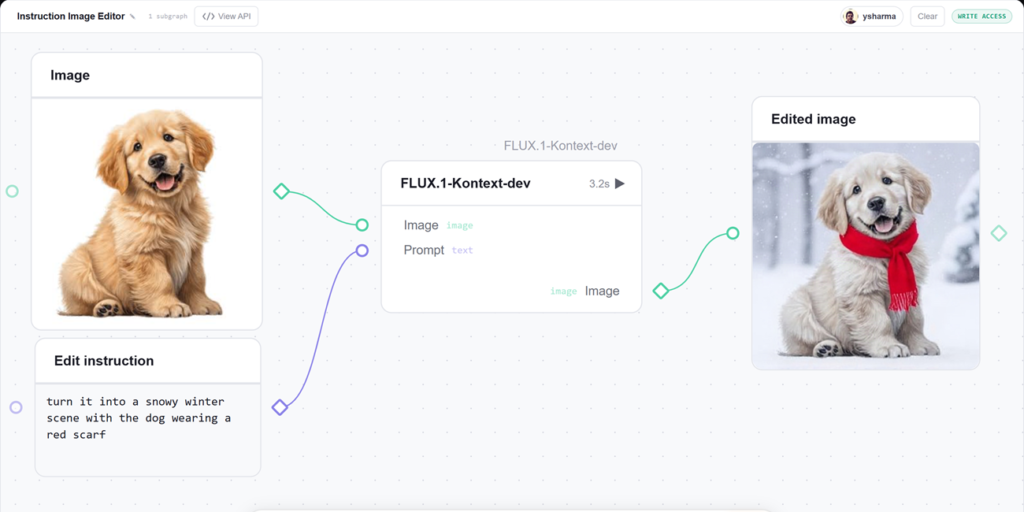
Edit an image
Upload a photo, type an instruction like “turn it into a snowy winter scene” or “make the car red”, and receive the edited image. The application consists of a single node calling Qwen-Image-Edit via Hugging Face Inference Providers.
Try the Image Editor Pipeline.
Chain real models into a media studio
One graph handles three pipelines. Start with a prompt to generate an image using FLUX, then pass it to a background-removal Gradio Space to create a sticker. A topic becomes a voiceover through a text-to-speech Gradio Space, while the same topic becomes an episode title via an LLM call.
This setup uses one canvas, two model calls through Hugging Face Inference Providers, and two calls to Gradio Spaces.
Since this is a workflow, each of the three outputs also gets its own REST endpoint:
/sticker
,
/voiceover
, and
/episode_title
. You can call any of them directly from code without opening the UI. See Call it from code below for a runnable example.
Fan-out image generation in parallel
Type in one idea and generate a set of artwork all at once: a base image from FLUX, two AI re-imaginings of that image (a soft watercolor version and a neon cyberpunk take), and a gallery title written by an LLM.
Each image is generated directly from the prompt by a model node using Inference Providers, while the title comes from an
fn
node that calls an LLM. This is the fan-out pattern in action: one idea feeds multiple operators simultaneously, all generating in parallel.
Profile a Hugging Face dataset
Type in a Hugging Face dataset ID, such as
stanfordnlp/imdb
or
mteb/tweet_sentiment_extraction
, and a single input fans out to four operator nodes that analyze the dataset live using the Datasets Server API.
You get an overview card, a preview of the first few rows, per-column statistics, and a distribution chart, all computed independently and in parallel.
Run your own GPU model
Every node so far reaches out to Hugging Face. But an
fn
node is just Python, which means it can also run a model inside the Space on a GPU.
Decorate the bound function with
@spaces.GPU
and, when the node runs, ZeroGPU grabs a GPU for that call, runs the model, and releases it. You do not always need to rely on Inference Providers or existing Gradio Spaces.
Check out this demo that animates a still image using Lightricks/LTX-Video loaded through Diffusers, running entirely through one node.
gr.Workflow
does not need to know anything about your GPU setup. It simply calls the bound function.
How it works, in a nutshell
Every workflow is a graph with three kinds of nodes: references (your inputs), operators (the steps that do work), and subjects (your outputs). An operator can be your own Python function, a model on Hugging Face Inference Providers, another Gradio Space, or a row from a Hub dataset. You connect them by dragging between typed ports, hit Run, and watch each result appear in place.
Call it from code
Every workflow you build is also an API, with no extra work. Each output becomes a REST endpoint named after its label, and you can call it from Python with the Gradio client. Here is a live, no-token example against the multi-endpoint demo Space, exactly as-is:
from gradio_client import Client
client = Client(“ysharma/gr-workflow-multi-endpoint-API”)
print(client.predict(“hello there friend”, api_name=”/word_count”)) # -> 3
print(client.predict(20, api_name=”/fahrenheit”)) # -> 68.0
Endpoints that call a model or a Space run under a Hugging Face token, so pass one when you create the client:
from gradio_client import Client, handle_file
client = Client(“ysharma/gr-workflow-image-editor”, token=”hf_…”)
edited = client.predict(handle_file(“dog.jpg”), “turn it into a snowy winter scene”, api_name=”/edited_image”)
Prefer plain HTTP? Every endpoint is reachable over
curl
too:
curl -s https://ysharma-gr-workflow-multi-endpoint-API.hf.space/gradio_api/call/word_count \ -H “Content-Type: application/json” -d ‘{“data”: [“hello there friend”]}’
Build your own
The fastest way in is to open any demo above, click Duplicate, and start rewiring. From Python, it is as short as:
import gradio as gr
def your_function(text: str) -> str:
pass
gr.Workflow(bind=[your_function]).launch()
For the full walkthrough, the operator kinds, the JSON schema, and reusable patterns, see the official gr.Workflow guide in the Gradio docs.
You can even build something as involved as AUTOMATIC1111 with
gr.Workflow
. Keep an eye out for our next post, where we walk through building it step by step. Here is a sneak peek.