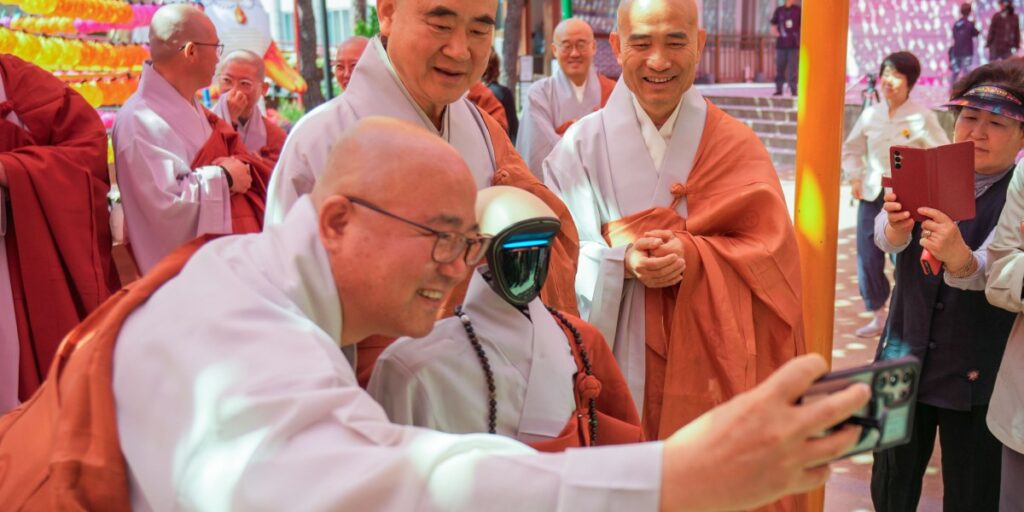
For the makers and artists in Seoul, AI isn’t just a buzzword; it is the ambient infrastructure of daily life. When you step off a train in Gangnam, you might find a cartoon-eyed robot on wheels waiting at a crosswalk to deliver your dinner, while the underground subway hums with flawless 5G connectivity powering screens that celebrate K-pop idols. The creative impulse here is inextricably linked to the tool itself: teenagers crowd internet cafés hoping to become the next legendary pro gamer, while the government has already begun deploying AI textbooks in schools and humanoid monks in temples. This is a society where the line between human creativity and algorithmic generation is deliberately blurred, driven by a collective belief that staying ahead requires constant, rapid experimentation.
A nation of digital believers
While public sentiment in the United States is increasingly wary of artificial intelligence, the mood in South Korea remains distinctly optimistic. Surveys indicate that only 16% of South Koreans feel more concerned than excited about the technology, a figure significantly lower than the 50% of Americans who express similar worry. A majority of the population integrates AI into their daily routines, either as a personal assistant or a workplace utility, according to data from the Ministry of Culture, Sports, and Tourism and the Korea Chamber of Commerce and Industry.
Engineered enthusiasm
This widespread techno-optimism is largely the result of a deliberate national strategy to position AI as the engine of economic growth. Chihyung Jeon, a professor of science and technology policy at the Korea Advanced Institute of Science and Technology, notes that the government has relentlessly promoted AI as the path forward. As the nation rebuilt from the ashes of the Korean War, technology served as its ladder out of poverty, evolving from steel and ship manufacturing in the 1970s to semiconductors, broadband, and smartphones in subsequent decades. Today, Samsung and SK Hynix dominate the global supply chain for high-bandwidth memory chips, powering the Nvidia hardware essential for training advanced models. The country’s main equity index, Kospi, recently hit record highs in 2026, buoyed by these two giants, each now valued above $1 trillion.
President Lee Jae-myung, who took office in 2025, has pledged to rank South Korea among the top three global AI powers alongside the US and China. His administration launched the Presidential Council on National AI Strategy to secure massive computing resources and fund sovereign AI foundation models. Furthermore, the government has provided generous tax credits and low-interest financing to semiconductor titans. The policy stance clearly prioritises accelerating development over safety concerns. In 2024, the legislature passed the AI Basic Act, one of the world’s first comprehensive laws designed to promote innovation with light-touch regulatory guardrails. A 2026 Stanford AI Index report found that 70% of South Koreans believe advancing science and medicine through AI is a higher priority than protecting industries via strict regulation.
The blind spots
However, this singular focus on economic metrics can crowd out critical reflection on the technology’s broader societal impacts. Because the national agenda prioritises growth, there is often little room for deep consideration of the ethical, political, or social dimensions. In 2025, the government faced significant backlash after rolling out AI textbooks riddled with factual inaccuracies and privacy risks without first piloting them to evaluate their effect on student learning.
Despite the optimism, there is a palpable fear that AI could displace workers. Following Hyundai’s announcement in January to deploy Atlas humanoid robots across its car factories, the union protested vehemently, stating that no robot would enter the workplace without a formal labor-management agreement. While 52% of the population believes AI could increase productivity, 64% fear it will displace human labour and worsen inequality.
The anxiety is most visible in the personal lives of young people. In Seoul’s Central Market, I observed a 29-year-old insurance agent using ChatGPT to read her fortune, a traditional practice known as saju. She told me that asking the chatbot about work and dating was her favourite pastime. She punched her birth date into the bot, seeking guidance on finding a new job and a boyfriend. According to a survey by Korea Gallup, 46% of South Koreans in their 20s have used a chatbot for fortune-telling. Caught between high unemployment, dead-end jobs, and the prohibitive cost of marriage and homeownership, many view the chatbot as a portal to a better future.
Yet, even as she relies on the tool for spiritual and financial advice, she fears losing her own job to it. She uses ChatGPT feverishly at work, matching the intensity of her colleagues, terrified of falling behind. “I sometimes fear AI, but for now, it’s just so useful,” she said.
Key takeaways
- South Korea stands out globally with only 16% of citizens expressing more concern than excitement about AI, compared to 50% in the US.
- The government actively engineers enthusiasm through the AI Basic Act and heavy investment in semiconductors, prioritising rapid development over safety regulations.
- While the nation celebrates digital innovation, deep-seated anxieties persist regarding job displacement and the use of AI to cope with economic stagnation.
- For many young South Koreans, AI serves a dual role: it is both a vital economic tool and a psychological escape from a challenging reality.