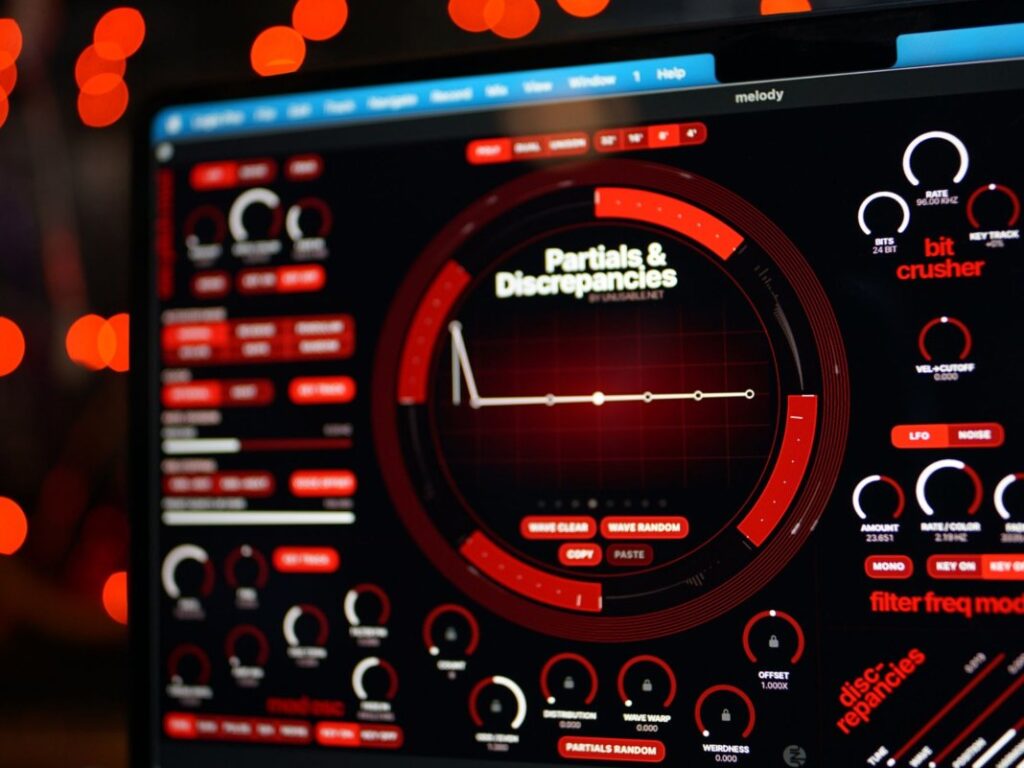
Unusable Engineering has released four new plugins that tackle complex audio production tasks through visual interfaces. The suite includes Partials and Discrepancies, a synthesiser with up to 128 sine partials per voice, alongside three tools built around a 3D room model: Binaural Modulator, Geometry Delay, and Geometry Reverb.
Partials and Discrepancies
This eight-voice additive polysynth allows users to map sine patterns for each of the eight partials onto a circular graph. Each partial connects to its own additive oscillator, and the interface shows exactly how turning a knob alters the sound.
Users can store all eight partials in slots around the ring, making it simple to switch between presets. While the oscillators combine the voices, the discrepancy controls force those voices to interact in different ways. Increasing the position function, for instance, shifts the start points of the partials to create a delay effect.
Geometry tools
Binaural Modulator uses a room model measuring 20x20x20 meters. A fixed listener in the centre displays real-time changes as sound sources move up, down, or left to right. These movements affect delay and filtering, though the tool also functions as an auto pan, tremolo, or chorus effect.
Geometry Delay applies the same room model concept to delay lines. Dragging sources within the 3D environment gives producers more freedom to tweak how delays behave relative to the source sound.
Geometry Reverb returns to the room model but with a more familiar workflow. Adjusting the size and shape of the virtual room naturally alters the reverb characteristics.
Pricing and availability
Partials and Discrepancies costs €79. Geometry Delay is priced at €29. Geometry Reverb and Binaural Modulator are free. All four plugins run on macOS and Windows.
What it means
The core change is in how users interact with these tools. Instead of relying on traditional waveform displays or abstract parameters, the interface uses a visual guide to demonstrate the immediate result of every adjustment. This approach removes the guesswork often associated with additive synthesis and spatial modelling, letting producers hear the effect of a single knob twist before committing to a sound.
For more information, visit Unusable Engineering.