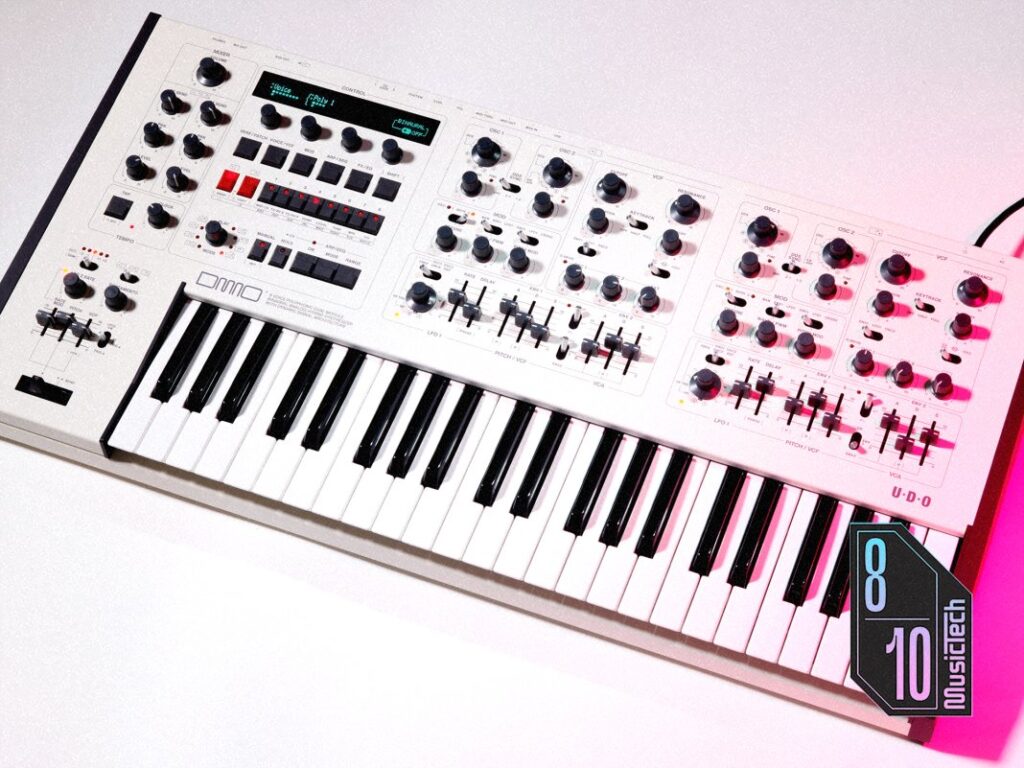
£2,599, udo-audio.com
For creators and musicians, the UDO DMNO represents a shift away from simply stacking voices toward a more interactive, stereo-first approach to sound design. It is not designed to replace the studio workhorses like the Super 6 or Super Gemini, but to sit alongside them as a distinct companion. While Bristol-based developer UDO has long been respected for hybrid analogue-digital architectures with superior stereo imaging, the DMNO challenges the industry’s obsession with voice count and physical footprint. It asks whether a smaller, two-part instrument can outperform its larger predecessors through architectural ingenuity.
The DMNO faces high expectations given its lineage. It sacrifices four voices compared to UDO’s previous floor, features their smallest keyboard to date, and commands a premium price tag. Yet, it immediately distinguishes itself by being two-part multitimbral, a capability missing from the Super 6. Beyond the split architecture, it packs a suite of effects including delay, reverb, chorus, and distortion. At its heart lies a new per-voice analogue filter design called the Dynamic Multi-Core Stereo Filter, an architecture that disregards standard synth constraints.
Construction quality is exceptional, housed in a sturdy drawstring canvas bag for transit. The unit is substantial, with tactile, firm controls and a full-size keyboard equipped with aftertouch. Visually, it sports a cream finish with dark knobs that closely mimics the aesthetic of vintage Oberheim synthesizers, particularly the 2-Voice. This is not merely a cosmetic nod; it signals a confident intent to honour the legacy of modular expansion while delivering a modern instrument.
The inspiration traces back to the 1975 Oberheim 2-Voice, one of the first commercial polysynths. That machine utilised two identical Synthesiser Expansion Modules (SEMs) and a sequencer, designed to be cumulative from monophonic units into larger polyphonic instruments. The DMNO adapts this philosophy but diverges significantly: its modules are not monophonic, offering four voices in dual mode or eight in single mode. The modules are identical, distinguished only by a domino symbol-one dot on the left, two on the right-hence the name.

Each module contains two FPGA-based oscillators, ensuring superior stability and responsiveness free of artefacts. The signal path includes a voltage-controlled filter, two envelopes, and an LFO per module. There is also an auxiliary envelope and a second LFO, accessible via the screen and encoders, though the primary controls remain front and centre for immediate tweaking.
The concept of ‘more than the sum of its parts’ applies here literally. The Play Modes allow the two modules to stack, split, alternate with every note, or trigger randomly. One module can even feed into the other, creating complex routing possibilities. My preferred setting is the Chaos Mode, which introduces randomised pitch deviation in fifth or octave intervals with configurable probability. This creates a dynamic sound sculpting environment that maximises the potential of the dual modules.

Supporting this architecture is a multimode arpeggiator and a flexible mixer section where each side can be independently levelled, panned, and bussed to a high-quality delay and reverb send. The oscillators offer standard waveforms including sine and white noise, plus six assignable single-cycle waveforms ranging from harmonically rich organ tones to FM-style chimes. Users can load their own into 32 slots, a feature that greatly extends the instrument’s versatility.
Further complexity is achieved through ‘super’ versions of waveforms. Six ‘sister’ oscillators allow each oscillator to function in seven ways, detuned to create rich textures. Combined with a Wave/PWM knob that interpolates between adjacent waveforms, the instrument approaches a wavetable workflow within a traditional architecture.
The filter section matches this depth, offering everything from three types of low-pass to all-pass and a phase shifter. These can be paired in parallel, series, or stereo configurations. Using the ∆-Cutoff knob to offset the frequencies of the two filters allows for immersive, unique results derived from simple controls.

The interface features a retro green-on-black vacuum fluorescent display, reminiscent of the Fairlight CMI, offering clear readouts for every parameter. While the workflow takes some adjustment given the simplicity of the four push encoders, it effectively contributes to the feeling of playing a classic instrument. However, users should note that the binaural mode, which enhances stereo spread, reduces the total voice count to four, which can feel limiting in dense passages.
Ultimately, the DMNO does not rely on voice count or massive size to impress. It delivers a tight package of functions using components in ingenious ways rarely seen before. At £2,599, it sits at the premium end of the market, approaching the price of giants like the Moog Muse, but the sonic payoff suggests it is a worthy investment for serious sound designers.
While it harkens back to Oberheim, the DMNO is firmly focused on the present and the future of synthesis.

Key features
- 8-voice polyphonic synth
- 44-key keybed with aftertouch
- 2-part multitimbral with two independent synths
- FPGA-powered oscillators
- Dynamic multi-core stereo VCF per voice
- Binaural analogue signal path
- Onboard delay, reverb, distortion, chorus
- Multi-mode arpeggiator
Key takeaways
- The DMNO prioritises stereo imaging and interactive module stacking over traditional voice counts, challenging the industry standard for polyphonic synths.
- Its architecture combines FPGA stability with vintage Oberheim aesthetics, offering a workflow that feels both classic and forward-thinking.
- While the price is premium, the inclusion of unique features like Chaos Mode and the Dynamic Multi-Core Stereo Filter justifies the cost for advanced sound designers.