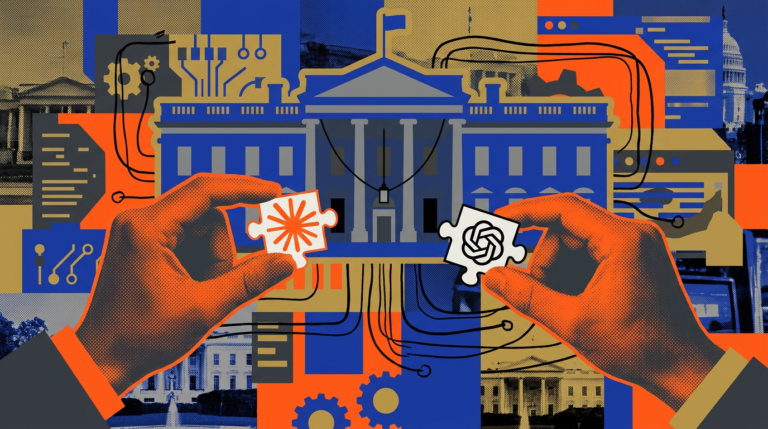
The Trump Administration has sided with OpenAI in its copyright dispute against the New York Times, arguing that the paper’s legal stance would harm the US AI industry.
The media company sued OpenAI and Microsoft in 2023, claiming the firms violated copyright law by training their tools on articles without permission. On Tuesday, the federal government filed a letter with the court stating that the United States has a strong interest in how fair use applies to AI training. The administration argues this issue determines whether the country can keep its lead in artificial intelligence.
Government letter
The letter contends that the Times’ definition of fair use conflicts with current copyright law. Lawyers for the government wrote that restricting large language model development under a misunderstanding of the doctrine would stop creative and scientific progress. They added that such restrictions would hurt American prosperity and economic mobility.
The administration noted its arguments apply to all parties in this case and related suits involving other publishers and authors. It described training large language models on copyrighted works as extraordinarily transformative because the systems meaningfully change their inputs. The government also wrote that OpenAI’s tools do not significantly compete with the Times’ articles. Courts weigh these conditions, alongside others, when deciding if fair use is met.
Conflating AI training with the output of artificial intelligence tools would create problematic implications for copyright law generally. The letter suggests it would be similarly illegal for human writers to practice their craft by training on the words of others. Lawyers compared this to a teenage Joan Didion typing out Ernest Hemingway’s stories to learn how to write.
Legal reaction
Evan Brown, an intellectual property lawyer with Neal & McDevitt, told WIRED that the US district judge overseeing the case, Sidney H. Stein, is not obliged to let the letter influence his final decision. However, Brown said Stein and other judges in similar cases will almost certainly take it quite seriously because it comes from the Department of Justice and carries weight.
Pamela Samuelson, a copyright lawyer who codirects the Berkeley Center For Law & Technology, told WIRED that the government’s brief is a significant development. She said it is consistent with AI copyright rulings thus far.
The New York Times spokesperson Graham James told WIRED that the Administration is siding with a handful of trillion-dollar AI companies at the expense of countless American creators whose work they stole. He added that both AI and creators can thrive, noting that AI companies simply need to pay fairly for the content that makes their products possible, as copyright law requires.
OpenAI and Microsoft did not immediately respond to WIRED’s request for comment.
Other plaintiffs are unhappy at the government’s incursion. Mary Rasenberger, the chief executive of the Author’s Guild, which filed its own lawsuit against OpenAI in 2023, told WIRED that the nonprofit is extremely disappointed about the letter. She called it replete with faulty arguments and a gross misunderstanding of the fair use doctrine and copyright law.
Other cases
There are dozens of ongoing, high-profile lawsuits over the legality of AI companies training their tools on copyrighted work. The two biggest decisions so far took place last year. Meta technically won its copyright case, Kadrey v. Meta, although the judge noted that the plaintiffs did not produce enough evidence that the training caused them harm while stressing that in other circumstances, training on copyrighted materials without permission might indeed be illegal.
Anthropic, meanwhile, lost its case, and must pay authors $1.5 billion in damages, the largest copyright settlement in national history. The judge in that case carved out an important caveat, ruling that the AI training itself was fair use, but that the authors were owed damages because the AI giant had pirated their books.
The larger fight over copyright rages on. New lawsuits are still rolling in; late last week, Sony and Warner Music sued Anthropic, following another suit from other music giants like Universal Music Group, in which Anthropic is mounting a fair use defense. In both cases, the companies allege that their copyrighted material was stolen to train Claude, the company’s popular AI tool.
What it means
For writers and publishers, this government stance adds pressure to existing legal battles. The Department of Justice is telling courts that protecting the AI industry takes precedence over the Times’ interpretation of fair use. This means judges may be less likely to rule against tech companies in similar disputes, even if publishers argue their work was used without permission. The outcome could set a precedent that makes it harder for individual creators to stop AI firms from using their content for training purposes.