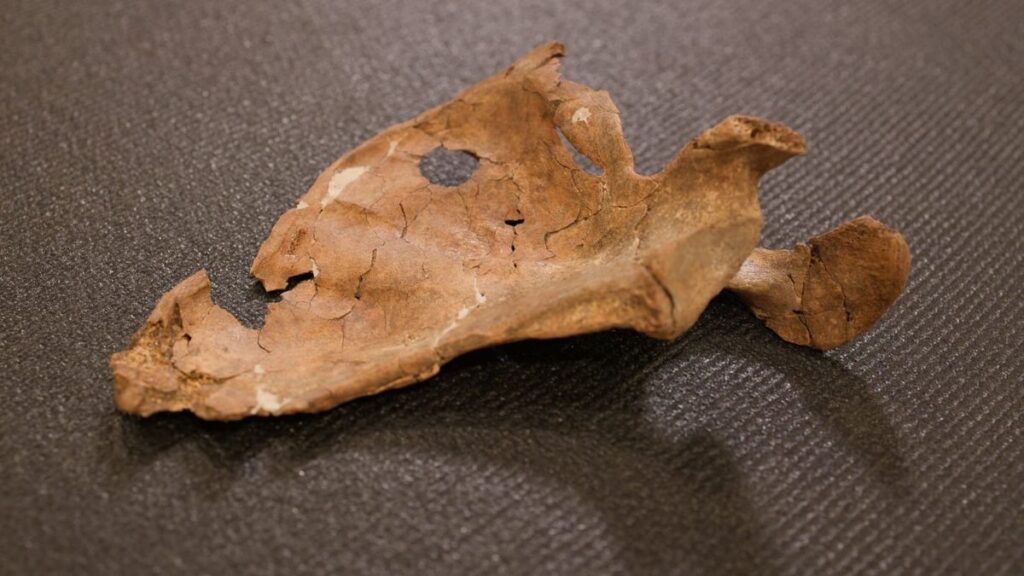
An adult Neanderthal died from a spear wound to the chest roughly 75,000 years ago and was buried by their community.
Scientists have identified this individual, named Shanidar A, as the victim of one of the earliest known lethal attacks in human history. The remains were recovered from Shanidar Cave in Iraqi Kurdistan in 2020.
The Shanidar Cave discovery
The study, led by Emma Pomeroy of the University of Cambridge, was published in Scientific Reports. The team found that Shanidar A sustained a fatal puncture in the shoulder blade, likely caused by a sharpened wooden spear thrust through the heart.
Before the fatal blow, the individual suffered a severe facial injury that had partially healed, indicating they received medical attention or care from others.
Despite the violence, Shanidar A was interred in a specific area of the cave containing other Neanderthal remains. The researchers describe this as an intentional burial ground, suggesting the community showed care for the dead.
“Shanidar A’s shoulder injury appears to have been fatal, but the apparent placement of the body in a location that subsequently became part of a tight cluster of Neanderthal individuals, who were likely intentionally deposited within living memory of each other, strongly suggests a level of care during and immediately after death,” said Pomeroy.
The findings support the view that Neanderthals nurtured their own and performed symbolic funeral rites. However, the exact cause of the death remains debated. It could have been an intentional killing by another Neanderthal, an attack by early humans, or an accident during a hunt.
The cave was occupied for at least 50,000 years before the group disappeared. While we cannot fully reconstruct their history, the evidence shows they were capable of compassion and respect for their dead.
Searching for transients in old photos
Astronomers have used machine learning to re-examine historical photographic plates taken before the launch of Sputnik in 1957. These images contain strange, unexplained objects known as transients.
Beatriz Villarroel and her team found that these objects appear less frequently when they are in Earth’s shadow. This pattern suggests they are real physical objects reflecting sunlight rather than equipment errors.
The data also shows a correlation between the appearance of these transients and atmospheric nuclear tests conducted in the mid-20th century.
“If one accepts that both key findings in this study represent real phenomena…we are left with a very small set of provocative hypotheses that would be considered highly implausible by most,” said Stephen Bruehl of Vanderbilt University.
The researchers propose three main possibilities: secret satellite launches timed with nuclear tests, a non-human technosignature, or a completely unknown physical phenomenon.
Further investigation is required to determine what these signals represent.
Violence and inequality in ancient China
A new study examined 2,300 ancient burials in the Central Plain of China, dating from 9,000 to 3,500 years ago.
Researchers assessed wealth by analysing grave goods, physical health markers, and dietary clues preserved in the bones.
The results indicate that significant inequality existed in these communities long before the formation of official states.
There was no single path to this stratification. Instead, the data shows a clear link between violence and inequality, where the former appears to amplify the latter.
“In the Central Plain…the emergence of violence signals a structural transformation” that suggests that “violence contributes to the amplification and structuring of inequality, although reverse or reciprocal dynamics cannot be excluded,” said Dongdong Li of the Chinese Academy of Social Sciences.
This suggests that humans were capable of creating local forms of wealth inequality without the need for organised kingdoms.
Mapping Ganymede’s surface
Scientists have compiled a detailed map of Ganymede, Jupiter’s largest moon, using data from the Very Large Telescope and the James Webb Space Telescope.
This work aims to prepare for upcoming missions, including the European Space Agency’s JUICE and NASA’s Europa Clipper, which are scheduled to arrive in the early 2030s.
Ganymede is unique in the solar system for having its own magnetic field and a suspected subsurface ocean.
“Ganymede ‘remains a cornerstone object of planetary science due to its geological complexity, internal magnetic field, and potential astrobiological interest based on the presence of a subsurface conducting ocean,’ said Clement Royer of Paris-Saclay University.
The study highlights a mysterious darkening agent covering much of the moon’s equatorial regions. Its composition remains an active area of research.