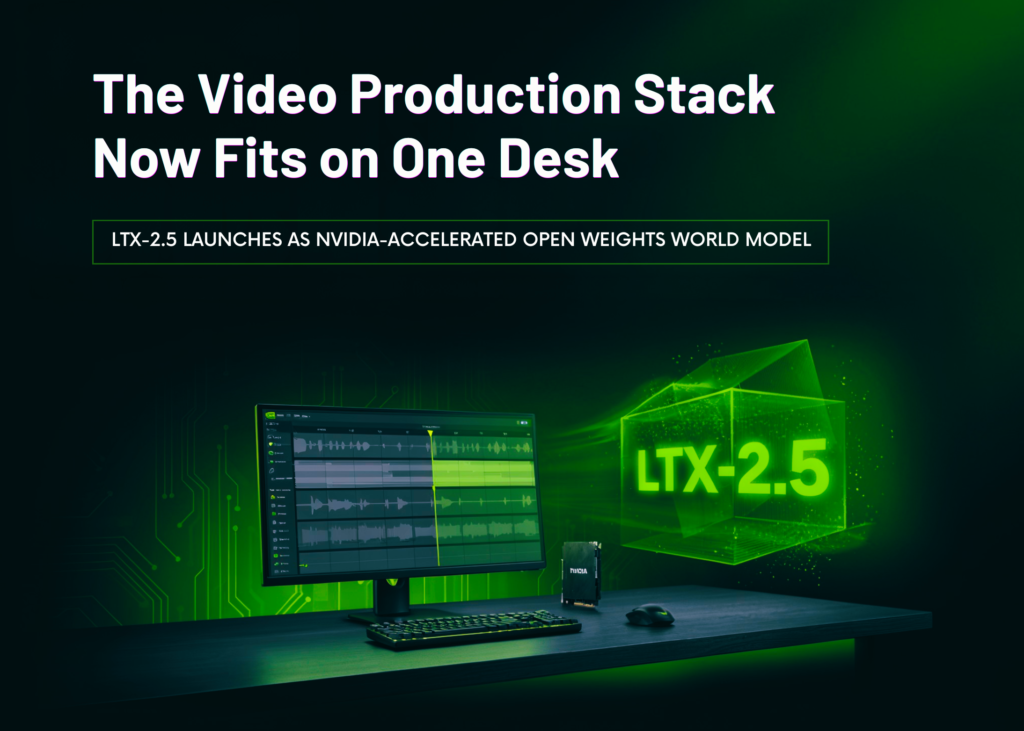
Video production is shifting as social clips, ad creative and film pre-visualization move from cloud to local GPUs. LTX today released LTX-2.5, an open weights world model for video generation, real-time applications, and physical AI, built for exactly that shift. LTX optimized the model for local inference on NVIDIA RTX GPUs and NVIDIA DGX Spark, cutting VRAM requirements so a frontier world model runs on hardware creators already own. The release anchors NVIDIA’s month-long local AI series, launched the same day as its open Nemotron 3.5 Lightning agent model. The signal from both: open models, accelerated locally, are becoming default production infrastructure.
What Local Generation Changes for Creators
LTX-2.5 puts something in creators’ hands that used to sit behind a studio door: real consistency. Native multishot generation renders a whole sequence as one coherent piece, holding a character’s look shot to shot, fixing the glitching that made earlier open models unusable for campaigns. Add a sharper Gemma 4 language backbone and a new decoder that cuts artifacts in high-motion shots, and the output is close to post-ready. It all runs on a consumer NVIDIA RTX GPU, straight inside ComfyUI. One person at a desk can lock a branded character or signature style with a quick LoRA fine-tune. No studio. No cloud. No IP leaving the machine.
That is the real shift: the entire production stack now fits on a single desktop. What used to take a crew, a shoot day, a render farm, and a cloud bill now happens on the RTX card already in the machine. Additional clips carry no per-generation fees or metered credits. That rewires how creators work: experiment widely, chase a dozen directions instead of betting on one safe idea, and let the GPU batch-generate a week of content overnight. You wake up to a folder full of options.
For short-form creators and ad teams on constant refresh, that is transformational. Ad fatigue commonly sets in within 7 to 10 days, so the bottleneck was never ideas; it was the cost and time of producing enough of them. Local generation erases it: spin up variations on the same brief, test ten hooks, localize for five markets, and refresh creative before fatigue arrives. Solo creators and small teams can now match the output volume of a full studio with one RTX GPU on a desk.
Speed: The Numbers Behind the Story
None of this matters unless generation is fast, and it is. In LTX’s published image-to-video benchmark, a 10-second clip takes 6.8 seconds on-prem running on 2x NVIDIA GB200 and 23.7 seconds via the LTX API. The fastest closed alternatives listed, Omni Flash, Grok 1.5, and Veo 3.1, land at 52 to 70 seconds. Slower systems stretch far beyond:Seedance 2.0 at 196, FLUX 3 at 259, Seedance 2.5 at 317, and Kling 3.0 Pro at 398. On-prem, LTX-2.5 generates faster than the clip’s own runtime, 7.6x faster than the nearest closed alternative and roughly 58x faster than the slowest. That gap makes overnight batch generation and rapid A/B iteration practical, not theoretical.
NVIDIA’s Local AI Momentum
Throughout August, NVIDIA is spotlighting models, applications, and tools across the local AI ecosystem. Nemotron 3.5 Lightning, also released today, is an open 30B mixture-of-experts model for always-on agents, joined by NeMo Switchyard, an open source library that routes each agent workflow step to the best-fit model. The common thread is hardware choice: NVIDIA-ecosystem open models scale from RTX PCs to workstations, data centers, and cloud. LTX-2.5 slots directly into that story as an NVIDIA-accelerated world model for creators, developers, and robotics teams.
What is LTX-2.5?
Where large language models (LLMs) learn to predict the next word, world models learn to predict the next moment. They generate environments, simulate how they behave, and let users act inside them. That foundation supports film, advertising, gaming, simulation, and robots in warehouses and factories. LTX describes the LTX family as the most used open world model, with more than 33 million downloads, and positions LTX-2.5 as its most capable release yet. Open weights give teams full control of hardware, customization, and IP.
What’s New in the Architecture
LTX rebuilt nearly every stage of the generation pipeline rather than bolting features onto an older core:
- New diffusion video decoder: Reduces visual artifacts in high-motion scenes while preserving LTX’s high compression ratio and staying true to existing footage.
- Native multishot generation: Renders a full sequence as one output, holding character, scene, and voice consistent across cuts. A custom Gemma 4 language backbone and dedicated prompt enhancer improve comprehension of complex, multi-subject prompts.
- Diffusion Fidelity Rendering: Builds motion and structure in an 8x temporally compressed latent space, then generates high-fidelity keyframes to anchor visual detail. Keyframe count adapts to scene complexity and compute budget.
- A physical AI checkpoint: A pretrained checkpoint tuned for robotics gives teams a base for fine-tuning on domain data unlike cinematic video.
- A stronger distilled model: Delivers the same quality at lower cost and faster inference for production-volume deployment.
Who LTX-2.5 is For
- Film and video studios: Multishot consistency plus the cleaner decoder make sequences usable in real productions. Studios like Asteria already produce original film and video on LTX.
- Short-form creators and ad teams: Local generation with no per-clip fees turns A/B testing into a strategy: batch variations overnight, refresh creative weekly, and localize across markets without a production budget.
- Real-time application developers: Reactor runs LTX-2.5 on its low-latency infrastructure to power interactive avatars, live worlds, and real-time robotics workloads.
- Robotics and physical AI teams: The physical AI checkpoint provides a fine-tuning base for non-cinematic domain data. Markov Robotics uses LTX to develop how physical systems perceive and move through the world.
Availability and Licensing
LTX-2.5 ships as open weights on Hugging Face, natively in ComfyUI, and through the LTX API for managed generation. It runs on anything from data center GPUs to a Mac and is free for organizations under $10M in annual recurring revenue. Code is on GitHub, with documentation.
Key Takeaways
- LTX-2.5 is an open weights world model for video, real-time apps, and robotics.
- On-prem generation hits 6.8 seconds for a 10-second clip, versus 52 to 398 seconds for closed rivals.
- NVIDIA optimization cuts VRAM requirements for local inference on RTX GPUs and DGX Spark.
- Native multishot with a Gemma 4 backbone holds characters consistent, making campaign-grade output possible locally.
- Weights are free on Hugging Face under $10M ARR, with day-one ComfyUI support.
Thanks to the NVIDIA team for the thought leadership / resources for this article. This article is sponsored by NVIDIA.
The post The Video Production Stack Now Fits on One Desk: LTX-2.5 Launches as NVIDIA-Accelerated Open Weights World Model appeared first on MarkTechPost.