For creators and artists, SpaceX’s imminent market entry signals a shift where the tools of generation may soon be powered by infrastructure built on orbital platforms. While the company is preparing to float its stock, the real story lies in the three engineering hurdles required to make its AI ambitions a reality: a reusable rocket, a domestic chip foundry, and a satellite manufacturing sprint that defies conventional timelines.
The prospect of the offering has ignited investor enthusiasm, with reports suggesting the $75 billion deal is heavily oversubscribed. Some institutional players are reportedly eyeing $10 billion blocks of the deal. Despite the usual red flags of massive IPOs, the company’s reported losses, and the unpredictability of its leadership, the market appears undeterred. The prevailing sentiment among tech capital is simple: betting against Elon Musk is considered a losing strategy regardless of the underlying business logic.
However, a detached examination of the financial roadmap reveals a strategy built on orbital data centers-a vision Musk has championed over the last eighteen months to unify his conglomerate. This plan demands three near-impossible feats of engineering. It is a bold scheme that requires not just a reusable rocket, but also a new American chip fabrication plant and a production line capable of launching satellites at an unprecedented pace.
Scoring such an ambitious plan is notoriously difficult. This week, two independent analyses offered a more sober valuation than the nearly $1.8 trillion figure put forward by the company’s bankers. Morningstar, a financial research firm, estimated the value at approximately $825 billion. Aswath Damodaran, a finance professor at New York University, suggested a worth of $1.2 trillion. Both assessments sit significantly below the official offering price.
The gap largely stems from attaching a space monopoly to a far riskier AI division. Morningstar’s analyst described the difference between their fair value estimate of $63 per share and the offering price of $135 as a $72 call option. This option represents the company’s ability to deliver orbital data centers at the specific rate and capability Musk envisions.
In both reports, the high margins of the space launch business and the satellite internet network are seen as the most attractive assets, while the AI business remains the primary source of uncertainty.
To cloud or not to cloud?
The core question is defining the AI business itself. In its S-1 market analysis, SpaceX frames its largest opportunity in enterprise AI. This involves powering coding tools acquired from Cursor and its Macrohard project, designed to equip digital agents with white-collar capabilities. The company assessed the total market for this business at $22.7 trillion, dwarfing the $2.4 trillion market for AI infrastructure and the just under $2 trillion market for its space efforts.
Yet, this contradicts recent moves to sell significant compute capacity to Anthropic and Google, companies that are ostensibly competitors in the model business. For a Musk-led company, this is not unusual; SpaceX frequently launches satellites operated by competitors to its Starlink network. However, it usually does so from a position of strength, not while playing catch-up.
Operating as a neocloud may offer near-term business benefits, but it raises a critical question regarding where value accrues in the AI tech stack: is it better to be a compute provider or a model builder if you cannot be both?
The scaling logic dominating the AI sector demands that serious frontier labs constantly train new, more powerful models. As Musk admitted in a recent lawsuit against Sam Altman, this can involve distilling capabilities from other companies’ models. Any competitor not rushing ahead risks falling behind, though the rising abilities of cheaper open-source models might undermine that dynamic.
Space data centers offer a way to square the circle, providing so much compute that SpaceX could effectively function as both provider and builder.
Musk’s space data center architecture
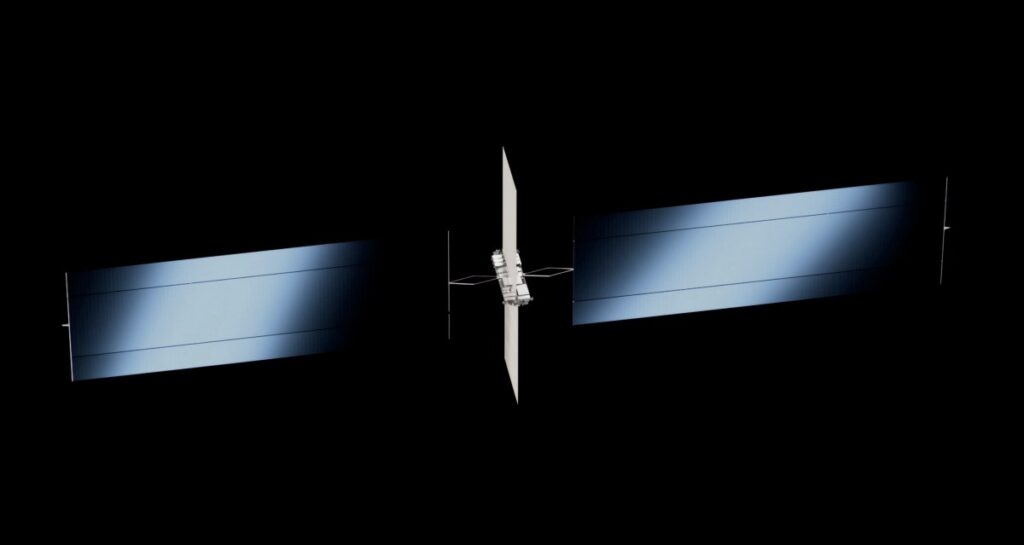
In a recent video interview, Musk outlined why SpaceX is best positioned to deliver on data centers. The core argument is that SpaceX is the only company capable of putting significant mass into orbit cheaply, constructing large arrays of solar panels, and building chips in-house. While industry experts generally see space data centers at scale as a decade away, Musk argued, with caveats, that they are much closer.
“This is not a promise of what we’ll do,” Musk stated in the video. “This is what we are going to try to do, and think we probably can do, which is to get to roughly an annualized rate of a gigawatt per year by the end of next year, in terms of space AI compute.”
Based on an expected maximum power delivery of 150kW per satellite, this translates to a production rate of 6,666 satellites a year, or about 556 a month. This is roughly twice the reported current production rate of Starlink satellites, which stands at just 70 a week. Even if the AI satellites have a simpler architecture, this is a massive ask for a production facility that does not yet exist. The company is also still finalising its solar panel production facility.
This is before addressing Terafab, the company’s long-discussed chip foundry, which Musk sees as feeding into later stages as the company scales toward a terawatt of annual compute production. Chip fabs are among the hardest modern industrial projects, typically costing billions of dollars and taking up to a decade to build.
Then comes the most vital question: What about Starship, the key to SpaceX’s ability to economically launch all those chips into orbit?
A recent test flight went well enough, but it did not suggest that rapid reusability is imminent. SpaceX may end up reusing only the booster initially, which would raise the costs of the space data center roll-out. For now, the company is undergoing a mishap investigation for the FAA to understand why the booster stage failed to achieve a controlled reentry as planned. SpaceX has not responded to questions about when the vehicle will fly again, though it has said it expects to begin launching Starlink satellites with it by the end of this year.
Approach that with a grain of salt: Consider that NASA, which holds a nearly $4 billion contract with SpaceX to use Starship as a Moon lander, still is not ready to commit to a test mission scheduled for late 2027.
Buyer Beware
As public investors acquire SpaceX shares, they will find themselves owning a near-monopoly on access to space in the US and Europe, a world-spanning communications network, and a wager on the most ambitious infrastructure project of the AI era.
These projects depend on SpaceX creating something never seen before: a fully reusable rocket. The company must also build a high-rate production facility for AI satellites in just eighteen months, rather than the decade it took to develop its Starlink manufacturing. Finally, it will need to build a chip foundry in the US, a task even dedicated silicon firms are reluctant to undertake. Musk is right that SpaceX is the only company positioned to build any of this anytime soon, but that speaks to the magnitude of the challenge as much as the likelihood of achieving it.
Musk used to say he would not take SpaceX public until he reached Mars, fearing fickle investors might lose faith along the way. Those plans may have been put on hold, but what he has laid out ahead of the company’s IPO could be just as difficult.
Key takeaways
- Independent valuations by Morningstar and NYU finance professor Aswath Damodaran suggest SpaceX is worth significantly less than the $1.8 trillion assessed by its bankers.
- The company’s AI strategy relies on space data centers to solve the compute vs. model-builder dilemma, aiming for a gigawatt of annual space AI compute by the end of next year.
- Success hinges on three near-impossible engineering feats: a fully reusable Starship rocket, a US-based chip foundry, and a satellite production line capable of launching thousands of units annually.
- Investors are betting on a timeline that is aggressive even for SpaceX, with critical milestones like Starship reusability and chip fabrication still unproven at scale.