The Pentagon prioritises speed over safety in its new AI strategy
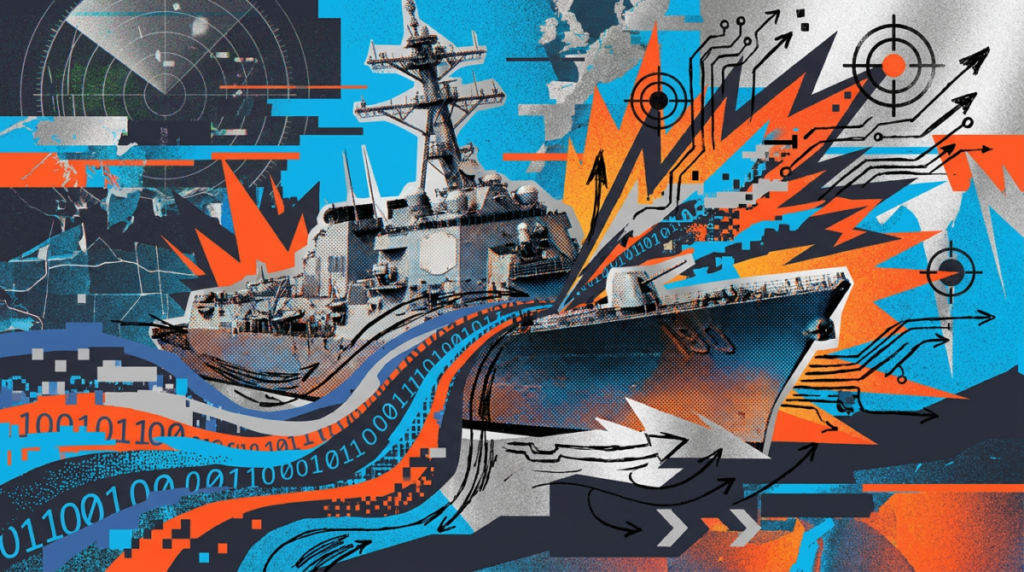
The Department of the Navy has formally approved a plan to turn data and artificial intelligence into immediate battlefield advantages. Acting Secretary of the Navy Hung Cao signed the document, putting it into effect immediately.
The strategy, titled “Strategy to Weaponize Data and Artificial Intelligence,” took more than a year to develop under the department’s Chief Data and Artificial Intelligence Officer. It involves collaboration with AI experts across the Navy and Marine Corps.
Cao stated the document allows the department to “out-learn and out-fight any adversary” through rapid deployment. He described it as a roadmap for an “AI-first” fleet that converts information into military advantage and enables faster, better decision-making.
The force that learns fastest wins
The core of the strategy is the “Bits2Effects Cycle,” a five-stage framework for digital adaptation. It tracks the path from automated collection of military data through transmission, classification, and analysis to its use in real military decisions and actions. Lessons learned feed back into the cycle, allowing continuous updates to systems, tactics, and training.
The key metric is “Mean Time to Effect,” or MTTE. This measures how long it takes from the moment new data is captured until it produces a concrete military response or adaptation. The shorter that window, the faster a force can react and adjust. In a drawn-out conflict with multiple learning cycles, the force that learns and adapts fastest will dominate, according to the strategy paper.
The announcement lays out six goals: speed up operational AI deployment, improve data availability and usability, expand technical infrastructure, streamline approval processes, strengthen data and AI literacy among personnel, and deepen collaboration with industry, academia, government agencies, and allies.
Many of these measures are supposed to be in place by the first quarter of fiscal year 2027, which ends in December 2026. By the end of fiscal year 2029, the number of qualified data engineers, data scientists, and AI and machine learning engineers is supposed to double.
Slow adoption is riskier than imperfect alignment
The strategy calls for running large language models and agentic AI directly on warships and with Marine Corps expeditionary units. These systems need to work even when comms are jammed or cut off. Service members would build their own apps on top of them. An “AI War Council” would prioritise use cases, coordinate resources, and pre-approve wartime changes to data sharing, classification, and deployment rules.
The strategy paper adopts a particularly far-reaching trade-off from the Department of Defense’s broader AI strategy: the risks of moving too slowly outweigh the risks of “imperfect alignment” in these systems. That passage sits within the context of a “Wartime Approach.” The department wants to handle risk assessments and organisational hurdles as if the country were already at war, making decisions that favour speed.
AI is already a battlefield reality for the US military
The Navy’s strategy is part of a broader AI transformation across the US armed forces. GenAI.mil, the central platform where Defense Department personnel and employees can use generative AI, hit 1.5 million daily users in June 2026. That is up from 80,000 when it launched in December 2025. Uses range from routine office tasks to military planning and combat operations.
The Army is testing AI in a “Next Generation Command and Control” system to process large volumes of data faster and help soldiers build situational awareness and make decisions. A Navy AI program reportedly cut a submarine planning task from 160 hours down to ten minutes.
How real these applications already are became clear during the war against Iran. The US military reportedly used Anthropic‘s language model Claude for target analysis and strike planning. The deployment is politically charged.
The Trump administration locked Anthropic out of government systems after the company insisted on restrictions for fully autonomous weapons and mass domestic surveillance. Shortly after, OpenAI struck a deal with the Pentagon to run its models on classified networks. OpenAI cites similar red lines but relies on contractual and technical safeguards rather than hard policy demands. The Navy’s new strategy is likely to push military demand for powerful language models and AI agents even higher.
A global AI arms race
The AI arms race is playing out on a broad scale worldwide. China is pushing military AI adoption at a rapid clip. Researchers at Georgetown University analysed thousands of publicly available procurement requests from the Chinese People’s Liberation Army. The documents show Beijing is testing AI systems for unmanned combat vehicles, cyber defence, ship tracking, target acquisition on land, at sea, and in space, and deepfake-powered disinformation.
NATO is already using AI operationally as well. French Admiral Pierre Vandier, NATO’s top officer for digital transformation, said alliance members are using AI to track Russia’s shadow tanker fleet. Israel spent years deploying AI to sift through the flood of intercepted intelligence data ahead of its war against Iran.
On the US side, the Pentagon is investing heavily in integrating commercial AI and plans to go further by letting AI companies train military-specific model versions on classified data. That would be a qualitative leap. Sensitive intelligence would be baked directly into the models.
Cybersecurity is where the stakes are highest
The pace is picking up fast in cybersecurity. The parallels to nuclear escalation are not just a metaphor anymore. Zhou Hongyi, founder of Chinese cybersecurity firm Qihoo 360, drew the comparison explicitly. He argued that the ability of AI models like Anthropic’s Claude Mythos to autonomously find vulnerabilities and build attack chains amounts to “cyber nuclear weapons of the AI age.”
The urgency behind that rhetoric is grounded in measurable technical progress. The UK’s AI Security Institute revised its estimate for how fast AI cyber capabilities are doubling, adjusting it upward twice in just a few months. The US government now treats these models as strategic assets and initially blocked Anthropic from publicly launching its Fable 5 AI model.
Zhou called Fable 5 a “civilian, neutered version of Mythos,” Anthropic’s most capable cybersecurity model, and suggested the US feared foreign actors would jailbreak the system to reach Mythos-level capabilities. “This is what the US government finds most intolerable. It must ensure that it alone possesses this capability, forming an absolute monopoly over this strategic asset,” Zhou said.
The European Union is stuck on the sidelines, dependent on the goodwill of big US tech companies because comparable European products do not exist.