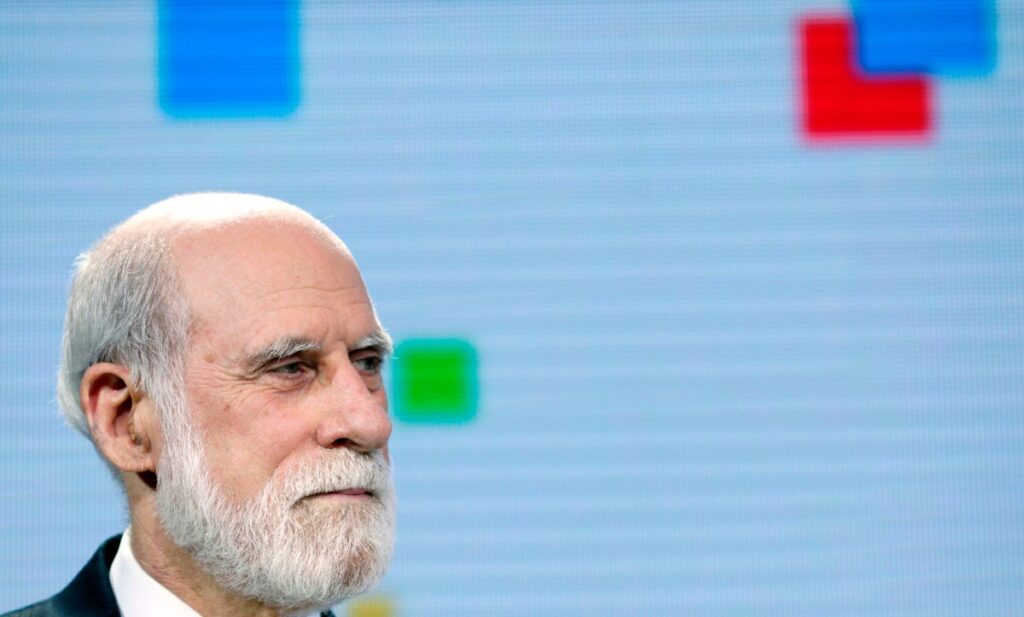
Vinton Cerf is stepping down from his role at Google next week. The 83-year-old engineer, who helped design the protocols that power the internet, ends his tenure as chief internet evangelist after more than 20 years.
The farewell
At the Open Frontier conference hosted by the Laude Institute, Dave Patterson, a professor at UC Berkeley, recognised Cerf. Patterson, known for co-developing RISC processor architecture, spoke on behalf of the room.
“Vint… has been at Google more than 20 years, and he is retiring a week from today, and so I think we ought to give him a round of applause for a relatively good career,” Patterson said. The audience applauded.
Google did not comment on the announcement by publication time.
Cerf and Robert Kahn are credited with architecting the networking protocols that form the modern internet. Their work developing and popularizing TCP/IP, the basic rules allowing different computer networks to communicate, began in the 1970s. They have received numerous honorary degrees, the Presidential Medal of Freedom, and a Turing Award for this work.
Since 2005, Cerf has served as a vice president and chief internet evangelist at Google. It is safe to say the internet is fully evangelized, for good or ill.
Building durable systems
Cerf spoke on a panel with other computer scientists known for durable open source projects. The group included Patterson, François Chollet, creator of the Keras deep-learning library and co-founder of Ndea, John Ousterhout, the Stanford computer scientist behind the Tcl programming language who also co-founded Electric Cloud, and Matei Zaharia, co-founder and chief technologist at Databricks.
They offered advice on building open source systems that survive. This advice is increasingly relevant as founders bet on open infrastructure for the next wave of AI products.
Much of the discussion focused on the problems caused by centralising advanced models in a handful of well-resourced labs. This stands in contrast to the decentralized world of the open internet that made Cerf’s own protocols so durable.
Cerf predicted that the rise of AI agents, software that can act autonomously and coordinate with other software, would push tech companies back towards standardised protocols.
“The agentic model of AI, with multiple agents from multiple sources interacting with each other, is going to force composability, and a requirement for interoperability and standardisation,” Cerf said.
If this prediction holds, the companies that define those interoperability standards early could end up with outsized influence over how the agentic economy actually works. This dynamic resembles the early internet protocol wars.
Why English is not enough
While other panelists speculated that natural language communication between large language model agents would be sufficient, Cerf predicted formal standards would be required.
“I don’t think English is going to be the best choice. There’s a flexibility in it, but there’s ambiguity, and I think precision for interagent interaction is going to be very, very important. An agent really needs to be sure the other agent understands what it is that they just agreed to do together,” Cerf said.
“Remember the old telephone game where you wish you’d whispered in somebody’s ear and then by the time it got to 10 people away the message was totally different? Imagine a bunch of agents talking to each other in natural language, you know, that’s kind of terrifying.”
A memory of suits
In a lighter moment, Patterson recalled meeting Cerf, known for his wardrobe of three-piece suits, as a graduate student in the 1970s.
“He’s always been the best dressed computer scientist I’ve ever met,” Patterson said. “My memory of Vint is that he came as a grad student with a shirt and tie in the 70s.”
“It absolutely is true,” Cerf said. “I even had a vest, and for some reason I always wanted to stick out, and instead of having long hair, and something in my nose, I thought just dressing differently was one way to do it.”