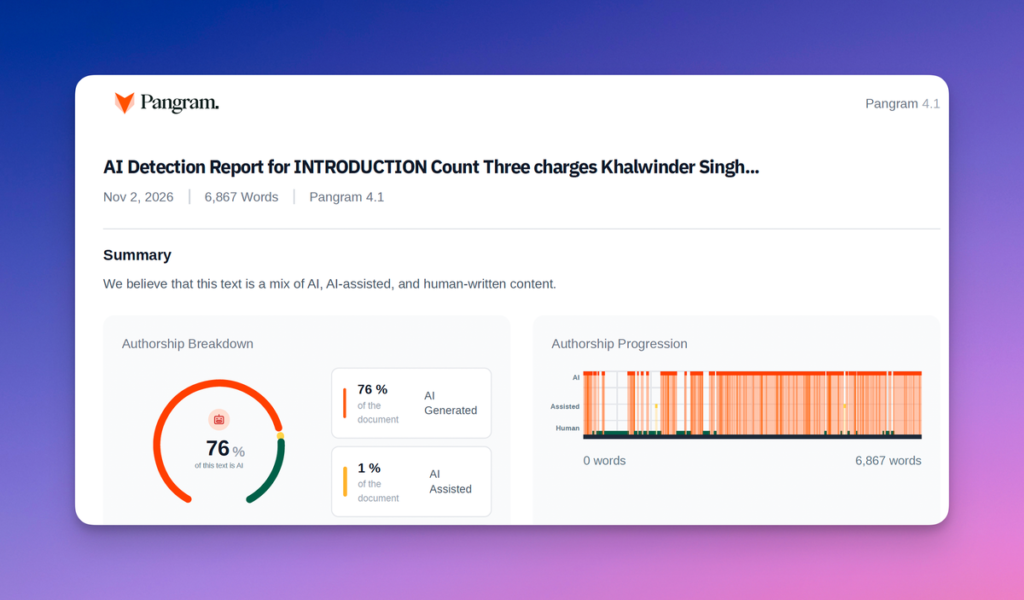
The Department of Justice is using the AI writing detection service Pangram to argue that opposing attorneys are using artificial intelligence to draft legal arguments
Government lawyers told a federal judge that defence counsel in a high-profile voter fraud case were producing “AI slop” and engaging in “defense by ChatGPT”. This claim appeared in filings reviewed by 404 Media. The Department of Justice ran several defence motions through Pangram and submitted the results as exhibits. The tool did not find the briefs to be 100 per cent AI-generated, but prosecutors argued they should not have to respond substantively to documents that were partially machine-drafted.
The case
The defendant is Khalwinder Bhengura, a 70-year-old man from India who entered the United States on an immigrant visa in 2022. He registered to vote in Texas in 2024 after falsely stating he was an American citizen on his driver’s license application. Bhengura was arrested in September on charges of lying about his citizenship, illegal voter registration, and illegal voting in the 2024 election. He was found guilty in October on two of the three counts.
His family and lawyers say the situation was a misunderstanding. Bhengura does not speak English well and did not realise he was committing a crime. He has been in prison for months and is set to be deported. The Trump administration has used his case as an example of voter fraud. Bhengura is now also at the centre of a dispute over how lawyers use generative tools.
The rule and the response
The case is in the Northern District of Texas, a court that recently implemented a rule requiring attorneys to disclose generative AI use in filings. Bhengura’s lawyers wrote that portions of their briefs were prepared with the assistance of a generative artificial intelligence tool. The government attorneys ran the filings through Pangram and filed the output.
The results were mixed. Prosecutors stated they did not feel they should have to respond to briefs that were partially AI-generated. They wrote that they were trying to economise the effort spent responding to what they called meritless motions. They noted that most non-AI text in the filings consisted of third-party statements, evidence, or caselaw quotes. They concluded that virtually nothing of substance seemed to have been drafted by a human on the defence team.
The judge’s reaction
Mark Pittman, the judge presiding over the case, chastised the defence attorneys. He wrote that the court was disturbed by counsel’s repeated filings which subtly bent the law by proffering superficially persuasive but fundamentally meritless arguments so clearly generated by artificial intelligence. He noted that the defendant was not a pro se litigant and had three counsel of record with decades of practice between them. Pittman said it was distressing to see how quickly the advent of artificial intelligence had undermined counsels’ ability to properly advocate for their client.
The lawyers’ explanation
Nicole Knox and Mario Herrera, two of Bhengura’s attorneys, told 404 Media that the story is not so simple. They said they felt they had to use AI because of a health emergency and to meet tight filing deadlines ahead of the election. Herrera said Knox experienced a medical emergency while they were preparing the case with prosecutors at the U.S. Attorney’s Office. He prepared a federal jury trial in four days with the lead attorney in the hospital.
“I represented my client to the best of my abilities within this limited timeframe,” Herrera said. “I utilized all available legal tools and did not violate any rules or laws in doing so.” He added that the government’s evidence consisted of output from Pangram, an AI-detection software. He argued that such software identifies patterns in writing styles based upon a document’s content. It cannot determine who wrote a document, how it was written, or if the law applied within a document is correct.
Herrera said the label “Defense by ChatGPT” was not a factual statement. He noted that the attorneys who wrote the filing were present when Ms Knox collapsed. They knew precisely why he was standing alone with a new co-counsel in that courtroom four days later. There was nothing requiring them to state what they stated.
Pangram CEO Max Spero told 404 Media that he has heard anecdotally that law firms have begun to use his company’s software. He said most use cases he has seen have been from firms using the tool internally to check whether their junior attorneys and paralegals are using AI to draft legal briefs.
What it means
Herrera said the fact that Bhengura was found not guilty on one of the three counts he faced is evidence that Mr Bhengura received the representation he deserved. He stated that lawyers have been using templates, forms, and drafting software for decades. This is merely a newer version of those very tools. The arguments the judge attacked were written by him. Some portions of the filings were written with the aid of AI but then reviewed and edited by him. All final work product was his and he stands behind the argument and logic of each and every document.
Knox added that AI could have never come up with their argument. She said the new AI disclosure rule has made it such that if you obtain one sentence or phrase through the use of A.I., then you must disclose it. She said they have nothing to hide.
Herrera said Mr Bhengura is 70 years old, a lawful permanent resident of this country, speaks Punjabi, and his English is limited. He has been in custody since the verdict. In addition to whatever sentence he receives for the offenses of which he has been found guilty, he faces deportation from this country. He is entitled to more compassion and humanity from everyone involved in this case than he has received so far.
The Department of Justice did not respond to a request for comment.