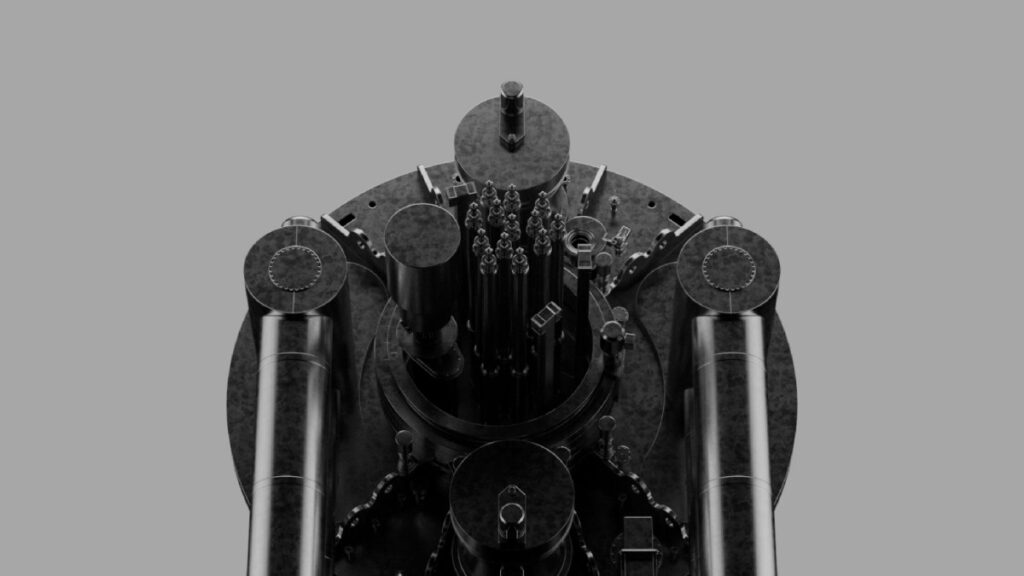
TerraPower will announce its first dedicated data center project this year, aiming to solve the power availability problem that plagues artificial intelligence facilities.
The company did not name the customer. Earlier this year, Meta agreed to purchase eight Natrium plants. The new data center site is expected to start construction in 2027, making it the second facility after the one currently being built in Wyoming.
Standard nuclear reactors struggle to match the erratic power demands of modern computing. TerraPower claims a distinct advantage through its approach to energy storage, a method that relies heavily on wind and solar integration.
Nuclear stations operate most efficiently when running at full output. In the United States, existing reactors maintain a capacity factor of 92.5%, meaning they generate maximum power for that duration of time. This is because current units are slow to adjust output.
According to the National Laboratory of the Rockies, traditional plants can only change their total rated output by about 5% per minute. New small modular reactors can react faster, adjusting roughly 10% of their rated output per minute. However, operating below full capacity reduces profitability for any power plant.
Nuclear energy involves the highest capital expenditures of any generation technology. Startups hope mass manufacturing will lower these costs, but that remains unproven. Even if successful, benefits may take over a decade to materialise. Consequently, early plants must run at peak capacity as often as possible to justify the investment.
Data centers face a specific hurdle here. Their loads fluctuate rapidly when GPUs train models or respond to prompts. These swings are so severe that natural gas turbines have failed under the stress. Utilities typically add large battery banks to smooth the curve, which drives up costs further.
TerraPower designed its 345-megawatt molten salt-cooled reactor to address these issues. A primary goal was ensuring the plant could complement intermittent sources like wind and solar by ramping up and down quickly. While the design originally focused on renewable grids rather than data centers, the two face similar intermittency problems on opposite sides of the equation.
The solution does not involve changing the reactor’s power output directly. The facility continues splitting atoms constantly. Instead, excess heat stores in a large tank of molten sodium. When demand spikes, the plant taps this reservoir to create more steam and spin the turbines.
This method keeps the expensive equipment working even during low demand periods, allowing the company to spread its investment over more operational hours.
The strategy combines the high capacity factor of nuclear power with storage technology that fits a renewable-heavy grid or connects directly to a data center. It offers a flexible approach that could provide an advantage in the race to power artificial intelligence.
What it means
For data centre operators, this design removes the need for massive external battery banks to handle rapid load changes. It also means nuclear power can act as a direct, responsive backup rather than a baseline power source that must be paired with other storage solutions.