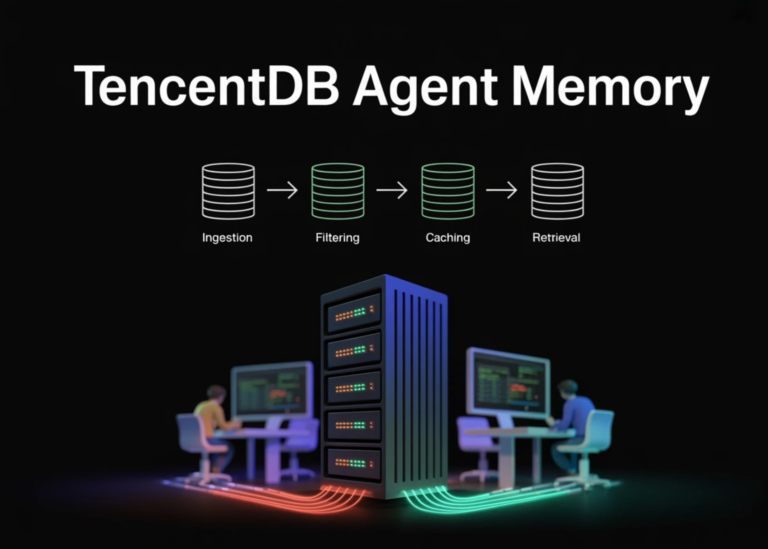
Tencent Cloud has released TencentDB Agent Memory v2.0, an open-source system for managing shared context across multiple AI coding agents. The software, published on August 3, 2026, allows a team to access the knowledge an individual agent has gathered without exposing private data. This release moves beyond single-agent recall by introducing a governance layer that controls who reads what.
Deployment and target audience
The project operates under an MIT licence and runs on self-hosted infrastructure. Users can deploy it via Docker Hub using a single command. Builds support both linux/amd64 and linux/arm64 architectures.
Current testing suggests the tool fits best with solo developers and small engineering teams. Mid-sized organisations with dedicated platform functions can adopt it as shared infrastructure. Large, regulated enterprises should treat it as a pilot project rather than a standard, as the private-repo CodeGraph feature and automated memory routing require further refinement.
Industries likely to benefit include software development, SaaS, fintech, consulting, and agencies. Any regulated team needing memory retention within a private network is a potential user.
Practical applications include onboarding new agents to existing codebases, performing impact analysis before refactoring, generating release checklists, creating incident runbooks, and converting product documentation into agent-readable pages.
The four memory assets
The system transforms work into four distinct asset types. Each registers uniformly as a Memory Asset, ensuring consistent handling of ownership, versioning, status, and visibility.
- Chat Memory stores preferences, facts, decisions, and interaction history.
- Skill distils reusable procedures from completed tasks. It carries version data, resource files, trigger boundaries, execution steps, and validation rules.
- Wiki converts documents into structured pages linked by a knowledge graph. This approach draws from the concept of an LLM-maintained knowledge base.
- CodeGraph indexes symbols, files, call relationships, and impact paths.
Layered distillation and budgeted retrieval
Chat Memory is not a flat list. Conversations save as L0, then an asynchronous pipeline refines them into L1 Atom, L2 Scenario, and L3 Core/Persona.
Retrieval follows a similar hierarchy. L2 and L3 provide a fast context bootstrap. When specific facts are required, the system combines BM25, vector retrieval, and RRF before falling back to L1 and L0. Results are capped by item count, character budget, and timeout to prevent the memory from crowding out the context window.
Governance controls
Standard RAG systems answer what information exists. This Hub also determines who may use it, which version is valid, and which agent receives it. Visibility levels include private, team, and restricted, alongside agent-specific targeting.
The private setting is owner-only and not readable even by team admins. New Chat Memory and Skills default to private, making sharing an explicit action.
The Memory Hub uses fixed binding plus Access Control Lists. It narrows access first by team, user, agent, and visibility before attempting to retrieve data.
Integration and wiring
The Memory Proxy supports both Anthropic and OpenAI protocols. It exposes endpoints for Claude Code and standard chat completions.
During the first turn, sessionInit uses Claude Code’s AskUserQuestion tool to select the team, agent, and task. Every subsequent turn injects the agent’s L2/L3 memory, matched skills, and knowledge into the system prompt before forwarding the request upstream.
Default ports are 8420 for the Memory Core, 8125 for the panel, 8424 for the knowledge service, and 8096 for the proxy. Official SDKs are available for TypeScript and Python. Supported integrations include OpenClaw, Hermes, Claude Code, CodeBuddy, and direct SDK use.
The 2.0.0 release introduces Skill forced archiving, scheduled CodeGraph repository sync, system-admin asset management, English/Chinese panel switching, and a Cost Guard that assigns cheaper models to specific agents.
Reported results
The project reports PersonaMem accuracy rising from 48% to 76%, a 59% relative improvement. This figure is self-reported, and no independent reproduction has been published.
What it means
This release shifts the focus from individual agent memory to team-wide context management. Developers can now build a shared knowledge base where skills and code graphs are versioned and accessible to authorised agents. The strict governance model ensures that private repository data remains secure while allowing broader teams to leverage the same context.