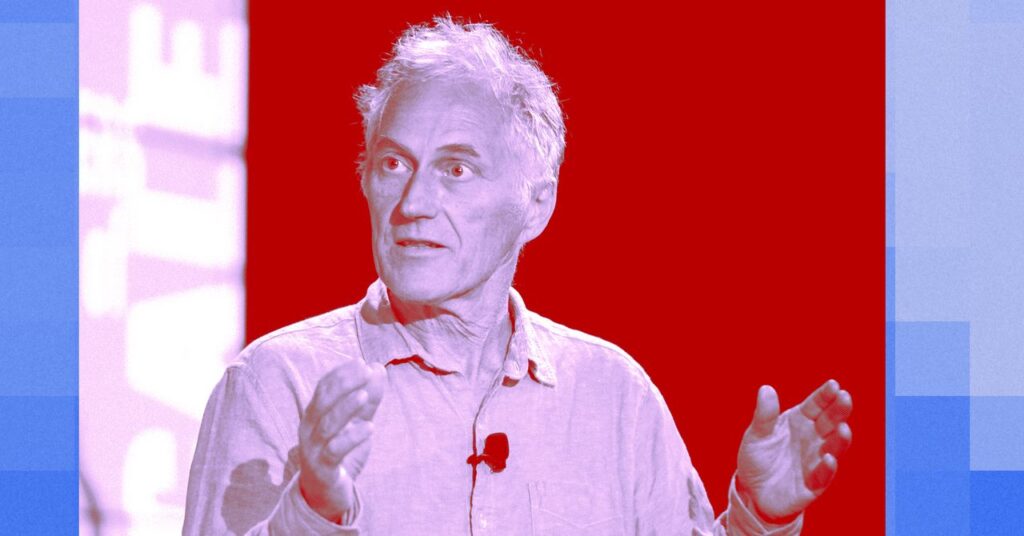
Tim O’Reilly argues that the major AI labs are failing to deliver what people actually want because they are prioritising control over participation. He warns that the current strategy of building ever-larger models creates a closed system similar to Microsoft in the 1990s, where users are locked into proprietary products rather than empowered to build their own.
The architecture of control versus freedom
Most discussions about open-source AI focus on open-weight models. O’Reilly insists this definition is too narrow. He points to the 1990s when the industry focused on licenses while he argued for the architecture of the system itself. The core question is whether the design enables participation. He believes the biggest labs have told themselves a narrative where having the largest model is the only path forward. Models like Claude are optimised for specific tasks but often miss the use cases ordinary users actually need. O’Reilly wants to embed his own special sauce into the technology. The most important requirement is a clean separation between the model, the harness, and the application. Currently, that separation does not exist. The labs have built an architecture of control rather than an architecture of freedom and participation, which allows them to track users.
Why big companies fight open source
O’Reilly acknowledges that giving up control is against the interests of big companies. However, he argues that this does not mean they are making the right strategic decision. For a long time, the latest models were better at everything. Now they are better at some things and worse at others. People are reporting that newer frontier models from companies like Anthropic and OpenAI are worse writers than lower-level models. The breakthroughs in so-called frontier AI are pushing the industry further away from what ordinary people need. O’Reilly suggests the US could win the race for frontier AI while China wins by widely diffusing lower-level models through society. The goal is to give people the ability to innovate freely and paint outside the lines.
Security risks and the frontier model
Concerns exist that open-source software creates security risks because bad actors could bypass the guardrails of frontier models. O’Reilly counters that all cybersecurity incidents seen so far come from frontier models. Risks like cybersecurity and the ability to develop pathogens are arguments for slowing down frontier models more than for restricting open-weight models.
A future without dominance
O’Reilly states he does not predict the future but notes the world is proceeding as he hoped. He asks what happens if big frontier models end up like mainframes or supercomputers aimed at really hard problems rather than the things that get diffused throughout society. People are building tools like Pi, an open-source agentic harness. One project at his nonprofit, the AI Disclosures Project, is developing an open-memory consortium. Mark Zuckerberg’s thesis is that he will lock users in because Meta will provide the AI that knows them best. The open-source vision must say no to this. Open source gives users the ability to switch models, switch providers, and maintain all the context they need.
Capitalism in Silicon Valley
O’Reilly notes that Silicon Valley has become anti-capitalist. They use the language of markets but the model changed around 2010 with Uber and Lyft. Funded by venture capitalists, these companies spent billions subsidising rides. The venture capitalists picked the winner rather than the market. That became the template. All the capital piles on and chokes out other possible paths. In AI, money is funneling into a few companies but none seem to have a lock. O’Reilly calls it a failed model. The real action is open source. Just like in the early 1990s when everyone thought it was a battle for who ruled the PC, the web came out of left field while nobody was paying attention. He believes the real AI future will be a ferment of innovation not funded by venture capital, in the same way the web was not funded by VCs.
What it means for creators
One potential disruption might be O’Reilly’s own company, built on books and writing. The book business has been in decline for 25 years. At its peak, the business generated around $70 million but now makes $30 million. As books generated less revenue, the company had to find a way to compensate people for sharing their knowledge, which is the fundamental business. Now AI comes along and hovers everything up. O’Reilly asks if they can build a set of tools that help people manage this. Being able to invoke the knowledge of experts is a superpower and they have to figure out what that looks like now.
O’Reilly recently wrote in the Economist about how Elon Musk and other tech leaders have so much power in their companies that their desires determine strategy rather than the marketplace. He argues this is a legacy thing that is going to fade. His ability to have a thought partner in AI when writing is very powerful. He uses the technology for brainstorming and functional writing. When he interviews someone for an hour, he asks the AI to turn the notes into something usable. He does not have the time to write up all those interviews himself.
He is not worried that AI will eventually supplant human writing. He views AI as a medium, in the same way written words, paint, or music are a medium. When he talks to an AI or designs art with it, he gets something different out of it than anyone else does, in the same way Michelangelo and Van Gogh got completely different things out of paint. The idea that you cannot write with AI will seem as curious as the idea that you cannot make a good portrait or landscape with a camera. There will be people who are masters at expressing their ideas by summoning words from LLMs. People used to ride horses. Now few do. We are in the early days.