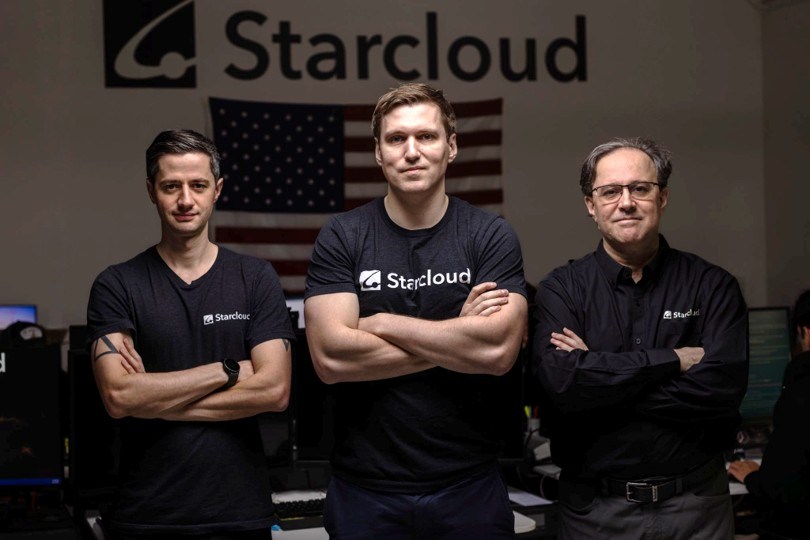
Starcloud has added $250 million to its existing $170 million Series A funding round, valuing the company at $2.3 billion. The startup builds satellites capable of running AI inference in orbit.
Funding and facilities
The new capital allows the firm to expand its manufacturing site in Woodinville, Washington, and accelerate development of the Starcloud-3 spacecraft. That vehicle is designed to launch on SpaceX’s Starship rocket.
CEO Philip Johnston is securing funds to guarantee launch capacity as the market tightens. “We can see what’s coming—we’re going to need to book an enormous amount of launch,” he told TechCrunch. Starcloud has already filed with the FCC to operate 88,000 spacecraft.
“As soon as we can, we want to get under contract with things like Starship,” Johnston said. “One of the biggest costs is now on securing your launch capacity….launch is pretty constrained right now because [SpaceX’s] Falcon 9 program is scheduled to end in 2028.”
Launch expenses have long been a primary hurdle for orbital data center startups. One competitor has already chosen to build its own rockets. SpaceX is now phasing out its Falcon 9 workhorse and moving toward Starship, while Blue Origin’s New Glenn, ULA’s Vulcan, and Rocket Lab’s Neutron are not yet flying regularly. Planning for satellite operators has become more difficult.
For now, Starcloud plans to launch two Starcloud-2 satellites in 2027. These 8 kW compute units will perform orbital inference for clients such as US government agencies. The firm is considering purchasing a dedicated Falcon 9 launch and signing contracts with other providers to support future missions.
Dependence on Starship
Starcloud’s strategy relies on Starship to reduce launch costs enough to compete with terrestrial data centers. Johnston remains confident that SpaceX can demonstrate rapid reuse of the world’s most powerful rocket.
This week, Elon Musk announced a delay to catching a returning Starship vehicle. The company plans its first re-flight attempt by the end of the year or early 2027.
“Obviously if we can’t book any SpaceX launch capacity in 2029, that will be that will be challenging for us,” Johnston said.
Investors and hardware
The funding extension was led by Manhattan West Ventures, with Nvidia and Cisco participating. A person familiar with the deal said Nvidia contributed $25 million. Other investors include Benchmark, EQT, Soma, NFX, 776, Cedar Capital, Goanna Capital, and Standard Capital.
Johnston cites the Nvidia investment as proof of Starcloud’s lead in space compute. The company is the only known operator of a Nvidia H100 GPU in orbit and the first to train a model using one. Most other space GPUs focus on edge processing.
Starcloud shares these learnings with Nvidia as it develops the Vera Rubin Space-1 chip, a purpose-built GPU for space. The chip has not yet been built, but Starcloud aims to fly it in late 2028.
Engineers are tracking design choices such as chip running temperature versus radiator size, radiation shielding placement, and the ruggedization needed to survive launch. The company currently employs 25 staff members and is building production lines at its 100,000 square foot Woodinville facility.
What it means
The investment signals that operators must lock in launch capacity years ahead, especially as Falcon 9 availability ends. Starcloud’s approach hinges on Starship’s success and Nvidia’s willingness to invest in space-specific hardware before it exists. For users of orbital inference, the timeline remains tied to SpaceX’s launch schedule and the maturity of the Vera Rubin chip.