Data centre developers face a ceiling of $4 trillion in spending by the end of the decade, yet political and power-grid constraints already limit where they can build. While most firms treat fibre speed as a fixed variable, Relativity Networks is betting that faster fibre could alter the geographical math behind data centre expansion.
On Tuesday, Relativity Networks announced $22 million in SAFE note funding from Rhapsody Venture Partners, Bell Ventures Inc., Faster Than Glass LLC, and others. A SAFE note converts into a specific number of shares once the company raises its first priced round. The firm also secured a $40 million follow-on order from a leading hyperscaler that declined to be named.
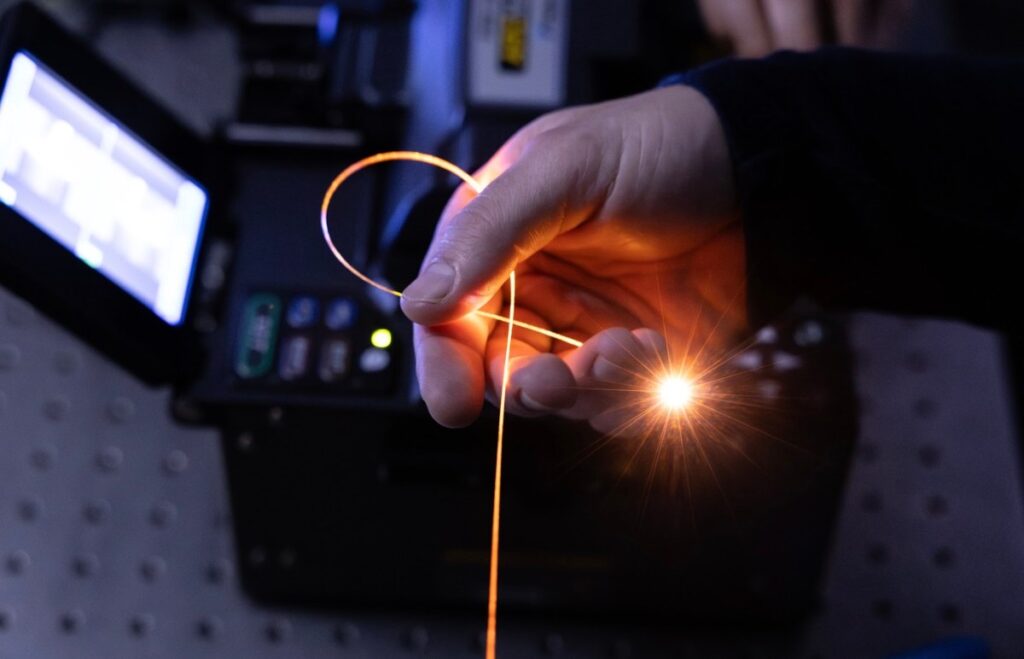
Relativity Networks deals in hollow-core fibre, a rarely deployed technology that allows data to be transmitted 30% faster than conventional fibre. Where traditional fibre transmits light through glass, hollow-core fibre transmits the same light through a vacuum chamber in the centre of the line, bringing it far closer to the theoretical limit of light speed.
The difference is a matter of microseconds. CEO Jason Eisenholz estimates that a signal takes roughly five microseconds to travel one kilometre in conventional fibre. By switching to hollow-core, that figure can be reduced to only 3.5 microseconds.
When AI compute occurred across a single rack of GPUs, the fibre latency was easy to ignore. As scale has grown, so has the physical distance between GPUs. It is now common for a data centre campus to sprawl across hundreds of acres and dozens of buildings. Eisenholz sees a particular opportunity for multi-campus deployments, in which pre-existing data centres are knit together to operate as a single unit.
“The largest systems are distributing the compute across multiple campuses to reach the power that exists,” he tells TechCrunch. “They’re moving to where the warm shell is, but they still need to operate as one synchronized machine.”
The result is a way to partially alleviate the harsh spatial logic that has restrained many ongoing data centre buildouts. In latency terms, reducing time by 30% is giving developers an opportunity to span 30% larger distances before latency becomes a problem. As compute projects scale ever larger, Eisenholz thinks it could be a major shift for the industry.
“The first era of AI optimized for compute,” he said. “It was GPU, GPU, GPU. The second era optimized the networking inside the data center to take advantage of that compute. The third era that we see coming is optimizing the geography.”
What it means
For engineers and operators, the change is practical rather than theoretical. Faster fibre reduces the penalty of distance, allowing new campuses to be placed further from power sources without sacrificing performance. This gives teams more freedom to site facilities where the grid allows, rather than where the current fibre infrastructure permits.