Slime Dot, a Las Vegas R&B artist with over 100,000 monthly listeners on Spotify, has over 100,000 monthly listeners on Spotify. In an interview with GQ in May, after sharing an image of herself posing with Drake on Instagram, Slime Dot directly denied accusations that she was an “AI artist,” saying “The truth doesn’t matter these days. People are always gonna try to explain something they don’t fully understand and believe what they want.” GQ originally credulously published the interview and said it was “debunking the AI rumors.” Eventually, GQ added a note to the end of the article conceding Slime Dot was an AI avatar, but said the “talent behind the music remains undeniable.”
The gap in the system
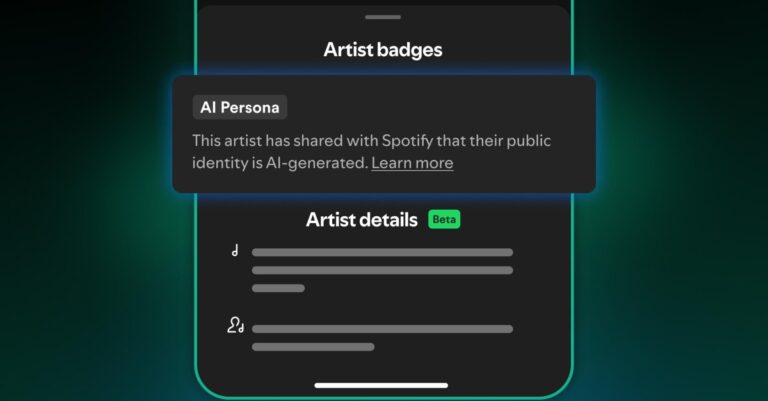
This confusion could have been avoided if Spotify had done what many of its users and critics have been begging it to do since AI music generators like Suno and Udio made it trivial to flood the internet with AI music. Spotify could flag Slime Dot and other AI-generated music on its platform as such. Other platforms, like YouTube, already do this.
Since Spotify doesn’t do that, users can visit SoullessMusic.com, a database for “AI artists hiding on Spotify. No bands, no studios, no soul, just machines and melody.” There, Slime Dot is listed as “almost certainly AI” based on an analysis of three of the tracks and the fact that Slime Dot released such a large number of tracks in a short period of time. Alternatively, users could go to SlopTracker, where they can upload files or copy/paste links to Spotify tracks to run them through a tool which will tell them, with varying degrees of confidence, whether a song was AI-generated or not. SlopTracker found that Slime Dot’s track “Fully” was 95 percent likely to be AI generated by Suno.
Artists losing out
“I didn’t know what’s AI and what’s not,” Graeme Fulton, who created SoullessMusic, told me. “And then I’m on Instagram Reels and I see loads of artists unhappy saying some artist has popped up with their song and just copied it. And there’s loads of different cases where they [AI artists] would copy an artist’s look and appearance […] sort of just stealing from artists.”
Last year, I wrote a story about an exceptionally bad example of what Fulton is talking about. A scammer used Spotify to publish AI-generated music under the name of a real, dead musician, seemingly in an attempt to syphon money from his popularity via streams. After I published that story I heard from several (living) artists who said the same thing happened to them. A similar case involving a Danish jazz musician was covered by Danish publications in April.
Another reader recently told me about a popular Spotify artist that was publishing hours of Iranian jazz every week. The channel, Qajar Jazz, which popped up in December of last year, has 29,579 monthly listeners, gained more popularity after the start of the U.S. war with Iran and the channel making vague allusions to resilience and preserving culture in video descriptions and comments on YouTube. Unlike Spotify, Qajar Jazz videos on YouTube are labeled as being AI-generated in the fine print, though it’s unclear if the channel tagged itself as such or if YouTube did. Both SoullessMusic and SlopTracker detect it as being AI generated.
Qajar Jazz did not respond to a request for comment.
Many of the YouTube comments on Qajar Jazz videos indicate that people think the music is made by real people. In addition to creating a database of AI generated music on Spotify, SoullessMusic also collects social media posts from people who say they were similarly tricked by AI generated music. Some posts are from musicians who lament the fact that they are now competing with algorithms that can produce thousands of tracks with no effort, and others are from artists whose music was directly ripped off by AI artists.