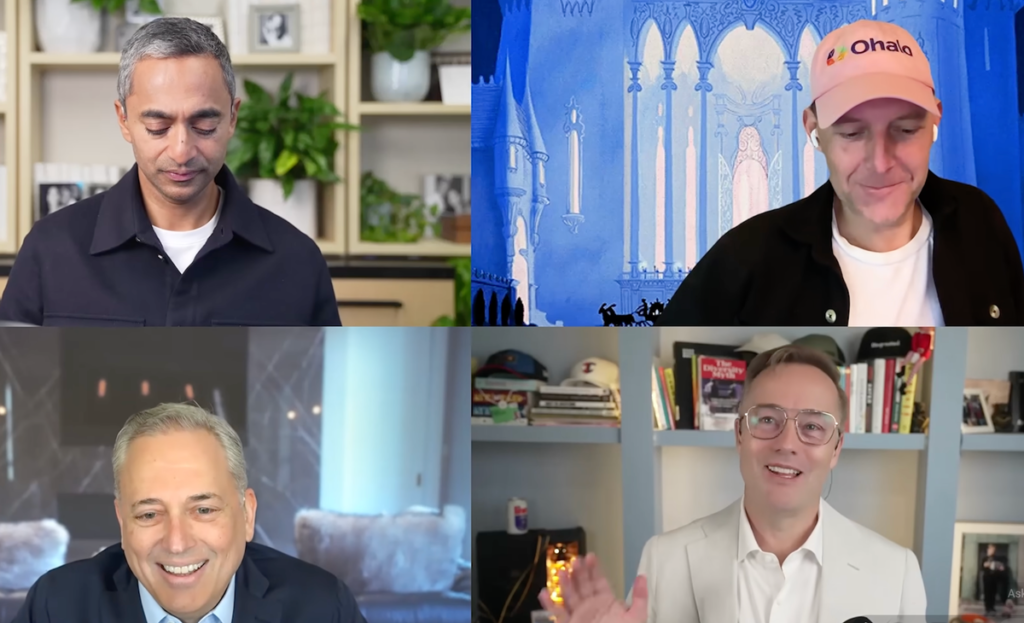
Four billionaire podcast hosts have released a four-hour livestream and follow-up episode attempting to explain why regular Americans are angry about the election results.
The hosts are David Sacks, Chamath Palihapitiya, Jason Calacanis, and David Friedberg. They appear to grasp that the public is furious at “oligarchs” but fail to recognise that they are the ones being accused. They describe populist anger as a “perception” problem rather than a reality. The group spends the segment wondering if they are out of touch, or if the public is simply wrong.
The media landscape
David Sacks, a billionaire known for leading anti-diversity initiatives and writing long-form tweets, stated on the episode that they have lost a significant portion of their audience.
“We lost all the podcast bros,” Sacks said. “We lost a huge part of our base. The Republicans in particular are dependent on the podcast circuit. Let’s call it alternative media. Why? Because the mainstream media hates us. Legacy media hates us.”
Jason Calacanis responded by noting that the audience is now 90 per cent left-wing. Calacanis recently moved from California to Texas. Sacks continued to argue that without their specific media circuit, there is no support for their views. He ignored the existence of Fox News, CBS News, and 60 Minutes under Bari Weiss. He also overlooked the Paramount-Skydance merger, Jeff Bezos’s Washington Post, and the concept of Elon Musk’s X. He did not mention Democratic scandals being manufactured by the New York Times.
The podcast includes election night coverage featuring Ted Cruz and a Polymarket CEO who explained little about how elections function.
Perception versus reality
Watching right-wing figures realise how unpopular Donald Trump’s policies have become is satisfying. It is particularly notable to see Silicon Valley figures who have not spoken to anyone outside the startup world advance theories on the election and what Trump should do to “save his legacy.”
Calacanis suggested a policy of no taxes on people under a certain revenue threshold. He corrected himself, perhaps realising that most people do not consider their paychecks as revenue because they are not businesses.
Palihapitiya suggested measures to allow the wage-earning class to feel more ownership of the United States economy. Calacanis realised that the bottom half of non-equity holders are angry about the state of the country. Sacks attributed the shift to a narrative around affordability and a perception of a lack of affordability. He stated this has put the public in a very ornery mood.
“It doesn’t matter how good the economy actually is,” Sacks said. “It matters how good people perceive it to be,” adding that “the economy is not that bad. I mean, in fact it’s quite good.”
Data indicates this view is disconnected from the experience of people across the country. More than half of Americans cannot afford an emergency fund or save for the future. Most Americans report having to cut back on their lifestyles to afford living. Housing affordability is at crisis levels.
The oligarchy and AI
Friedberg noted the idea of an oligarchy. He stated that artificial intelligence made it easy to attack with this narrative. He claimed this has not led to people choosing socialism as an ideology or a set of principles. He argued that socialist outcomes arise from policies people believe will solve cost issues.
The hosts pretend the tech oligarchy is not real. Elon Musk, an unelected official, has ransacked the government while his companies collect billions in contracts. People are angry about artificial intelligence because it threatens livelihoods, enables superpower surveillance, has driven up the price of gadgets and computers, is built on stolen content, and has degraded public cognition.
Palihapitiya appeared shocked that trickle-down economics, a widely disproven theory, failed to work. He noted it served to make everyone on the podcast far richer. He believed top-down economics can still work when asset owners build assets and invest in the economy, allowing these benefits to reach everyone else. He stated this is clearly not happening.
He believes some of the anger is a perception problem rather than a real one. He cited a viral video of SpaceX employees pitching a data center to Cochise County, Arizona. The employees explained potential benefits. Palihapitiya said the employees should be proud of how they conducted themselves. He stated they were getting run over. He described this as an emotional issue not tethered to the facts. He called it a totem around the oligarchy and the economic fissure in the United States.
Calacanis suggested the data center discussion was performative. He proposed Trump could work with Democrats to raise the minimum wage to $15. He stated this would counter the narrative that they do not care about the bottom half of society. He noted there are only 10-15 million people earning under $15 an hour, so it is an easy thing to do.
The emotional issue is a well-documented and factual one. Data centers do not deliver on the job growth they promise communities. They are credibly accused of manipulating air pollution permitting processes. They temporarily and permanently damage and disrupt the places where they are located. They are driving a new fossil fuel boom.
Political fears
Friedberg appeared obsessed with the idea of socialism and government spending. He stated the end result of people being mad about the oligarchy is voting in more of these kinds of socialist principles, socialist policies, and socialist politicians.
Sacks has convinced himself that the public must not get what they voted for, which is accountability. He sees the Democrats as a huge danger. He believes Democrats want to create a surveillance and censorship state turbocharged by super intelligence. He stated that is ultimately the end state.
Flock CEO Garrett Langley, who is actively building the super intelligence powered surveillance state, was a recent All-In guest. He spoke at length about how vital his company is to hundreds of communities across the country that do not want it. He received little pushback from the hosts.
What it means
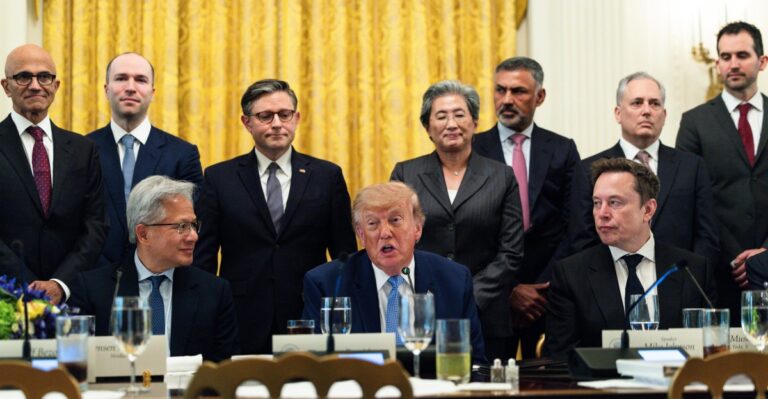
There is not much to analyse other than to point out how out of touch the oligarchs are. They look at the world extremely weirdly and think little about or interact with the average person. They are not to be taken seriously, save for the fact that they have lots of money and have a close relationship with the current administration.
It is hard to hand out gold stars to this lot. However, Palihapitiya came close to actually getting it at one point.
“They are shouting a broad-based belief that the economy has completely decoupled from reality and is broken,” Palihapitiya said. “The economic reality in America is broken. There is a small percentage of people—the four of us on this podcast and our friends—who are the asset owners of America.” He added, “We have benefitted in every weather condition. When rates were zero, we benefitted because we were able to build our businesses with very cheap capital. When rates were high, we benefitted because we had pricing power.”