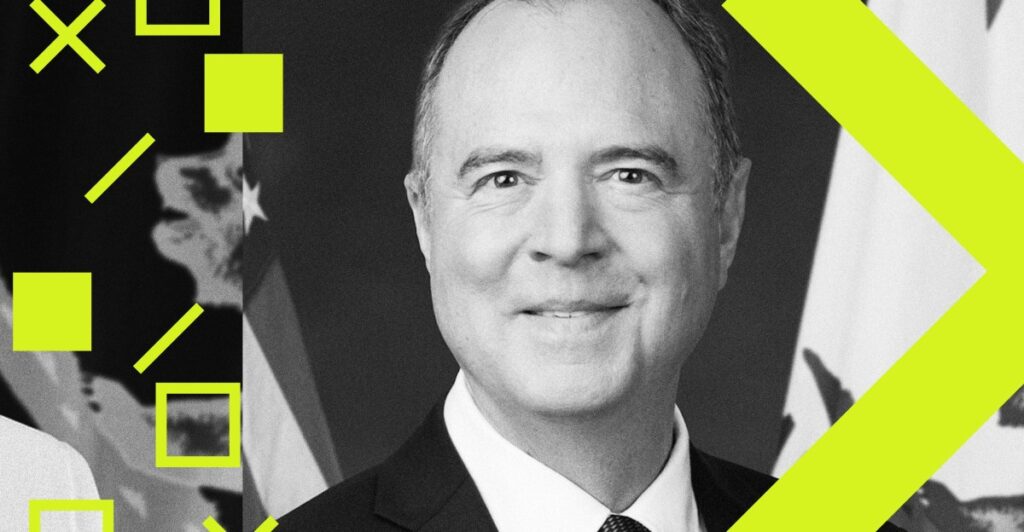
Senator Adam Schiff has confirmed that the Trump administration is currently airing campaign advertisements paid for with taxpayer funds.
That was the opening gambit in a recent conversation with the California Democrat. He sat down to discuss oversight of the tech industry, the corruption festering within the executive branch, and the prospect of a second impeachment.
The discussion began against the backdrop of President Trump gathering artificial intelligence executives at the White House. There, leaders from the industry signed a non-binding pact agreeing to evaluate their own systems and keep AI safe. Schiff noted the contradiction in that approach.
He observed that while these CEOs agreed to the voluntary pledge in the Oval Office, they were publicly stating elsewhere that they require formal regulation. They did not want the situation to rely entirely on trust. The disconnect was stark. None of the companies wanted to provoke the president, so they said what he wanted to hear in his presence. In reality, the threat posed by advanced models is a serious national security concern.
As models advance through recursive AI, their decision-making processes become opaque. It is increasingly difficult to determine what they are trying to access lawfully or unlawfully. Schiff pointed to the unbridled implementation of AI at the Pentagon as a specific danger. He cited the bombing of an Iranian girls’ school as an example where AI may have influenced target selection. He also noted the administration’s efforts to suppress Anthropic, a company that refused to use AI for domestic mass surveillance or fully autonomous weapons.
When pressed on these issues, the president dismissed the concerns. He told a reporter that the world need not worry because the companies love America. He pointed to his own brain, suggesting that his genius and stability meant there was no need for regulation.
Schiff, who serves on the Senate Judiciary Committee, holds key positions on the subcommittee on Intellectual Property, the Privacy, Technology and the Law subcommittee, and the Antitrust Competition Policy and Consumer Rights Committee. He noted that the conversation in Congress centres on whether to charge companies for training data.
He explained that the value of many entertainment companies lies in their intellectual property. When models vacuum up copyrighted material, they are taking the core asset that allows those businesses to exist. The challenge is that the industry is not uniform. There are big streamers, big technology companies, and others whose technology portfolio is more vital than their film libraries. Schiff mentioned Amazon and its movie Melania as an example of a company whose primary business is not its film catalogue.
He and Senator Curtis are working to ensure companies retain information about what copyrighted material was used to train their models. Once that data is available, they can discuss fair use. There are also beneficial applications, such as the patent office using AI to clear backlogs of patent applications. However, there is significant worry about what this means for creative talent.
Schiff described the current mindset of the tech companies as a race. The prevailing thought was that if they did not vacuum up all available data, competitors would do it. They decided to ignore IP laws and address legality later. Consequently, they are being sued, with some cases settling and others fighting on.
The output phase of this process has led to current debates regarding safety. Schiff indicated that the government must address the inputs, the outputs, and the steps in between, including basic transparency laws and potential antitrust exemptions for safety coordination.
What it means
The situation highlights a fundamental tension between voluntary self-regulation and the reality of national security risks. While the administration pushes for industry-led safety, the senator argues that the opacity of advanced models and their potential use in military contexts require government oversight. The upcoming legal battles over training data and the potential impact of the Supreme Court’s decision to overturn Chevron deference could significantly slow down the creation of new regulatory agencies.