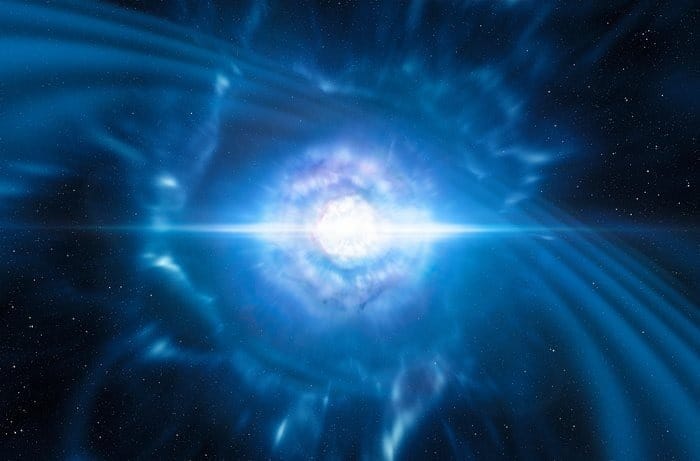
A study published on Wednesday in Science Advances reports the discovery of an invisible object in the system J0008+0128 that challenges current models of stellar evolution.
The anomaly
The object is likely a supermassive neutron star, the collapsed core remaining after a massive star explodes. It was identified by observing its gravitational pull on a companion red giant star.
For decades, astronomers have noted a scarcity of stellar remnants between 2.5 and five times the mass of the Sun. This range is known as the mass gap between neutron stars and black holes.
The object in J0008+0128 could weigh up to 2.8 times the Sun. Its mass places it within this gap. The system also features an unusually wide orbit of 1,218 days. These factors contradict standard theories on how such objects form.
Song Wang, an associate researcher at the National Astronomical Observatories of the Chinese Academy of Sciences, co-authored the study. He told 404 Media that the team uses large spectroscopic surveys to find compact objects.
“We have found more than 10 neutron stars, and J0008+0128 is the most massive one among them,” Wang said.
What the object is
Stars over 25 times the mass of the Sun generally become black holes. Those between 10 and 25 times the solar mass become neutron stars. The Sun itself will end as a white dwarf.
Neutron stars are dense pressure cookers filled with neutrons, protons, and electrons. They are mere miles in diameter. White dwarfs are roughly the size of Earth.
Supermassive neutron stars like this one help scientists study the equation of state. This relationship defines how pressure and density interact inside these objects.
“The equation of state of neutron stars is a long-standing unsolved problem in astrophysics, and neutron star masses can provide crucial observational tests,” Wang said.
He added that massive neutron stars reveal how stiff internal matter is against gravitational collapse.
“The discovery and measurement of supermassive neutron stars can place important constraints on the equation of state of matter at extreme densities,” he said.
Why it is strange
Neutron stars usually gain mass by pulling material from a companion star. This object is too far from its red giant companion for that mechanism to work.
Wang noted that many compact objects found recently cannot be explained by standard binary evolution models or supernova mechanisms. He cited Gaia BH2 and G3425 as other examples.
The team ran thousands of simulations. None reproduced the physical and orbital properties of J0008+0128.
Wang and his colleagues proposed a few alternate scenarios. One is that supernovae can form supermassive neutron stars within the mass gap in rare cases.
Another possibility is that the system once contained three objects. Two of them may have merged to form the current neutron star.
“There may be two massive stars forming an inner binary,” Wang explained. “They can merge at different stages. For example, a neutron star merges with a normal star, or two neutron stars merge.”
He added that if the system formed through single-star evolution, the discovery suggests supernovae can produce massive neutron stars.
The next steps
Studying systems like J0008+0128 helps define the limits for the afterlives of massive stars. It also aids in understanding neutron star mergers, which scientists detect through gravitational waves.
The discovery relied on sophisticated sky surveys, including astrometric data from Europe’s Gaia space telescope.
Wang and his colleagues hope the forthcoming Gaia data release, due next month, will help narrow the possible mass of the unseen object.
“The discovery of J0008+0128, together with other systems discovered in these years, suggests that much work remains to be done on binary evolution and supernova explosion theory,” Wang concluded.