Compressed 4-bit model beats full-precision original on seven benchmarks
A new method called Quantization-Aware Healing (QAH) has produced a 4-bit version of a GPT-OSS 120B model that outperforms the original 16-bit checkpoint on seven out of nine tests. The compressed model uses 60B parameters and runs in MXFP4 precision. It is smaller, cheaper to run, and more accurate than the bfloat16 checkpoint it was derived from. This reverses the standard pattern where a compressed model loses performance compared to its full-precision source.
Why standard recovery methods fail
Most efficiency pipelines follow three steps: compress the architecture, quantize the weights, then fix the damage. The difference between methods lies entirely in that final step.
The dominant approach is quantization-aware training (QAT). It inserts fake-quantization operators into the forward pass and fine-tunes the model on a task loss. This forces the weights to learn how to tolerate low-precision representation. In practice, this means re-running an expensive multi-stage post-training process, including supervised fine-tuning and RLHF, through a noisier forward pass. It is costly. Our results show it can also become unstable if training continues too long past its best point.
An alternative, quantization-aware distillation (QAD), avoids re-running that history. Instead of a task loss, it distills a frozen full-precision teacher directly into the quantized student through a KL-divergence loss on the output logits. This works well when the only change is quantization, because a genuine full-precision version of the exact same model exists to act as teacher. But once a model has gone through structural compression, fewer layers, heads, or neurons, that assumption breaks. There is no independently trained full-precision version of the smaller architecture. The only candidate teacher is the recovered bfloat16 checkpoint, which is itself a distilled approximation of the original model. Distilling from it anchors the quantized student to a degraded target and caps its accuracy at that recovered checkpoint’s own ceiling.
So the question of how to heal a model that has been both structurally compressed and quantized was, until now, genuinely open.
The new approach
QAH removes that ceiling with one change: it distills directly from the original, pre-compression model rather than from the recovered one. Teacher and student do not even share an architecture. The teacher is full-size and full-precision, the student is half the size and running in MXFP4. Because a teacher’s output distribution is architecture-agnostic, nothing about the size or shape mismatch prevents the transfer. The student never sees hard labels, only the teacher’s output distribution, matched through KL divergence on the logits.
This reframes what the quantization stage is doing. Under QAH it is no longer a lossy postprocessing step applied after healing is finished. It is a second, full pass of distillation against the original teacher, supervision that the bfloat16 checkpoint never received. The 4-bit student is not compensating for information lost to quantization; it is picking up information the earlier recovery stage did not have the time or data to transfer.
There is also a stability benefit that falls out of the loss itself. Because KL distillation ties the student to a fixed teacher distribution, once the student catches up there is no further pressure for it to drift. A cross-entropy task loss, by contrast, keeps pushing the student toward hard labels indefinitely. That difference turns out to matter for both accuracy and training stability.
To make QAH work at long context, where the healing corpus includes documents up to 32k tokens, we reuse the memory-efficient chunked KL-divergence loss from our companion paper on efficient distillation. That loss computes the KL one slice of the sequence at a time and never materializes the full vocabulary-by-sequence grid, which is what makes 32k-token healing fit inside a fixed GPU memory budget. We covered the mechanics of that loss in a previous post.
QAH overview. After structural compression and quantization, capabilities drop sharply. QAH distills from the original model, a frozen teacher whose logits are precomputed offline, rather than from the recovered checkpoint. Source: paper Figure 1.
Results
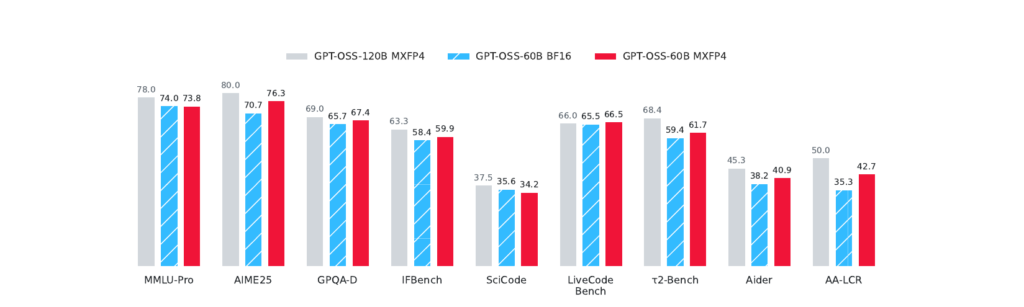
We applied QAH to a GPT-OSS 120B model, compressed to 60B parameters and recovered in bfloat16, then re-quantized to MXFP4 under QAH. The natural comparison is against that same 60B model’s bfloat16 checkpoint, the best full-precision version of this architecture that exists. The QAH model wins on 7 of the 9 benchmarks.
The two benchmarks where QAH trails, MMLU-Pro and SciCode, lose by less than a point and a half. Everywhere else the 4-bit model is ahead of its own 16-bit source, and the largest gains land on exactly the capabilities compression usually damages most: long-context reasoning (+7.4 on AA-LCR) and math (+5.6 on AIME 2025).
The comparison against the original 120B teacher is just as telling. Despite running at half the teacher’s parameter count and roughly a quarter of its weight memory, the QAH model surpasses the full-size teacher on LiveCodeBench (66.5 vs. 66.0) and comes within 1.6 points on GPQA Diamond (67.4 vs. 69.0). The largest remaining gap against the teacher is on AA-LCR, an extreme long-context benchmark where the capacity lost to compression is intrinsically the hardest to recover.
The 4-bit QAH model matches or beats its bfloat16 source on 7 of 9 benchmarks, and beats the full-size teacher on LiveCodeBench. Source: paper Figure 2.
QAH against QAT, head to head
To isolate the effect of the loss function from everything else, we also compared QAH directly against QAT under matched conditions, quantizing a GPT-OSS 9B model to MXFP4 and tracking average performance across MMLU-Pro, LiveCodeBench, and GPQA Diamond as training progresses.
Both methods reach a similar peak, 54.9 for QAH against 54.6 for QAT, so on best-case accuracy they are effectively tied. The difference is in how they get there and what happens afterwards. QAH reaches its peak in about 100 steps, roughly 7 times faster than QAT’s 700, and then stays within about two points of that peak for the rest of training. QAT collapses sharply once past its peak, shedding nearly 19 points by step 1,200.
The practical consequence is a real deployment risk difference. A QAT checkpoint needs careful early stopping against a held-out signal to avoid shipping a model that has already started to degrade, whereas a sufficiently trained QAH checkpoint can be served safely because it simply does not drift. This is consistent with the mechanism: KL distillation against a frozen teacher gives the student no incentive to move once it matches the teacher, while a cross-entropy objective keeps pushing on hard labels and eventually erodes capabilities the model inherited from the original.
QAH peaks at 54.9 in roughly 100 steps and holds; QAT reaches 54.6 only around step 700, then loses nearly 19 points by step 1,200. Source: paper Figure 3.
What this changes in practice
The accuracy story comes paired with the efficiency story that motivated compression in the first place. At 4-bit precision the QAH model uses roughly 4 times less weight memory than the bfloat16 student, and at half the parameter count of the 120B teacher it roughly halves compute per token, which is what lets it run on substantially smaller hardware. For model families that ship in bfloat16 rather than 4-bit, the combined parameter and